
Brand teardownsSupplements & wellness
One famous face.
$200M in 18 months.
A $1B war chest.
IM8 is David Beckham’s supplement brand — and it went from launch to $200M+ in eighteen months, then raised a billion dollars to pour into acquisition. One sachet, 90 ingredients, and a machine built to scale globally. Here’s the teardown.
Start reading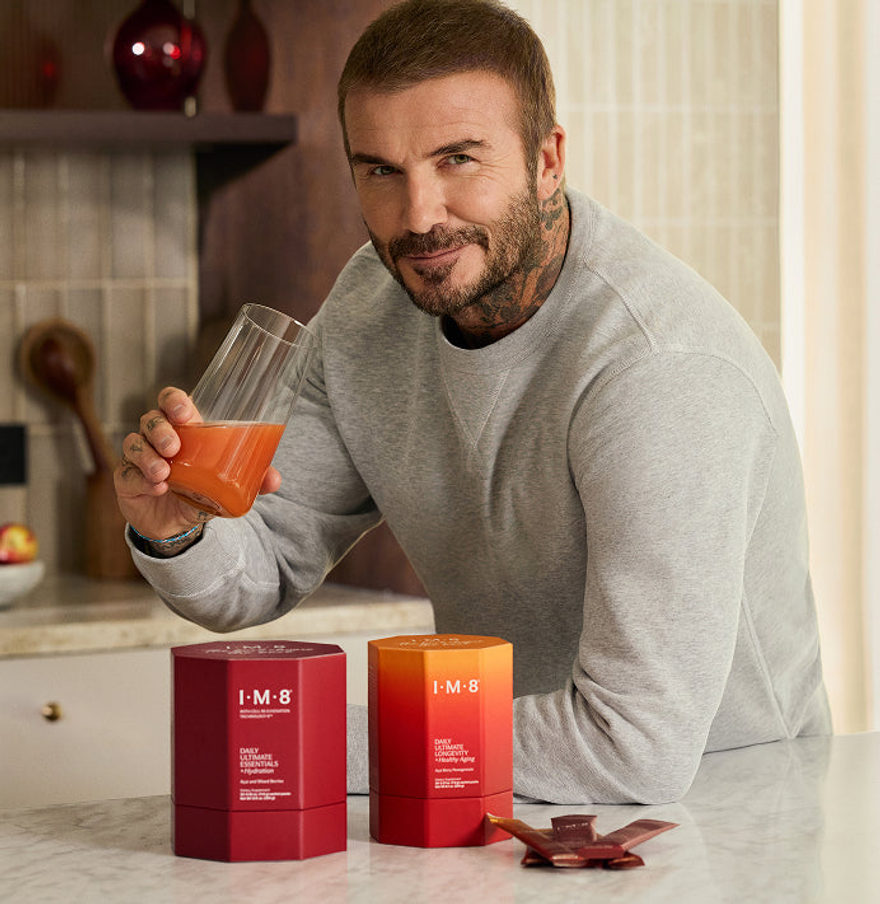
- Revenue in ~18 mo
- $200M+
- General Catalyst raise
- $1B
- /mo, 90-day subscription
- $78
- Countries (AI ads)
- 43
- Reviews · 4.8★
- 22,104
- Launched
- Dec ’24
The idea
A supplement that launched at the end of 2024 has already done north of $200 million and just raised a billion dollars — not to build a product, but to buy customers.
That’s the first thing that should stop you about IM8. This isn’t a slow-burn wellness brand. It’s a celebrity, a science story, and a subscription funnel, strapped to a war chest and an AI ad engine. Here’s exactly how the machine is built.
By the end you’ll have the seven plays behind $200M+ in eighteen months and a $1B growth raise — each with a “steal this” you can run tomorrow.
A celebrity, a science story, and a subscription.
IM8 is the wellness brand of David Beckham — not as a paid face, but as a co-founding partner — built by the NASDAQ-listed health company Prenetics. It launched in December 2024 with a single pitch: one daily sachet, 90 ingredients, replaces your entire supplement stack. Eighteen months later it’s cleared $200M+, guided to $210–220M for 2026, and secured a $1 billion growth raise aimed squarely at scaling customer acquisition.
Strip away the celebrity and the science, and the engine is simple:
“Borrow trust, sell simplicity, subscribe them, then buy the next customer at scale.”The IM8 operating principle
The receipts — revenue on a rocket
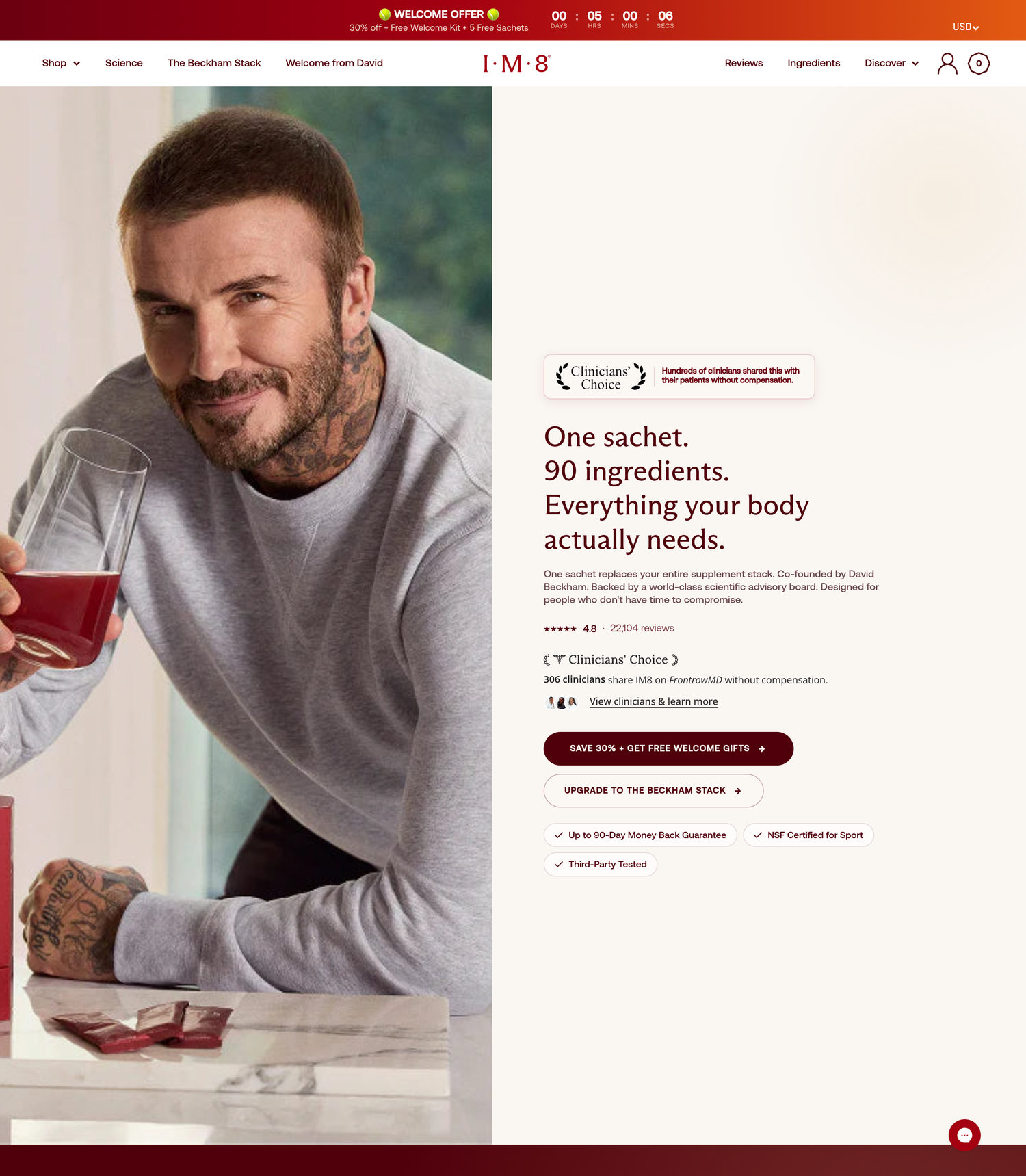
Public filings & guidance · annualized run-rateTheir storefront, captured live.
The plays
Seven moves behind IM8.
Move 01 of 07
The co-founder is the product, not the poster
David Beckham didn’t lend his face to IM8 — he co-founded it. That distinction is the whole trust play. It’s “the Beckham Formula,” “the Beckham Stack,” “Welcome from David.” A global sports icon vouching as an owner reads completely differently than an endorsement, and it hands a brand-new supplement instant, borrowed credibility on a planetary scale.
Move 02 of 07
Stack authority until the price feels obvious
IM8 doesn’t argue it’s worth $78 a month — it surrounds you with proof until the number stops mattering: “Mayo Clinic & NASA,” “clinically proven,” NSF Certified for Sport, third-party tested, 22,104 reviews, 53M+ servings, and “306 clinicians share it without compensation.” Each badge is small; together they manufacture the feeling that skipping it would be irresponsible.
Move 03 of 07
Sell subtraction — replace the whole shelf
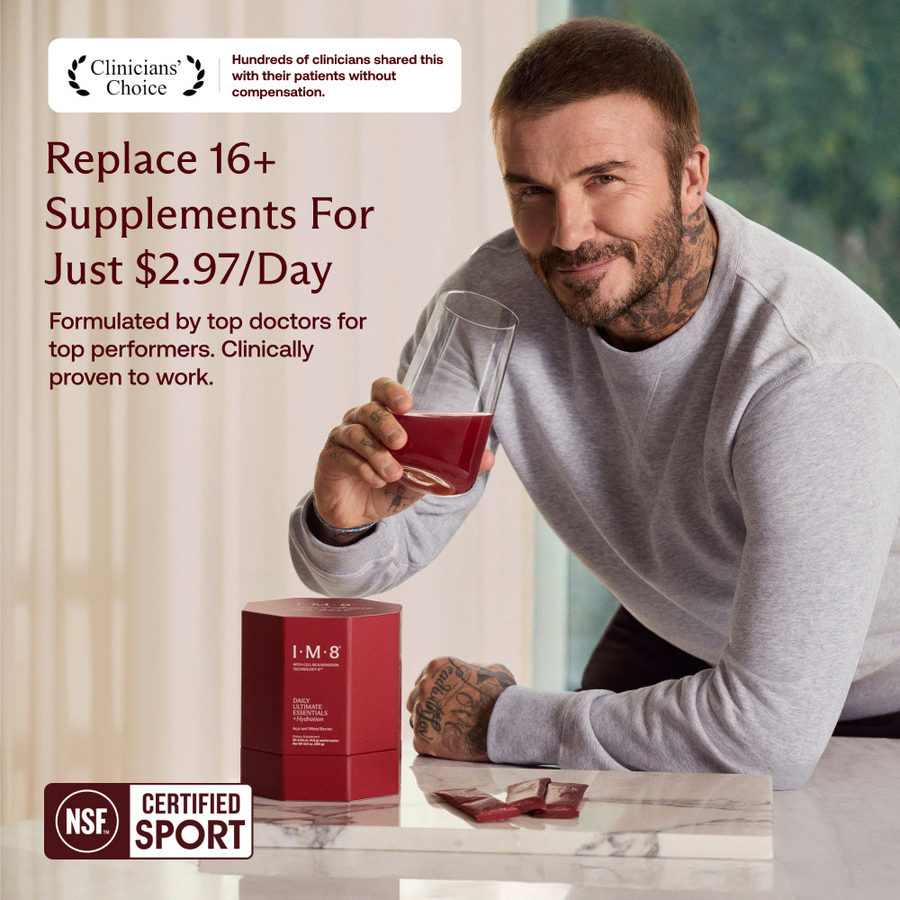
Most supplements ask you to add one more thing. IM8 sells the opposite: “One sachet replaces 16+ supplements for $2.61 a day.” They price against the cluttered, expensive shelf you already own — not against a greens powder. Framed that way, $78/mo isn’t a new cost, it’s a consolidation and a saving. Simplicity is the feature; the price comparison is the close.
Move 04 of 07
Subscription-first, buried under value
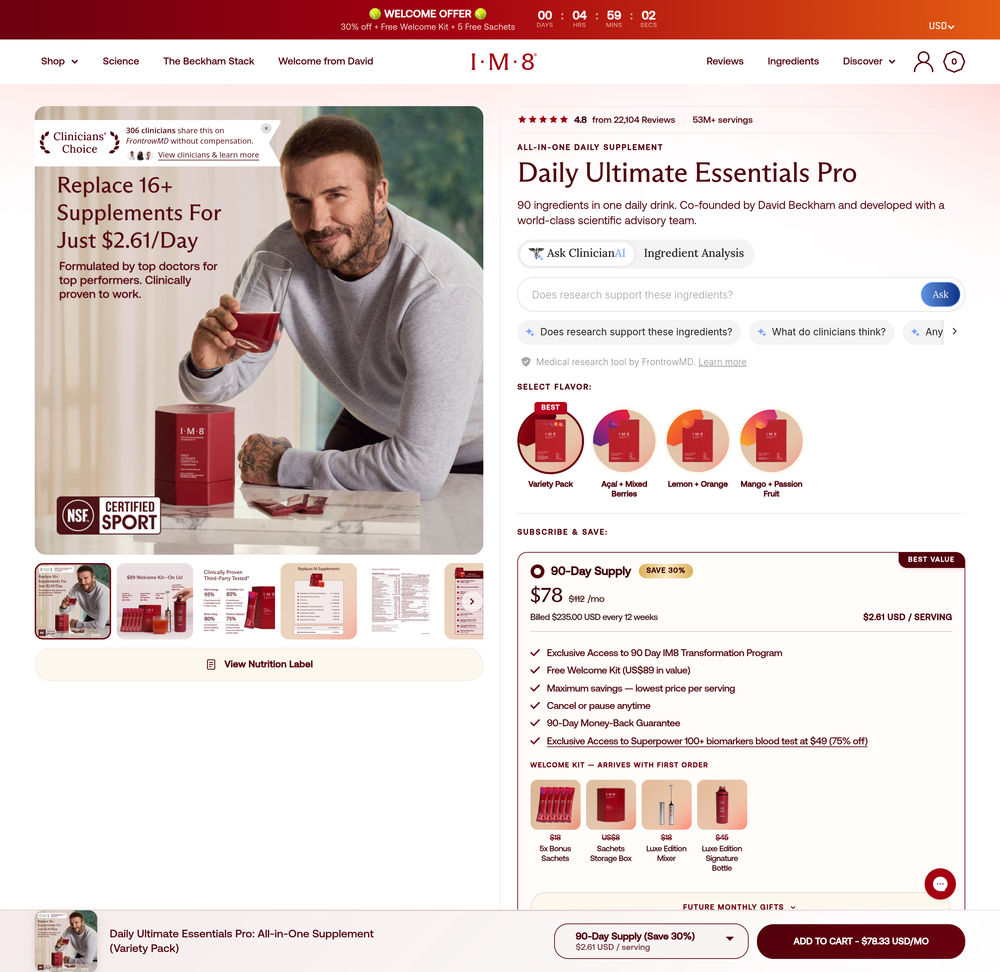
The default isn’t a jar — it’s a 90-day subscription at $78/mo (30% off), and the offer buries every objection under a stack: a free $89 welcome kit, a luxe mixer and bottle, a “transformation program,” a discounted biomarker blood test, a 90-day money-back guarantee. You’re not deciding whether to buy a powder; you’re deciding whether to join a program. That’s how a consumable becomes recurring, compounding revenue.
Move 05 of 07
Ride the longevity wave with a proprietary mechanism
IM8 didn’t just enter the greens category — it planted a flag in longevity, the biggest story in wellness. Its second product, Daily Ultimate Longevity, is marketed as the “first supplement to target all 12 hallmarks of aging” via a proprietary “5-Complex System.” A named, ownable mechanism turns a commodity (powdered nutrients) into a category of one.
Move 06 of 07
Run creative like software — AI ads at global scale
Here’s the modern part. IM8 runs an AI-native ad engine that continuously creates, tests, and rotates thousands of ads simultaneously across 43 countries. It’s Arrae’s “treat creative like inventory” — automated. Instead of a team hand-building winners, a system spins up variations, kills losers, and scales winners around the clock, in dozens of markets at once. Creative volume stops being a headcount problem.
Move 07 of 07
Raise capital as an acquisition weapon
Most brands raise to build. IM8 raised to buy customers. The $1B came from General Catalyst’s Customer Value Fund — capital structured specifically to finance acquisition against future lifetime value. Pair that with a high-AOV subscription and an AI ad engine, and you get a machine that can outspend everyone on the first purchase because it knows what the second, third, and tenth are worth. Capital becomes the moat.
The trade-offs
Big claims and borrowed money are both leverage — and both risk.
Be clear-eyed. “Replace 16 supplements,” “clinically proven,” “targets the 12 hallmarks of aging,” “Mayo Clinic & NASA” — this is exactly the language the FTC and FDA scrutinize on dietary supplements, where structure-function claims must be carefully substantiated and “clinically proven” is a loaded phrase. The “306 clinicians recommend it” mechanic is clever but the kind of thing regulators probe. And the business model leans hard on debt-funded paid acquisition: a $1B war chest only works if the LTV math holds — if CAC rises or retention slips, that leverage cuts the other way. Bold claims and borrowed money both amplify whatever’s underneath them.
The IM8 playbook on one screen.
- Co-founder, not spokesperson. Ownership reads as belief — borrowed trust at scale.
- Stack authority. Certs, clinicians, reviews until the price feels obvious.
- Sell subtraction. “Replaces 16 supplements” beats “another supplement.”
- Subscription-first. Bury the “no” under a welcome-kit value stack.
- Ride longevity. A named, proprietary mechanism turns a commodity into a category.
- AI ads at global scale. Creative as software — thousands of ads, 43 countries.
- Capital as a weapon. Raise against LTV and outspend the category on customer one.
Keep reading.
All teardowns
Ready when you are
Put these playbooks to work.
Bring us the brand you’re building. We’ll show you what the launch, the offer, and the field could look like in Fluid.
Book a demo