
Brand teardownsHome & grooming
A $4,500 video.
A $1 razor.
A $1B exit.
Michael Dubin shot a 90-second deadpan video for $4,500, put a razor subscription behind it, and took 12,000 orders in 48 hours. Four years later he’d beaten Gillette online and sold to Unilever for a billion in cash. Here’s the teardown.
Start reading
- 2016 exit
- $1B
- Subscribers
- 3.2M
- Founded
- 2012
- Starting price
- $1
- Online share, 2015
- 51%
- To 12K orders
- 48h
The idea
Most companies spend millions to find their first customers. Dollar Shave Club spent $4,500.
In March 2012, Michael Dubin — a digital marketer and trained improv comedian — released a 90-second video titled “Our Blades Are F***ing Great,” a deadpan tour of a warehouse that skewered overpriced razors. It took 12,000 orders in 48 hours. Behind the joke was a genuinely smart idea: a subscription that delivered blades for as little as a dollar a month, solving the exact frustration the video named. Four years later Dubin had beaten Gillette online and sold to Unilever for $1 billion in cash.
By the end you’ll have the seven plays behind launching a category-killer with one video and a subscription — each with a “steal this” you can run tomorrow.
They didn’t buy customers. They made one great video.
Michael Dubin met a guy at a party frustrated with a garage full of unsold razor blades. Dubin — who’d worked in digital marketing and moonlighted in improv — saw a business and a bit. He wrote and starred in a 90-second video, shot in a day by an improv friend for $4,500, and put a dead-simple offer behind it: quality razors mailed to you monthly, starting at a dollar. The video went viral; the servers crashed; 12,000 orders landed in two days.
The genius wasn’t just the laugh — it was that the joke and the model were the same argument. Razors were overpriced and annoying to buy; DSC was cheap and automatic. By 2015 it was the Nº 1 online razor brand (51% share to Gillette’s 21%), and in 2016 Unilever bought it for $1 billion with 3.2 million subscribers.
“The video wasn’t the ad. The video was the whole argument.”The Dollar Shave Club operating principle
The receipts — one video, compounded
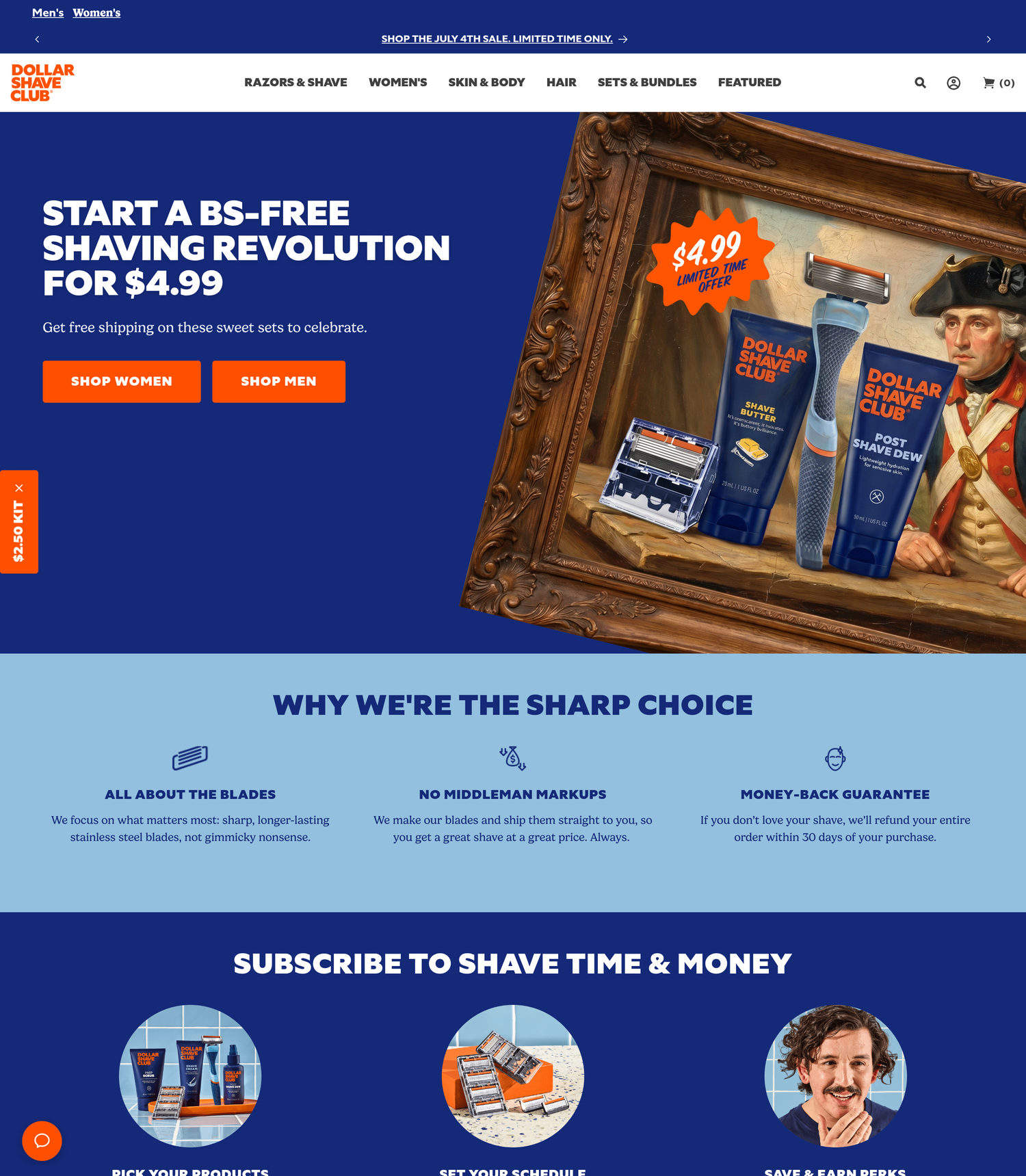
Public reporting · subscribersTheir storefront, captured live.
A decade on, the DNA is unchanged: irreverent humor, a subscription pitch, and a jab at the overpriced incumbent.
The plays
Seven moves behind Dollar Shave Club.
Move 01 of 07
Lead with one unforgettable piece of content
The $4,500 video did what a multi-million-dollar campaign couldn’t, because it was genuinely funny and on-message. One piece of content, engineered to be shared, can launch a whole company.

Move 02 of 07
Sell a subscription, not a product
Razors are consumable and forgettable — the perfect subscription. A dollar a month, delivered, solved the “ran out again” problem and locked in lifetime value from the first order.
Move 03 of 07
Name a real enemy
Locked drugstore cabinets, absurd prices, razors with a pointless fifth blade — the video named consumers’ actual frustrations with Gillette out loud. Righteous, specific frustration is both shareable and positioning.
Move 04 of 07
Make the founder the voice
Dubin’s deadpan improv delivery WAS the brand — a tone no competitor could copy because it was a person, not a style guide. A distinctive founder-voice is cheap and ownable.
Move 05 of 07
Strip the decision to nothing
One choice (which blade), one price, one box on a schedule. Radical simplicity removes friction and scales cleanly. Complexity is the enemy of conversion.
Move 06 of 07
Undercut on price, win on story
$1 razors plus a story about “no middleman markups” — the price advantage was real, and the narrative explained why the incumbent was ripping people off.
Move 07 of 07
Out-execute the giant you disrupt
DSC took 51% of the online razor market, then Unilever bought the disruptor for $1B. Beating the incumbent on a focused beachhead can turn the incumbent into your exit.
The trade-offs
Simplicity built it. Complexity nearly broke it.
Be clear-eyed. Dubin himself later admitted a business built on simplicity got complicated: after the acquisition, Dollar Shave Club sprawled into a broad men’s-care catalog, diluted the razor-sharp focus and voice, and lost momentum as competitors (and Gillette’s own belated DTC response) caught up. A viral video is a launch, not a moat — and every subscription business ultimately lives or dies on churn and the cost of acquiring the next customer once the novelty fades. The lesson: the focus and voice that made the story land are precisely what you have to protect as you scale, not the first things you trade away.
The Dollar Shave Club playbook on one screen.
- One great video. Content, not media spend, can launch a company.
- Sell the subscription. Recurring beats one-time for consumables.
- Name the enemy. The incumbent’s BS is your positioning.
- Founder as voice. Personality is an unownable-by-others moat.
- Radical simplicity. One choice, one price, one box.
- Cheap + story. A price edge plus a reason it’s righteous.
- Beat the giant. Win the beachhead; become the exit.
Keep reading.
All teardowns

Ready when you are
Put these playbooks to work.
Bring us the brand you’re building. We’ll show you what the launch, the offer, and the field could look like in Fluid.
Book a demo