

Britt's Getting Fit with SeedSponsored
Esc
How Seed tied DS-01 to a creator's weight-loss routine
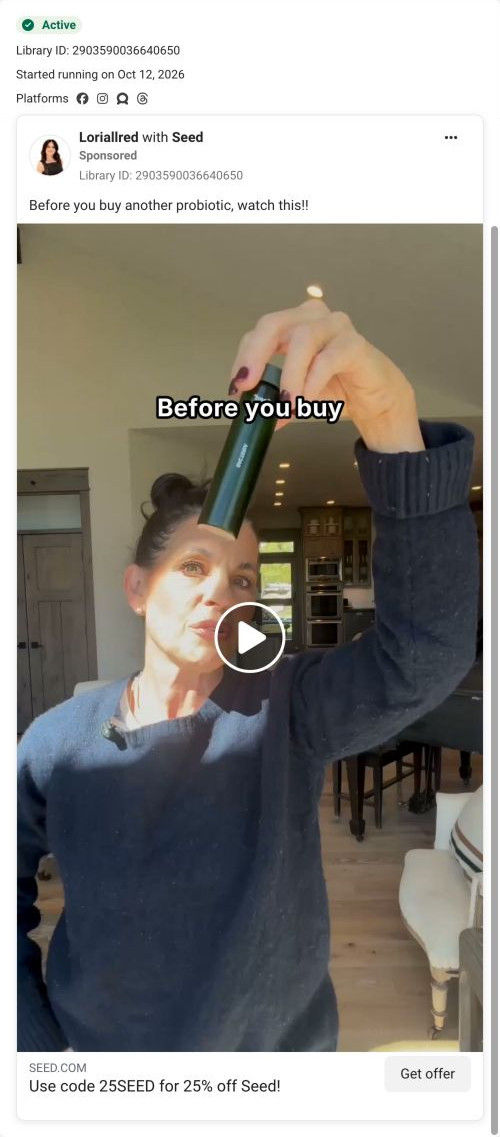
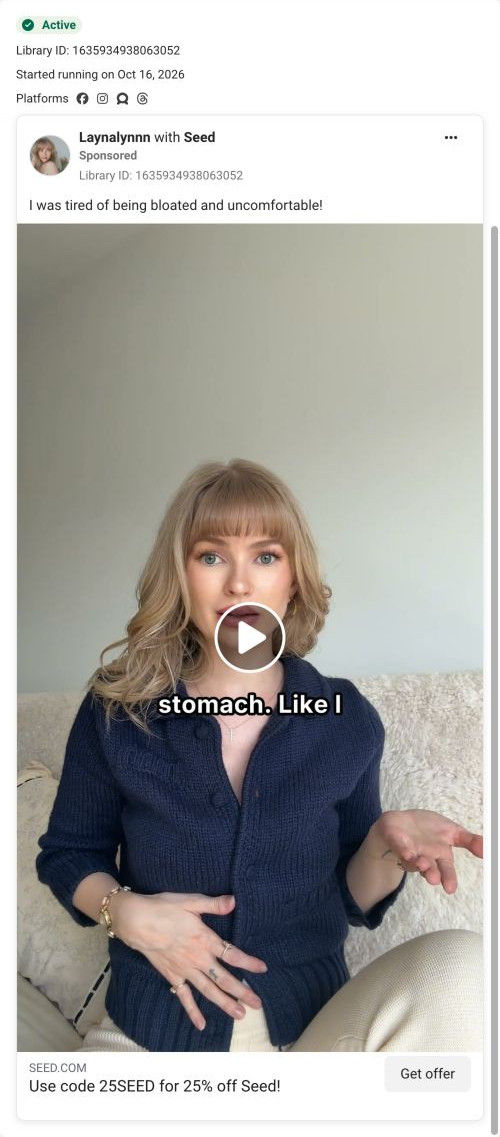
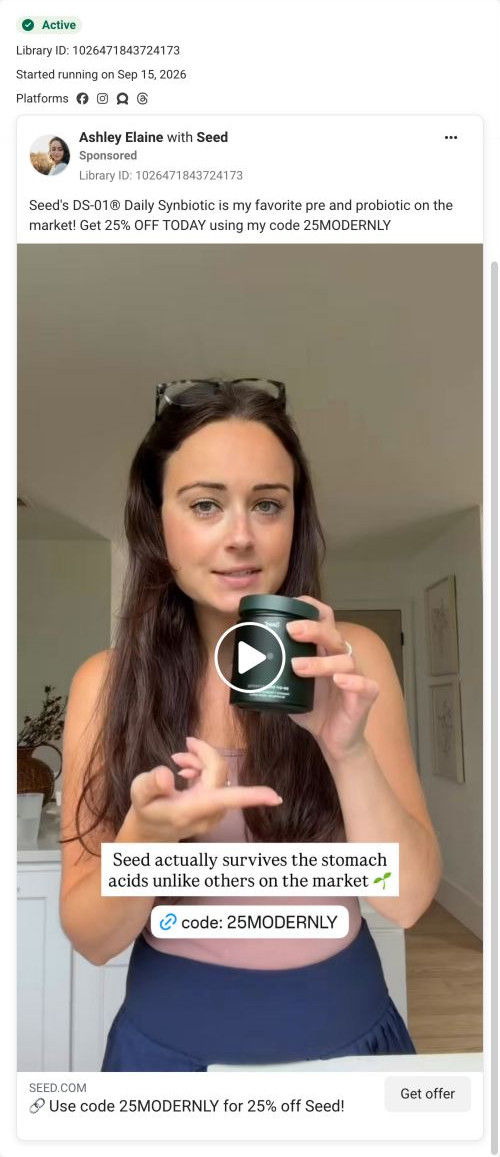
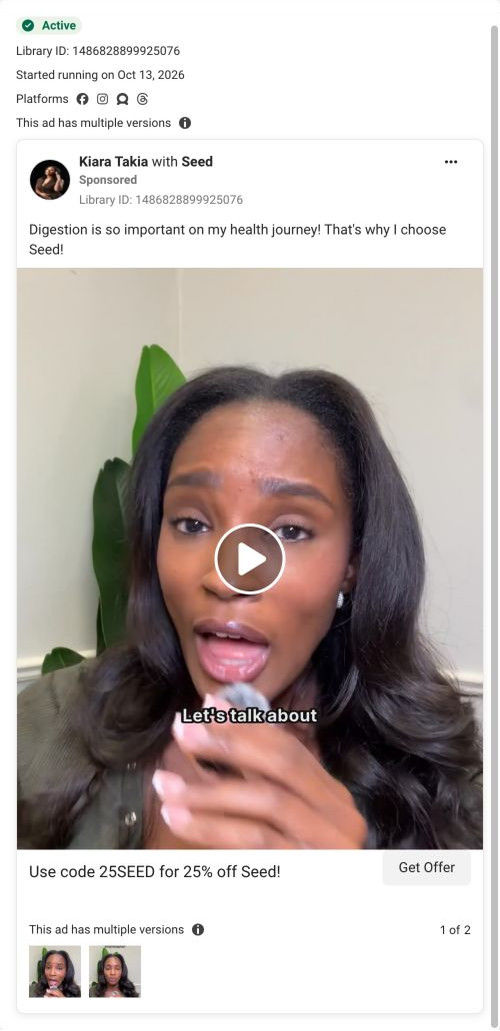
A selfie video, just under a minute, from the creator behind Britt's Getting Fit. She talks about her weight loss and her GLP-1, then says her gut became the next part of her routine. The copy offers 25% off DS-01, and the link opens Seed's DS-01 quiz with the code 25SEED attached.
Seed
43 creatives lead here1 / 43


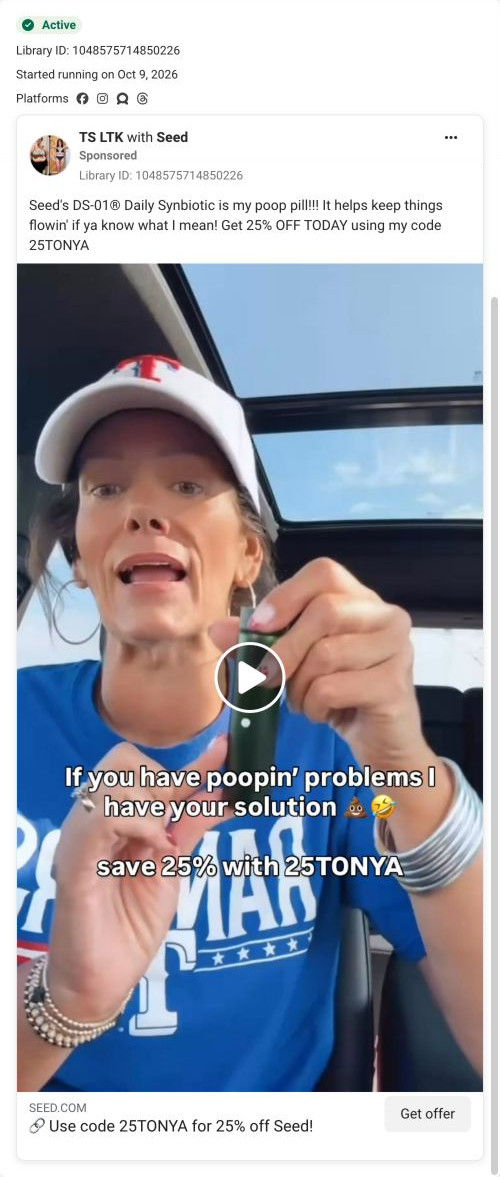


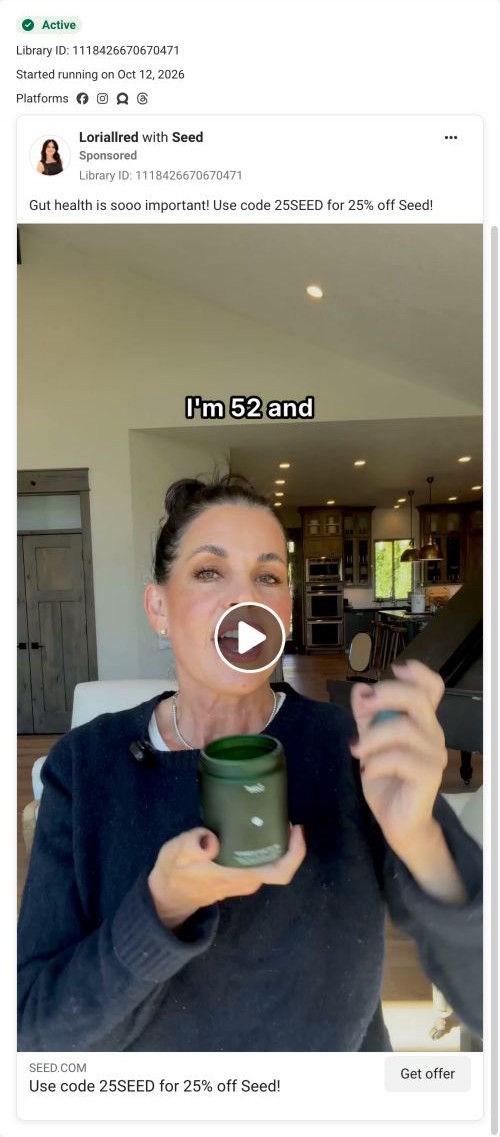
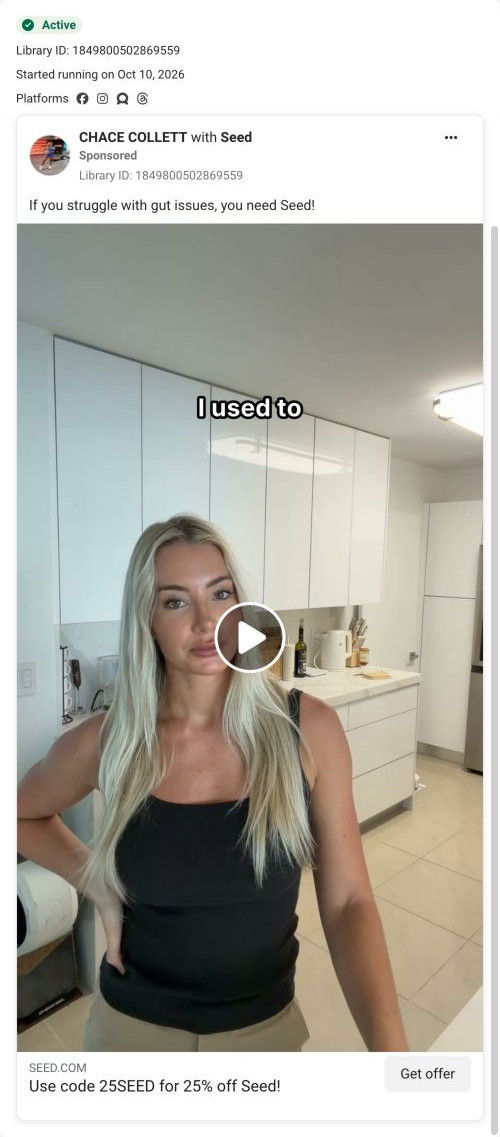


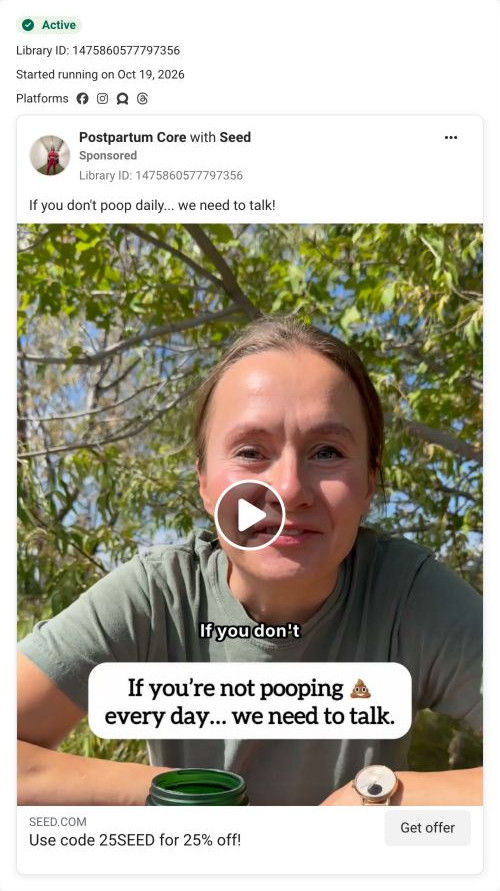





The Seed DS-01 quiz entry
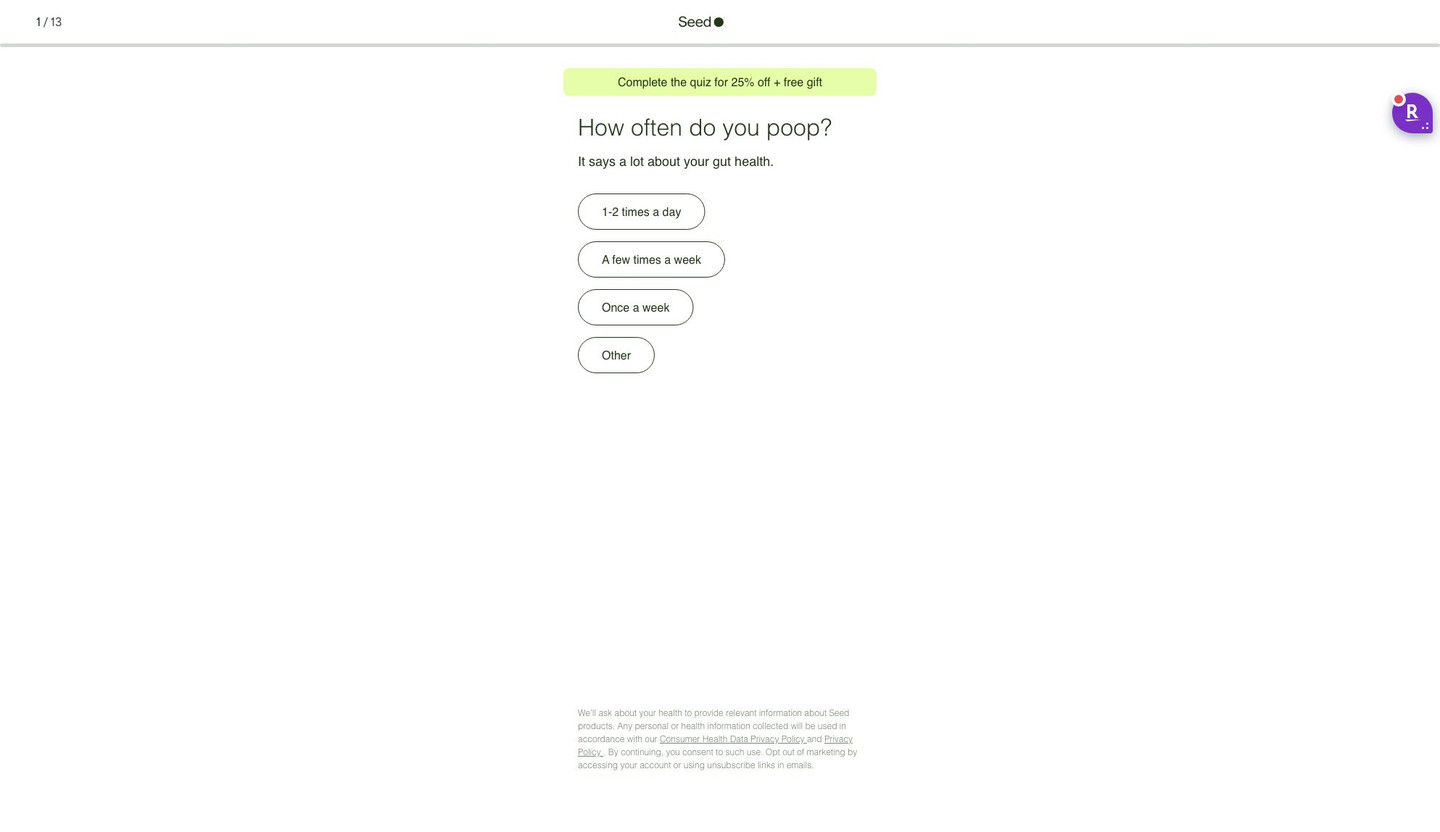
Quiz entry screen only; personal health questions were not answered. A browser shopping-extension badge appears in the upper-right margin of this capture.
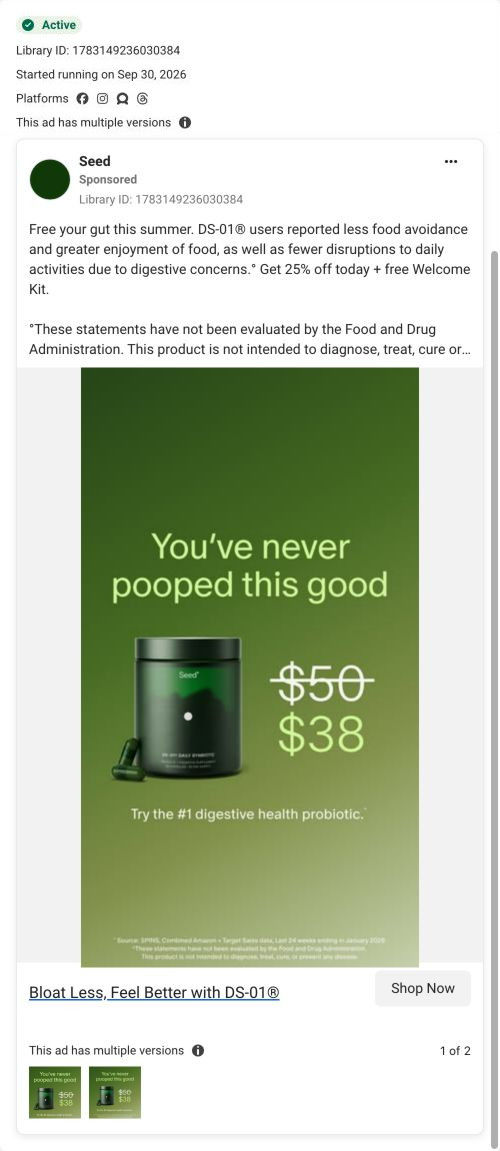
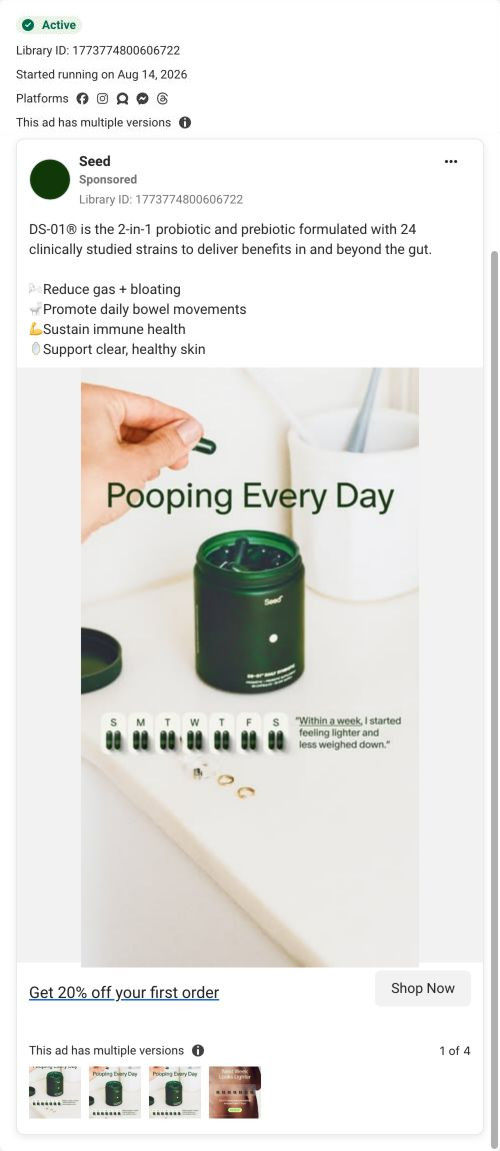
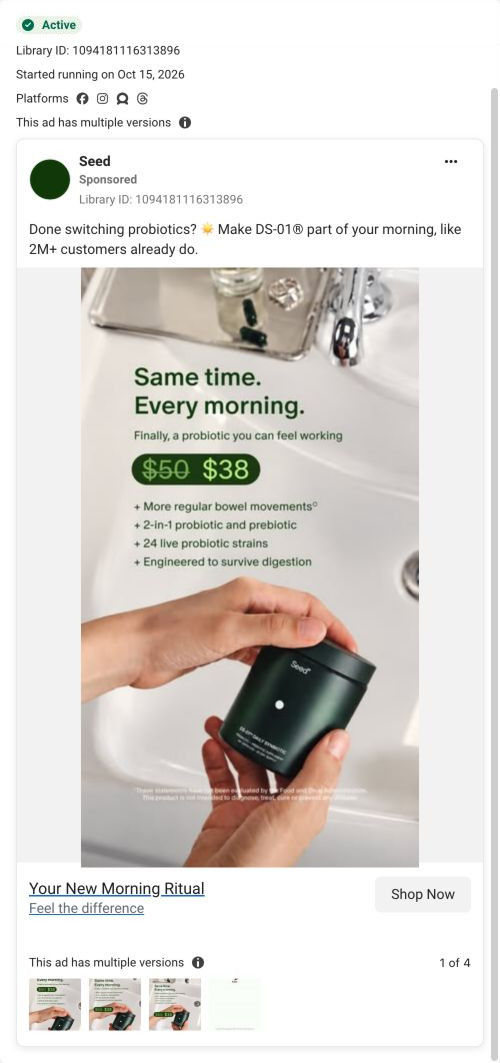
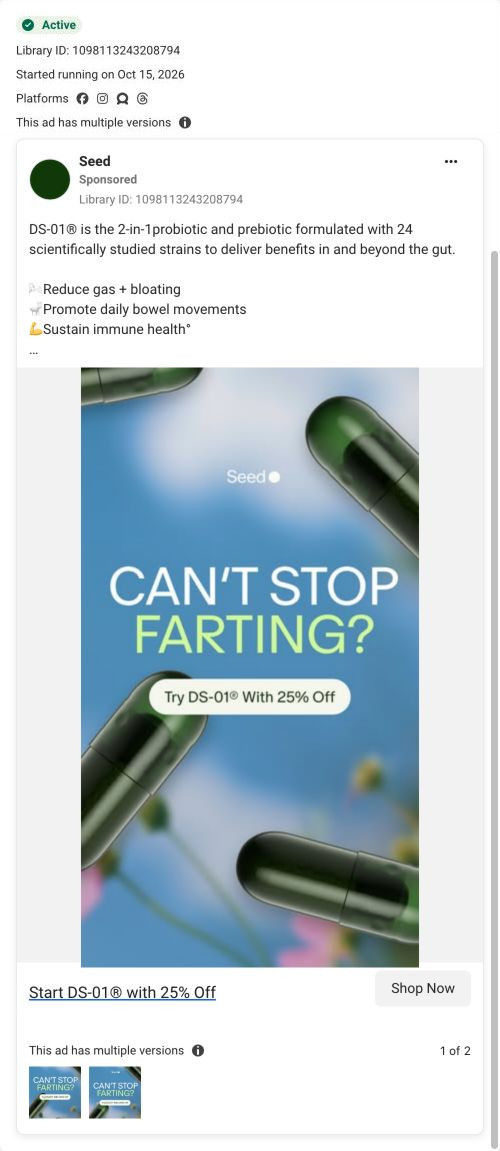
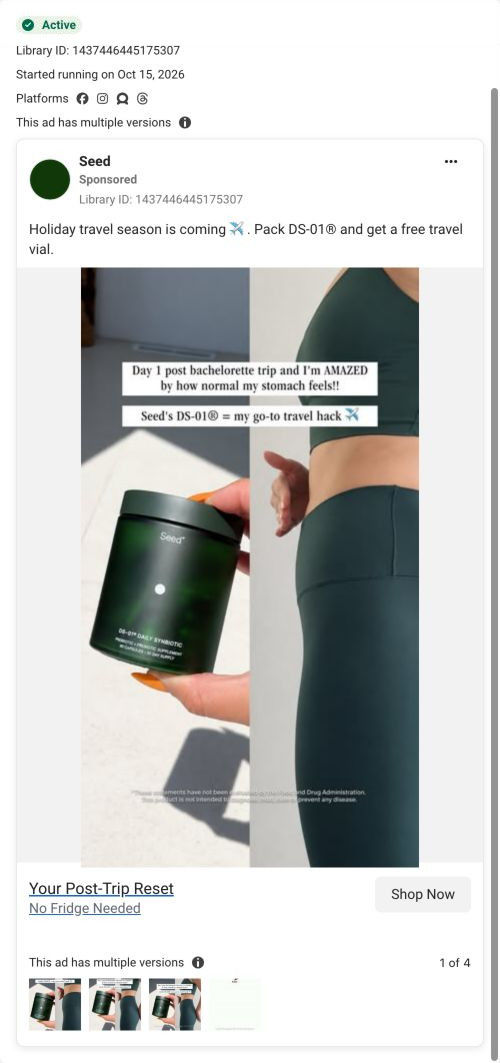
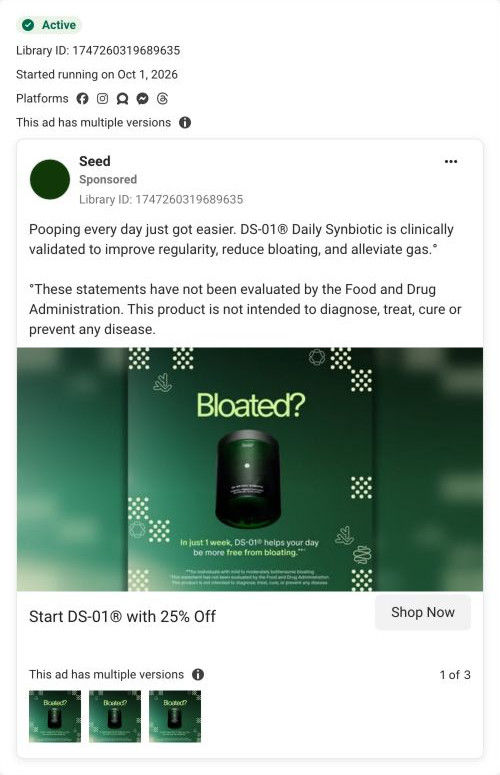
Bloat Less, Feel Better with DS-01®
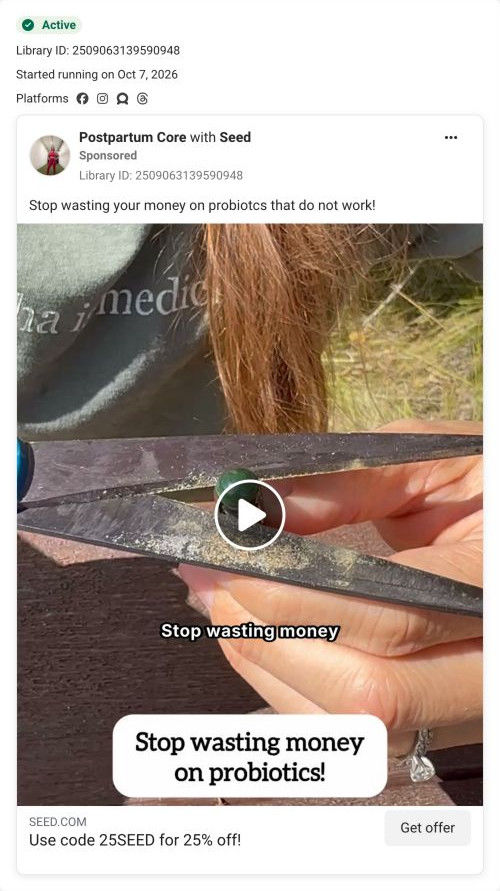
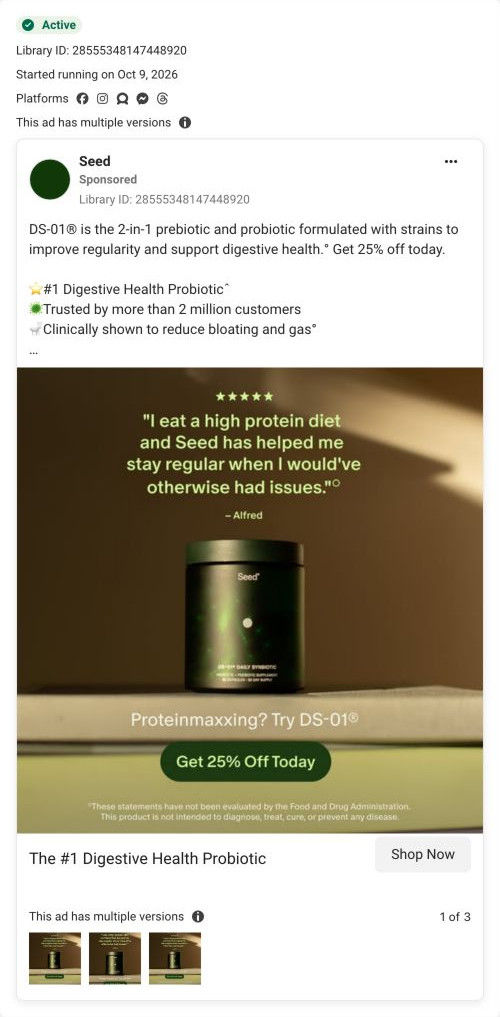
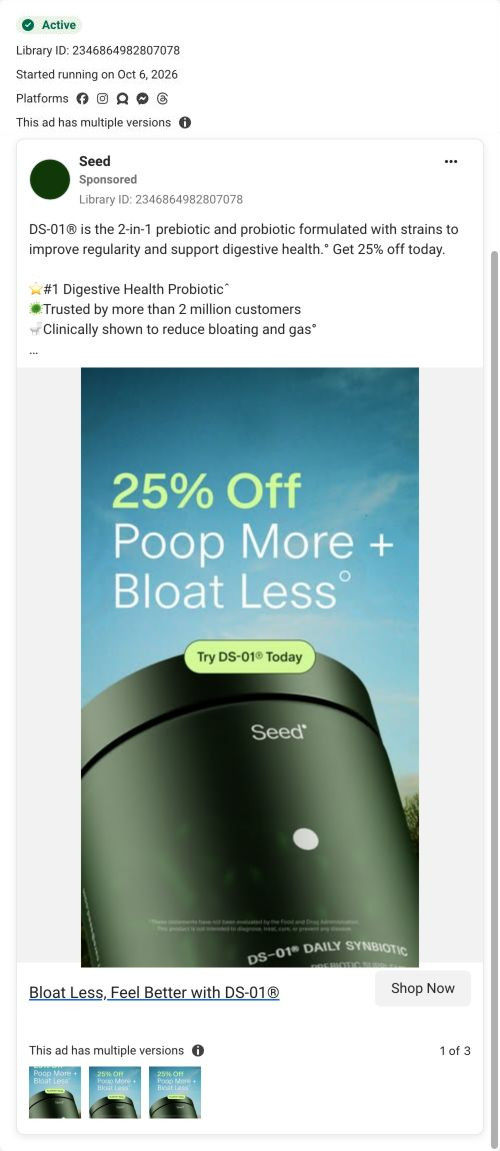
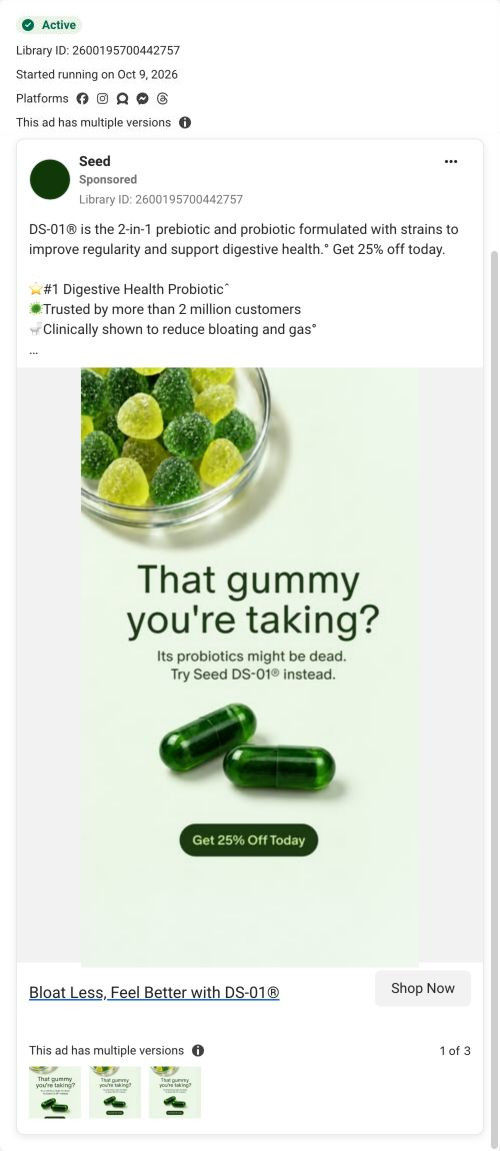
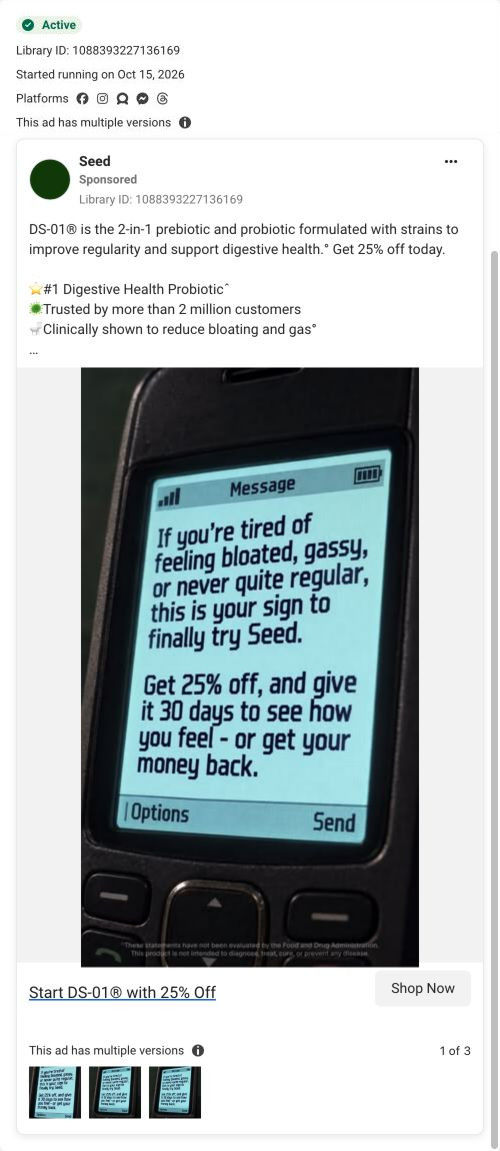
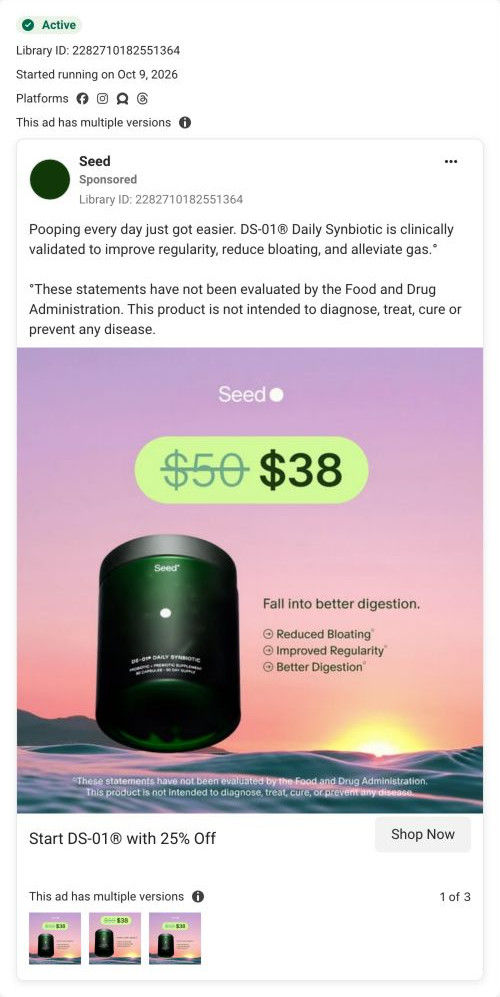
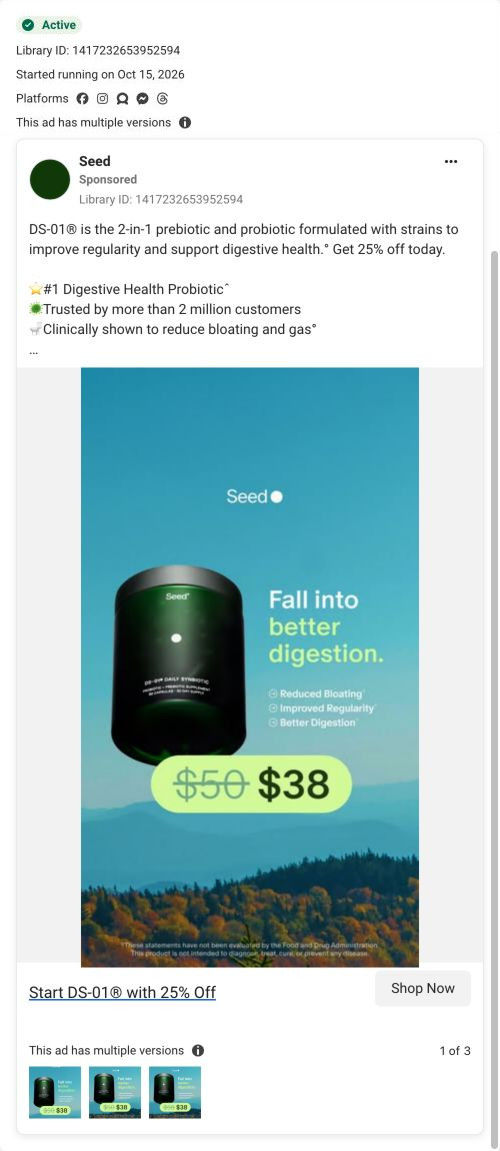
The ad leads with 25% savings and a short list of the digestive benefits advertised for DS-01. The code-bearing CTA now opens a 13-step quiz starting with “How often do you poop?” and promoting 25% off plus a free gift for completion. Compare the creative with the destination and explore the other ads sharing this route.
- Brand
- Seed
- Observed offer
- Advertised 25% off DS-01
- Creative angle
- Discount
- Page type
- Quiz
- Ad format
- Video · 0:57
- Listed start date
- Oct 13, 2026
- Captured
- Oct 19, 2026
- Library ID
- 1597798732046345
- Destination
- seed.com
Selected for its design and offer structure. Ad performance isn’t available in this collection.
What this ad does well
Britt opens on a line that makes you want the second half of the sentence: “You can see what changed on the outside.” She's a real person with a visible change, and she frames DS-01 as the next step in a routine she already describes in detail (protein, fiber, exercise), so the product feels like part of her habits instead of a pitch. She also explains the mechanism Seed claims in plain words: a capsule inside a capsule meant to get the bacteria through digestion. The close mirrors the open (outside, then inside), which gives the whole video a clean shape.
What's missing
The video never names a gut problem the viewer has. Britt says she started paying attention to her gut, but she doesn't say what she noticed or what changed after she added DS-01, so a viewer with the same routine can't tell whether it's for them. The copy lists bloating, gas and regularity, and none of that makes it into her story. If you make one like this, have the creator describe a moment from her own routine in her own words (attributed, and without promising a result), and move the 25% off up from the last line so there's a reason to act before people scroll away.
Beat by beat
- 0-5sBritt, on camera at home, says there's something about her weight-loss journey you can't see.
It opens a curiosity gap that only the rest of the video closes, which is what keeps a cold viewer watching.
- 5-20sShe covers her weight loss, her GLP-1 and her habits: protein, fiber and regular exercise.
The specifics make her credible and tell a viewer on a similar path that this is about them.
- 20-35sShe says those changes made her pay attention to her gut, which is why she added Seed's DS-01.
It positions the product as the next habit in a routine she already has, not a new problem to worry about.
- 35-50sShe describes Seed's claims: a 2-in-1 probiotic and prebiotic with 24 strains in a capsule inside a capsule.
Explaining how the product is built gives the viewer a reason to believe it's different from other probiotics.
- 50-57sShe contrasts years spent on the outside with being intentional about the inside, then mentions 25% off.
The callback to the opening line ties the story together, and the discount gives the click a reason.
The offer
25% off DS-01, stated in the copy and spoken in the final line, with the creator's link carrying the code 25SEED.
Where it sends people
The ad goes to Seed's DS-01 quiz, which sits on the strongest rung of the landing-page ladder: it asks what the visitor is dealing with before recommending anything. The entry screen shows a step counter and progress bar, a banner promising a discount plus a free gift for finishing, and a first question about how often you poop, answered with one tap. The 25% off carries straight through, which is good. Britt's story doesn't, though: the screen has no product, no creator and nothing about routines, so someone who clicked because of her weight-loss journey lands on a generic question. A first screen (or question) that speaks to people who've changed how they eat would keep her angle alive for this traffic.
The page it sends people to: How Seed's DS-01 quiz turns every ad into the same first question
Seed's DS-01 quiz entry is a 13-step quiz captured on its first screen: a step counter, a banner offering 25% off plus a free gift for finishing, one tap-only question and a consent note. Forty-three ads in the Fluid library send people here, from creator promo-code videos to problem-led, bloating and discount ads.
How the page is built
- 01Header
A 1 / 13 step counter, the centered logo and a thin progress bar answer how long this is going to take.
- 02Offer banner
A highlighted pill promises 25% off plus a free gift for completing the quiz, which answers what the visitor gets for finishing.
- 03Question
A large question about a daily habit, with a one-line reason it matters, answers why Seed is asking.
- 04Answers
Four stacked pill buttons with frequency options let the visitor answer in one tap, with no Next button to find.
- 05Consent note
Small privacy and data-use text at the bottom answers what happens to the health information they share.
The first fixes we would make
- Creator traffic arrives with a code in the URL (25BOBBY, for example), but the banner reads the same for everyone and never mentions the creator. Add a line like "Bobby's 25% off is applied" for coded traffic, so a viewer who just watched that creator knows they're in the right place.
- The screen doesn't say what the visitor gets at the end besides the discount. Add one short line under the banner saying the quiz ends with a recommendation on whether DS-01 fits them (the page address already asks that question), so 13 steps feel worth finishing.
Read the full breakdown of this page
Three hooks you could test
- Sell the outcome. “I changed everything about how I eat. Here's the part of my routine nobody sees.”
- Show a specific moment of use. “Protein shake, walk, then this capsule. That's my morning now.”
- Call out the habit you're replacing. “I tracked every gram of protein and never once thought about my gut.”
What to borrow for your brand
- Open with a sentence that's only half finished (what you can see versus what you can't), so the viewer has to keep watching to hear the rest.
- Place your product as the next step in a routine the creator already describes in detail, so it reads as a habit instead of an ad.
- End on a line that mirrors your opening, which gives a talking-head video a clear beginning and end without any editing tricks.
Transcript
You can see what changed on the outside, but here's something about my weight loss journey that you can't see. I've lost over £100 and obviously I've completely changed the way I eat and move my body. I'm on a GOP one. I prioritize protein and fiber, and I exercise consistently. But all of those changes also made me start paying a lot more attention to something I wasn't thinking about before. My gut. Supporting my gut has become another part of my routine, which is why I added C, DSO one daily symbiotic. It's a clinically validated 2 and one probiotic and prebiotic with 24 scientifically studied probiotic strains. And this part is really cool. It's actually a capsule inside a capsule designed to protect the live bacteria through digestion so that they can reach the colon. I've spent 3.5 years working on what's happening on the outside of my body. Now I'm just as intentional about supporting what's happening on the inside. If you're ready to focus on your inside too. Make sure to try DSO1 today for 25% off.
Text on screen
- I've lost over 100
- and obviously, I've
- I eat and move my body
- prioritize
- protein and fiber, and I
- exercise consistently
- But all of those changes
- lot
- I wasn't thinking about
- before, my gut
- Supporting my gut has
- routine, which is why I
- added Seed's DS-01°
- Daily
- Seed
- BACTERIA
- Seed®
- For your world whin
- reach the colon
- half
- happening on the outside
- intentional
- If you're ready to focus
- your inside too, make
- try DS-01° today for 25%
One of 50 Seed ads in the Fluid Inspiration Library, captured from the Meta Ad Library on Oct 19, 2026. We record that an ad ran publicly, not how it performed.