How Blueland sells a dishwasher starter kit with two free gifts
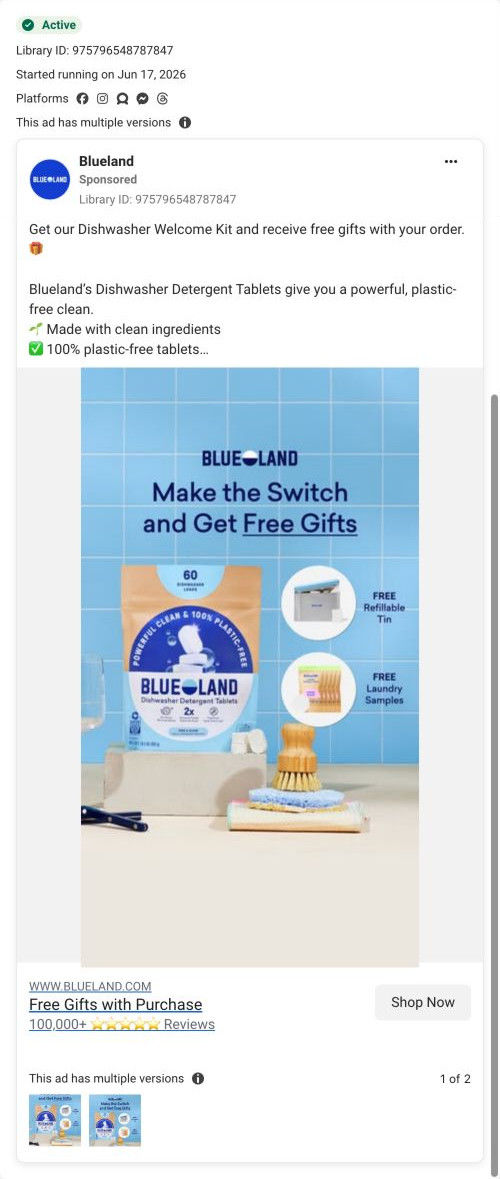
A Blueland static on Meta from Jun 17, 2026, with the headline “Make the Switch and Get Free Gifts.” A dishwasher tablet pouch sits on a sink ledge beside two circled extras labeled FREE: a refillable tin and laundry samples. The copy lists plastic-free and clean-ingredient claims, and the ad links to the Dishwasher Welcome Kit offer page.

Free Gifts with Purchase
The ad makes free gifts the entry offer and supports the dishwasher kit with a short benefit list and review-count framing. The CTA leads to the dedicated Dishwasher Welcome Kit page. Compare the creative with the destination and explore the other ads sharing this route.
- Brand
- Blueland
- Observed offer
- Dishwasher Welcome Kit + advertised free gifts
- Creative angle
- Bundles
- Page type
- Dedicated offer
- Ad format
- Image
- Listed start date
- Jun 17, 2026
- Captured
- Oct 19, 2026
- Library ID
- 975796548787847
- Destination
- blueland.com
Selected for its design and offer structure. Ad performance isn’t available in this collection.
What this ad does well
Blueland makes the gifts visible instead of just promising them. The two FREE callouts each show the actual item (the steel refill tin and a fan of laundry sample sachets), so you know what lands in the box before you tap. The scene is built from things you'd find next to a real sink (a wooden dish brush, a sponge, a glass), which keeps it feeling like a kitchen and not a studio pack shot. And the headline does two jobs at once: “Make the Switch” names the habit change, and “Free Gifts” gives the reason to do it now.
What's missing
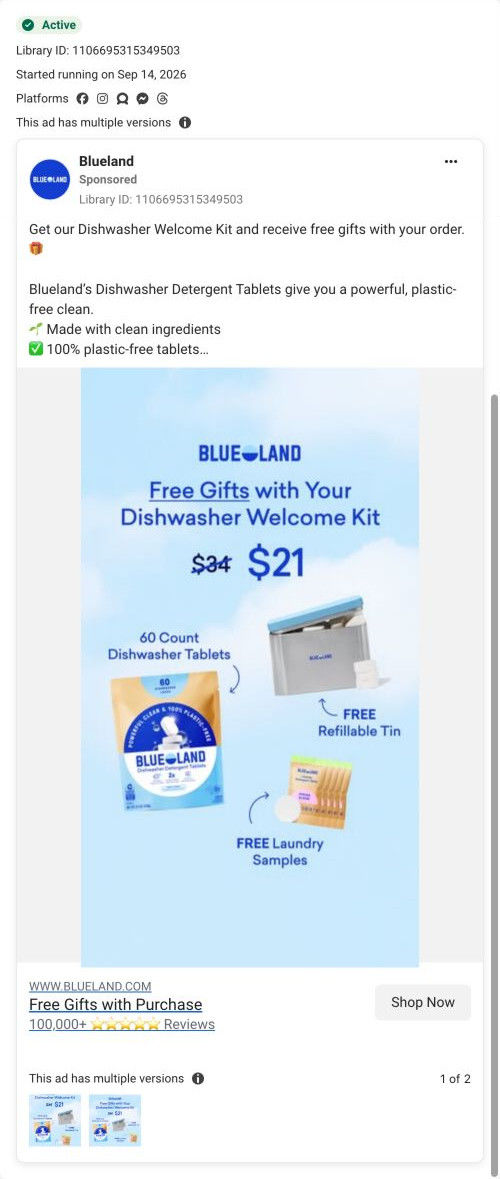
There's no price anywhere in the image, so the viewer can't tell whether the gifts make this a good deal or just a nice extra. Blueland ran another version of this same kit offer that shows $34 crossed out to $21, and that number does a lot of work this version leaves on the table. The ad also skips the problem: it never says what's wrong with the detergent you're using now. If you make one like this, put the first-order price under the headline and add one line naming what you're switching away from, like the plastic tub under the sink.
Beat by beat
- ImageA Blueland dishwasher tablet pouch on a stone block, a dish brush and sponge beside it, and two circled insets marked FREE Refillable Tin and FREE Laundry Samples.
Showing each gift as a real object makes the bonus feel concrete instead of vague.
- Headline“Make the Switch and Get Free Gifts” runs across the top, with Free Gifts underlined.
It pairs the behavior Blueland wants (switching detergent) with the reward for doing it today.
- CopyThe copy offers the Dishwasher Welcome Kit with free gifts, then bullets clean ingredients, plastic-free tablets and removing 48-hour stuck-on food.
The bullets give a skeptic a cleaning claim to hold on to, not only a sustainability one.
- Link card“Free Gifts with Purchase” sits over a 100,000+ five-star reviews line and a Shop Now button.
The review line is the only proof in the unit, so it carries the trust job on its own.
The offer
The offer is the Dishwasher Welcome Kit with a free refillable tin and free laundry samples. No price appears in this version; the gifts are the whole pitch.
Where it sends people
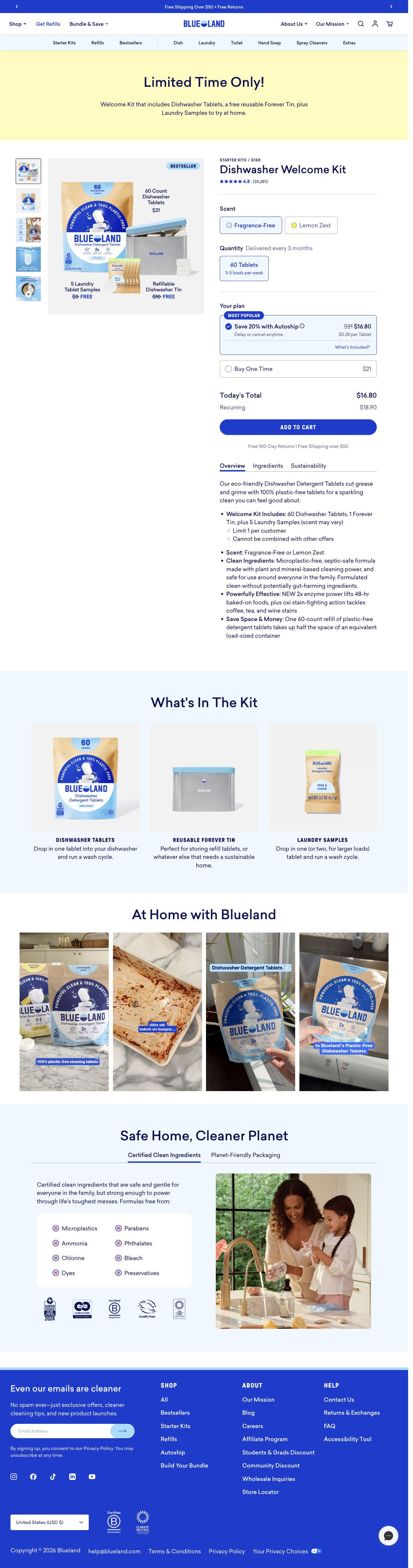
The ad links to Blueland's Dishwasher Welcome Kit page, a dedicated offer page rather than the homepage, which is a better rung on the ladder. It picks up the promise right away: a yellow “Limited Time Only!” banner names the kit contents, and the main buy box image labels each item with its value, the free ones struck through and marked FREE. A three-card “what's in the kit” row follows the buy box, so the tin and samples from the ad show up again in plain view. The buy box pre-selects autoship and shows “Today's total” and “Recurring” as separate lines, which is where the price this ad leaves out finally appears.
The page it sends people to: How Blueland's Dishwasher Welcome Kit page pays off a free-gift ad
Blueland's Dishwasher Welcome Kit page is a short dedicated offer page. A “Limited Time Only!” banner names the kit, an annotated buy box image values each item, autoship is pre-selected, and a what's-in-the-kit row, UGC stills and an ingredient panel follow. Three ads in the Fluid library send people here, all bundle offers built around free gifts.
How the page is built
- 01Announcement bar and header
A rotating shipping-and-returns line and Blueland's full navigation answer can I trust this store before the offer starts.
- 02Offer banner
A yellow “Limited Time Only!” band lists what the kit includes, answering am I in the right place for the ad I tapped.
- 03Buy box image
An annotated kit image labels each item's count or value with free items struck through, answering what exactly am I getting.
- 04Buy box options
Star rating, scent pills, a quantity tile with usage notes and a pre-selected autoship card tagged most popular answer which version should I pick.
- 05Buy box close
“Today's total” and “Recurring” lines, Add to cart and tabs listing kit contents and offer limits answer what will I pay now and later.
- 06What's in the kit
Three product cards with one-line usage notes answer how each piece is used.
- 07UGC demos
Four vertical video stills under an “At home” headline, including a dirty dish before shot, answer does it really clean.
- 08Safety and planet tabs
Ingredient and packaging tabs with a free-from card and certification badges answer is it safe for my family.
- 09Newsletter and footer
An email signup band and footer links catch visitors who aren't ready to buy.
The first fixes we would make
- The UGC section shows a before shot of a dirty dish but the stills don't pair it with the clean after. Put a matched before and after right under the buy box, so cleaning proof sits next to the price.
- There's no comparison with the detergent the visitor uses now. Add a short tablets-versus-pods-or-gel table after the kit row, the way Blueland's laundry page compares against named competitors.
Read the full breakdown of this page
Three hooks you could test
- Call out the habit you're replacing. “Still buying detergent in a plastic tub? Switch and we'll send the tin free.”
- Make the product the whole scene. “Everything in your first box, laid out on the counter: one pouch, two free extras.”
- Turn the benefit into a picture people get in a second. “One refill pouch, one tin that lives under your sink forever.”
What to borrow for your brand
- Show every free gift as a real photo with a FREE label next to it, so the bonus reads as a physical thing the customer gets.
- Stage the product with the tools it lives beside at home (a brush, a sponge, a glass) so a starter kit looks like part of a routine.
- Pair a behavior-change headline with an immediate reward, the way “Make the Switch” is paired with “Get Free Gifts.”
One of 9 Blueland ads in the Fluid Inspiration Library, captured from the Meta Ad Library on Oct 19, 2026. We record that an ad ran publicly, not how it performed.