

BobbyParrish with SeedSponsored
Esc
How Seed pairs a wasted-money hook with a scissors demo
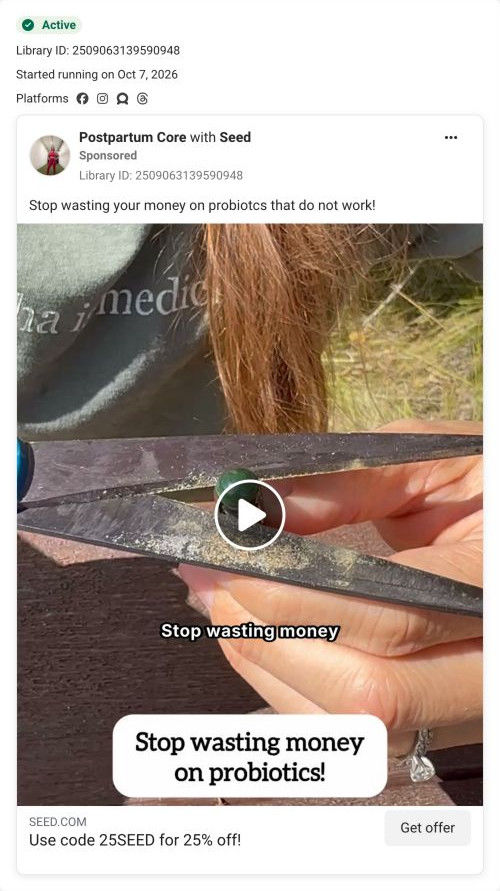
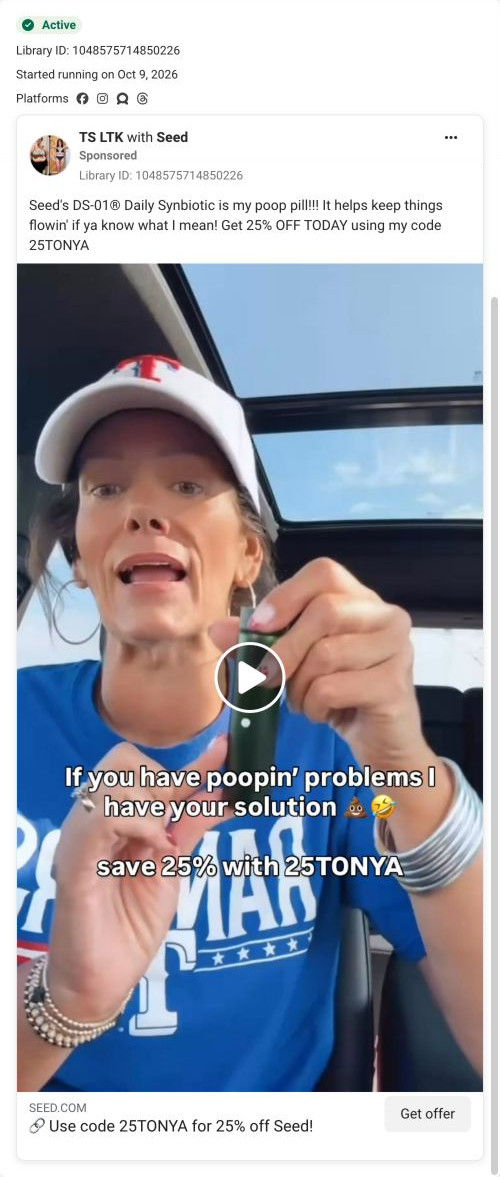
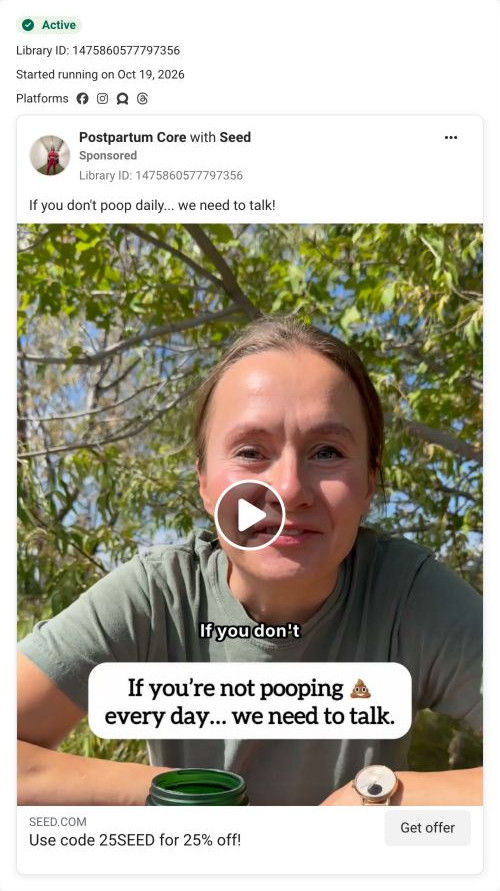
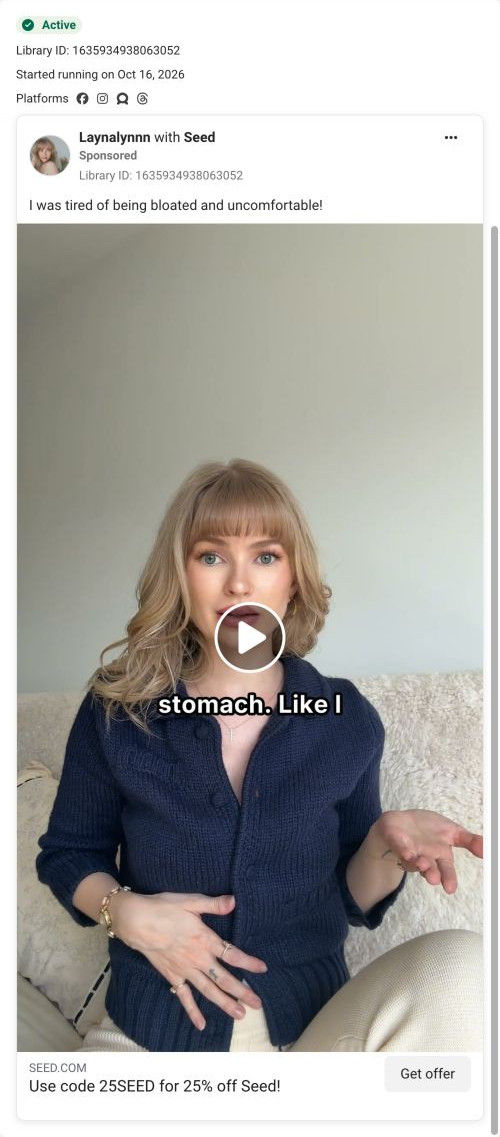
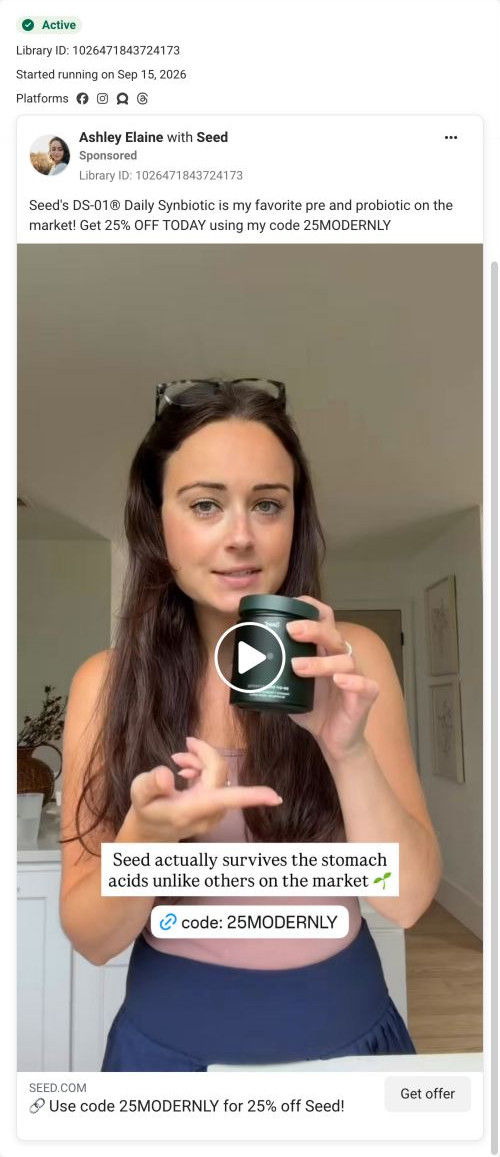
A creator video from the Postpartum Core account: a capsule is cut with scissors under the caption "Stop wasting money on probiotics!" The copy repeats the wasted-money line. The headline offers 25% off with code 25SEED, and Get Offer opens Seed's DS-01 quiz.
Seed
43 creatives lead here1 / 43










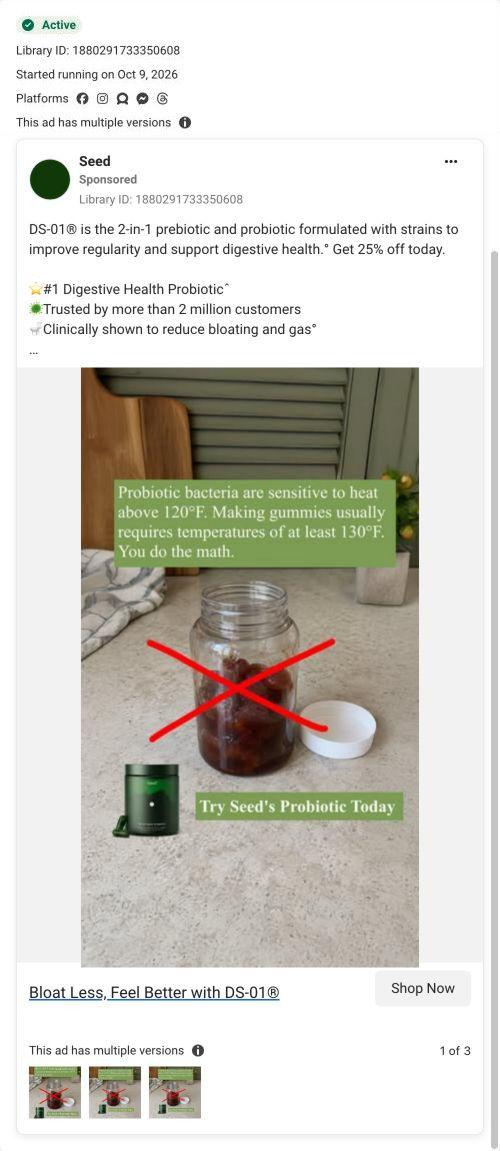
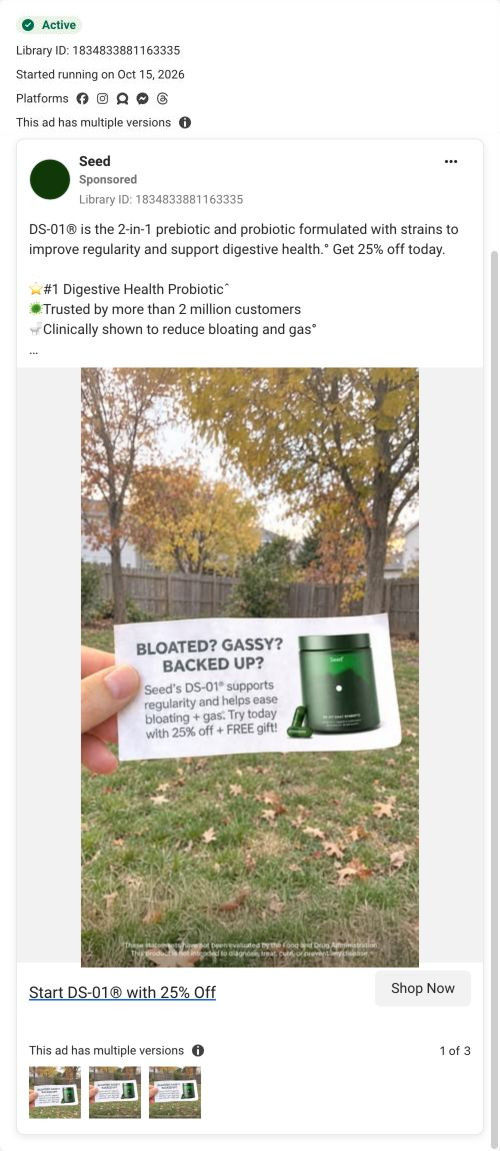
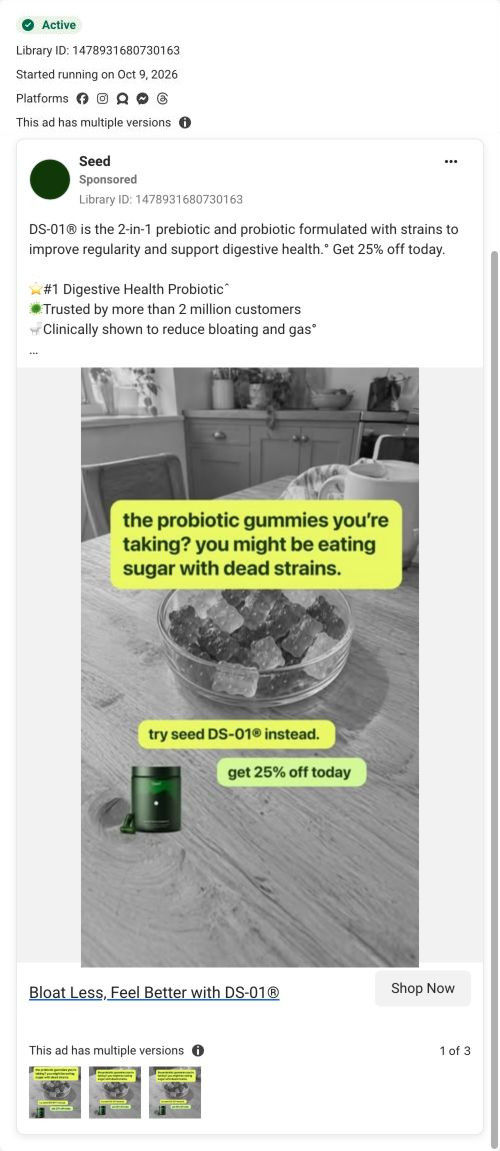
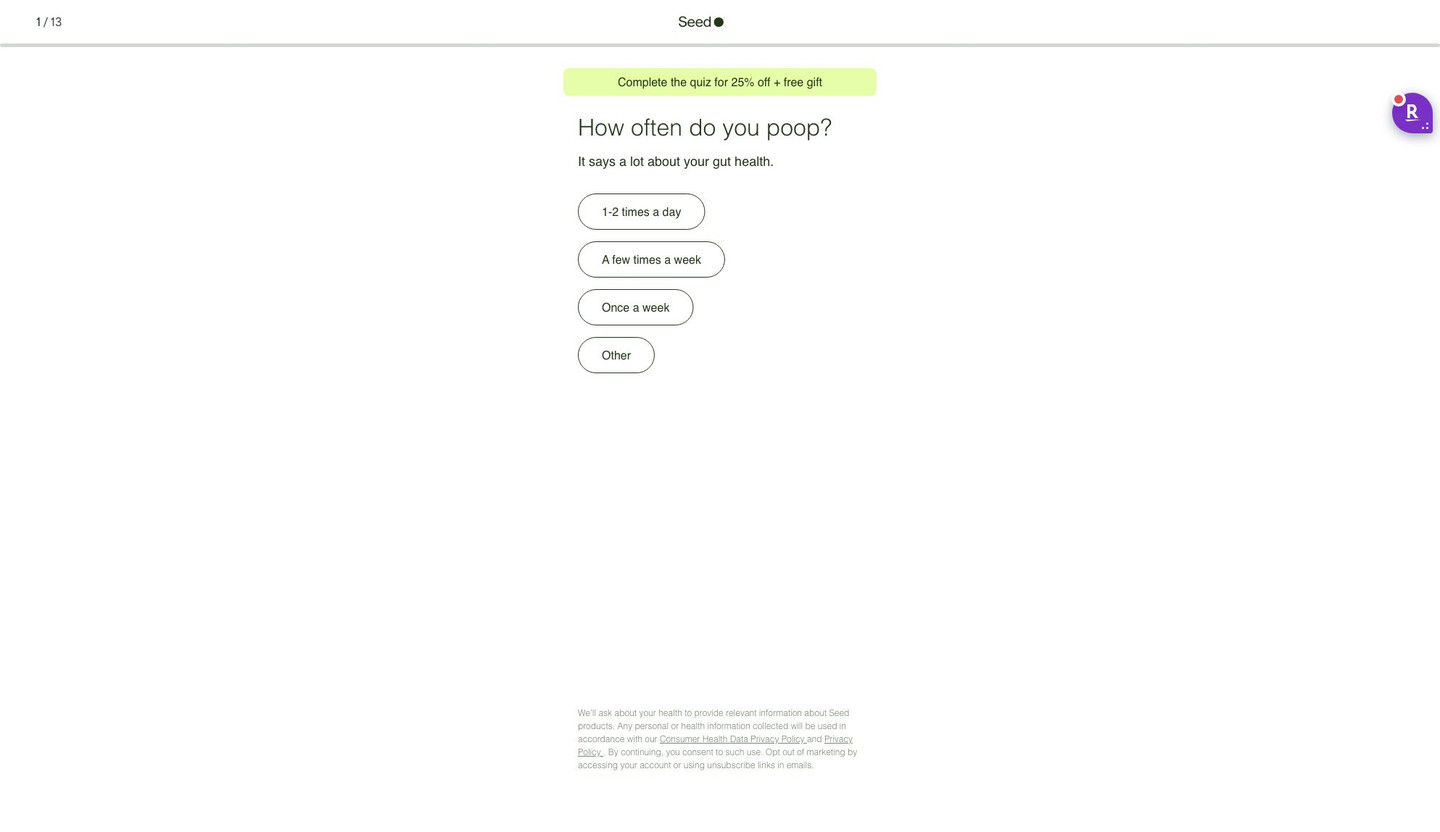
The Seed DS-01 quiz entry
Quiz entry screen only; personal health questions were not answered. A browser shopping-extension badge appears in the upper-right margin of this capture.
Stop wasting money on probiotics that do not work
The ad opens with a blunt wasted-money hook before the CTA supplies an offer code. The code-bearing CTA now opens a 13-step quiz starting with “How often do you poop?” and promoting 25% off plus a free gift for completion. Compare the creative with the destination and explore the other ads sharing this route.
- Brand
- Seed
- Observed offer
- Advertised 25% off with code 25SEED
- Creative angle
- Pattern interrupts
- Page type
- Quiz
- Ad format
- Video
- Listed start date
- Oct 7, 2026
- Captured
- Oct 19, 2026
- Library ID
- 2509063139590948
- Destination
- seed.com
Selected for its design and offer structure. Ad performance isn’t available in this collection.
What this ad does well
The hook goes straight at a feeling many supplement buyers have, that they've paid for something without knowing if it did anything. Pairing that line with a physical demo (the capsule pinched in scissor blades, powder already visible on the blade) gives the claim something to show instead of just assert. It's the same creator and setting as another Seed ad built around the two-capsule question, which is a sensible way to get more than one ad out of a single shoot. The headline makes the offer concrete with a number and a code.
What's missing
The hook names a pain (wasted money) but the captured copy never says why other probiotics would be a waste or what this one does instead. There's no transcript in our capture, so we can't tell if the video explains it, but the copy and caption alone give a cold viewer no proof. If you make one like this, put the reason in the caption right after the hook ("most capsules dissolve before they get there" or your own supported claim) so the accusation is backed by an explanation.
Beat by beat
- Opening frameA capsule pinched between scissor blades outdoors, with powder on the blade, under the caption "Stop wasting money on probiotics!"
It pairs a money pain with a visual that suggests the creator is about to show what's inside.
- Copy"Stop wasting your money on probiotcs that do not work!" (with the typo as captured).
It repeats the hook for people reading rather than watching.
- CTAUse code 25SEED for 25% off, with a Get Offer button.
It gives the viewer a reason to act now right after accusing their current purchase of being a waste.
The offer
25% off with code 25SEED, stated in the headline next to Get Offer.
Where it sends people
Get Offer opens Seed's DS-01 quiz with code 25SEED, and a quiz is often the best landing choice because it learns what the visitor is dealing with before recommending a product. The entry banner promises a discount and a free gift for finishing, so the 25% carries through with a small bonus. The first question is about a daily bathroom habit rather than money, which is a shift in topic, but it's one tap. The screen shows no product or claims, so for an ad whose hook says other probiotics are a waste, a single line of reassurance near the banner would keep that thread going.
The page it sends people to: How Seed's DS-01 quiz turns every ad into the same first question
Seed's DS-01 quiz entry is a 13-step quiz captured on its first screen: a step counter, a banner offering 25% off plus a free gift for finishing, one tap-only question and a consent note. Forty-three ads in the Fluid library send people here, from creator promo-code videos to problem-led, bloating and discount ads.
How the page is built
- 01Header
A 1 / 13 step counter, the centered logo and a thin progress bar answer how long this is going to take.
- 02Offer banner
A highlighted pill promises 25% off plus a free gift for completing the quiz, which answers what the visitor gets for finishing.
- 03Question
A large question about a daily habit, with a one-line reason it matters, answers why Seed is asking.
- 04Answers
Four stacked pill buttons with frequency options let the visitor answer in one tap, with no Next button to find.
- 05Consent note
Small privacy and data-use text at the bottom answers what happens to the health information they share.
The first fixes we would make
- Creator traffic arrives with a code in the URL (25BOBBY, for example), but the banner reads the same for everyone and never mentions the creator. Add a line like "Bobby's 25% off is applied" for coded traffic, so a viewer who just watched that creator knows they're in the right place.
- The screen doesn't say what the visitor gets at the end besides the discount. Add one short line under the banner saying the quiz ends with a recommendation on whether DS-01 fits them (the page address already asks that question), so 13 steps feel worth finishing.
Read the full breakdown of this page
Three hooks you could test
- Call out the habit you're replacing. “Stop paying for [category] that never make it past [obstacle].”
- Make the product the whole scene. “Let's cut one open and see what you're actually paying for.”
- Lead with the uncomfortable problem. “If you can't tell whether your [product] is doing anything, watch this.”
What to borrow for your brand
- Shoot several hooks in the same setting with the same creator, so one shoot produces more than one ad.
- Pair a money-wasted hook with a physical demo so the viewer sees evidence instead of a bare claim.
- Follow any accusation about competitors with a one-line reason, in the caption, before the offer.
One of 50 Seed ads in the Fluid Inspiration Library, captured from the Meta Ad Library on Oct 19, 2026. We record that an ad ran publicly, not how it performed.