

Monica Hime HenrySponsored
Esc
How Prose used a creator's curl try-on video to sell custom haircare
A 47-second creator video that ran under Monica Hime Henry's name. It opens on a car selfie of defined curls, then tells a try-it story: she sees someone's curls, takes the Prose consultation, uses the shampoo and curl cream on camera and shows the result. A 60% off first order sticker appears, and the ad links into the Prose consultation.
Prose
64 creatives lead here1 / 64







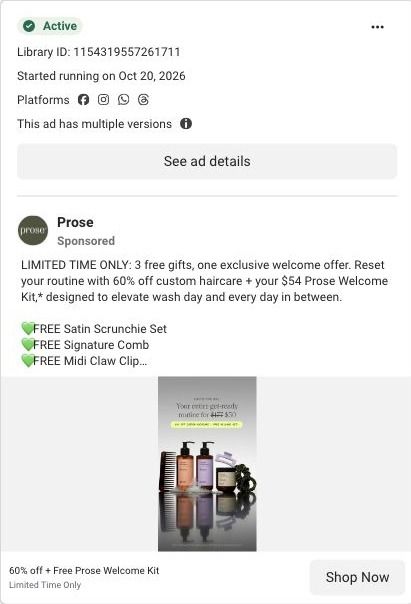
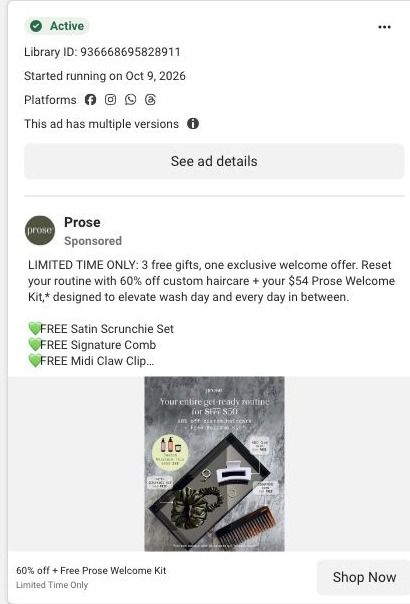


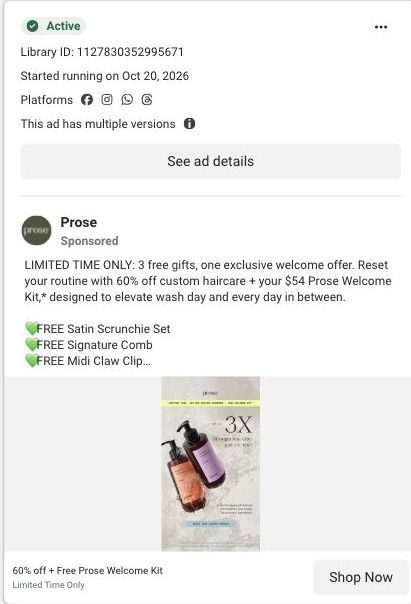


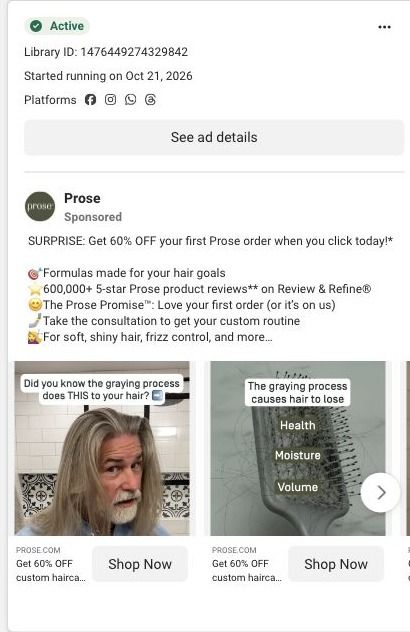







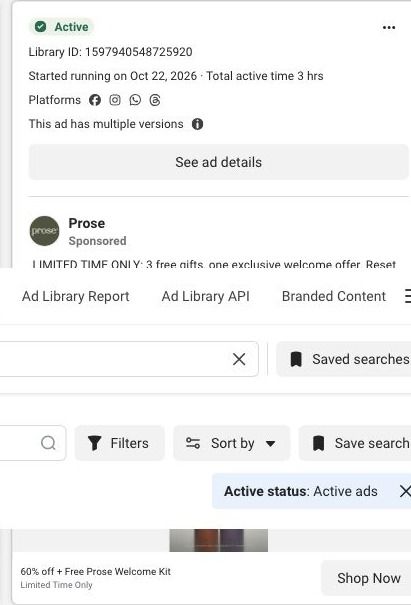


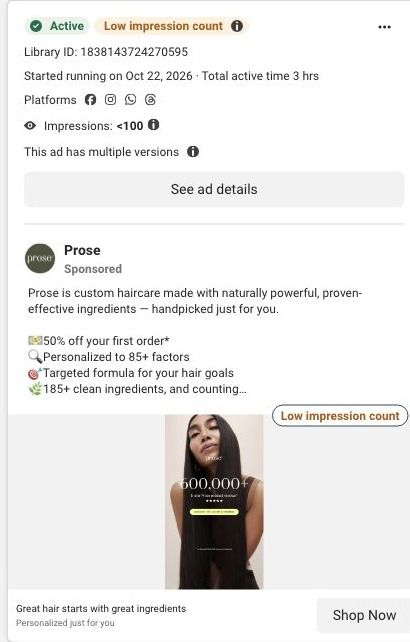
Prose · Haircare consultation
Public page captured October 22, 2026. Promotional sheets, chat, extension overlays and sticky cart bars were removed from the static reference; page layout and copy were preserved. No account, personal, health or payment details were supplied. Quiz captures show the observed entry screen, not the complete consultation.
Get 60% OFF custom haircare from Prose
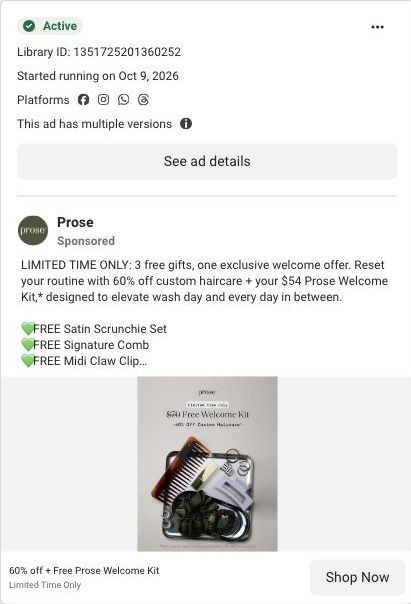
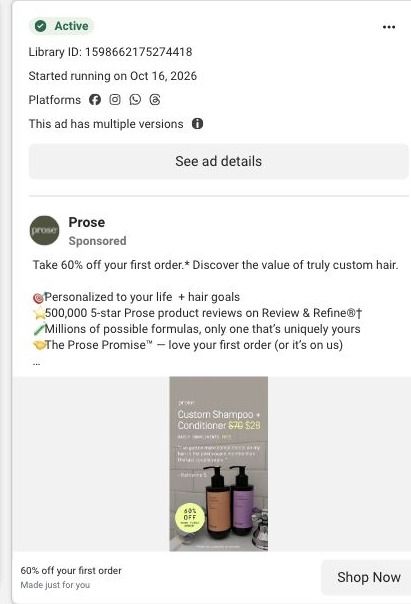
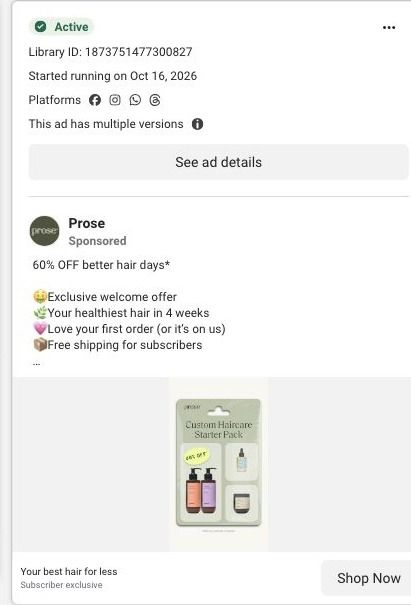
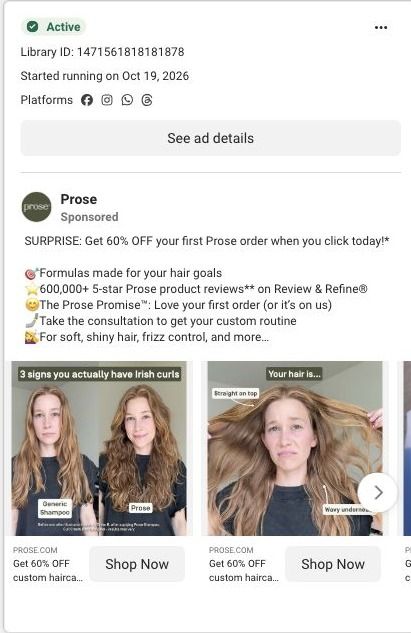
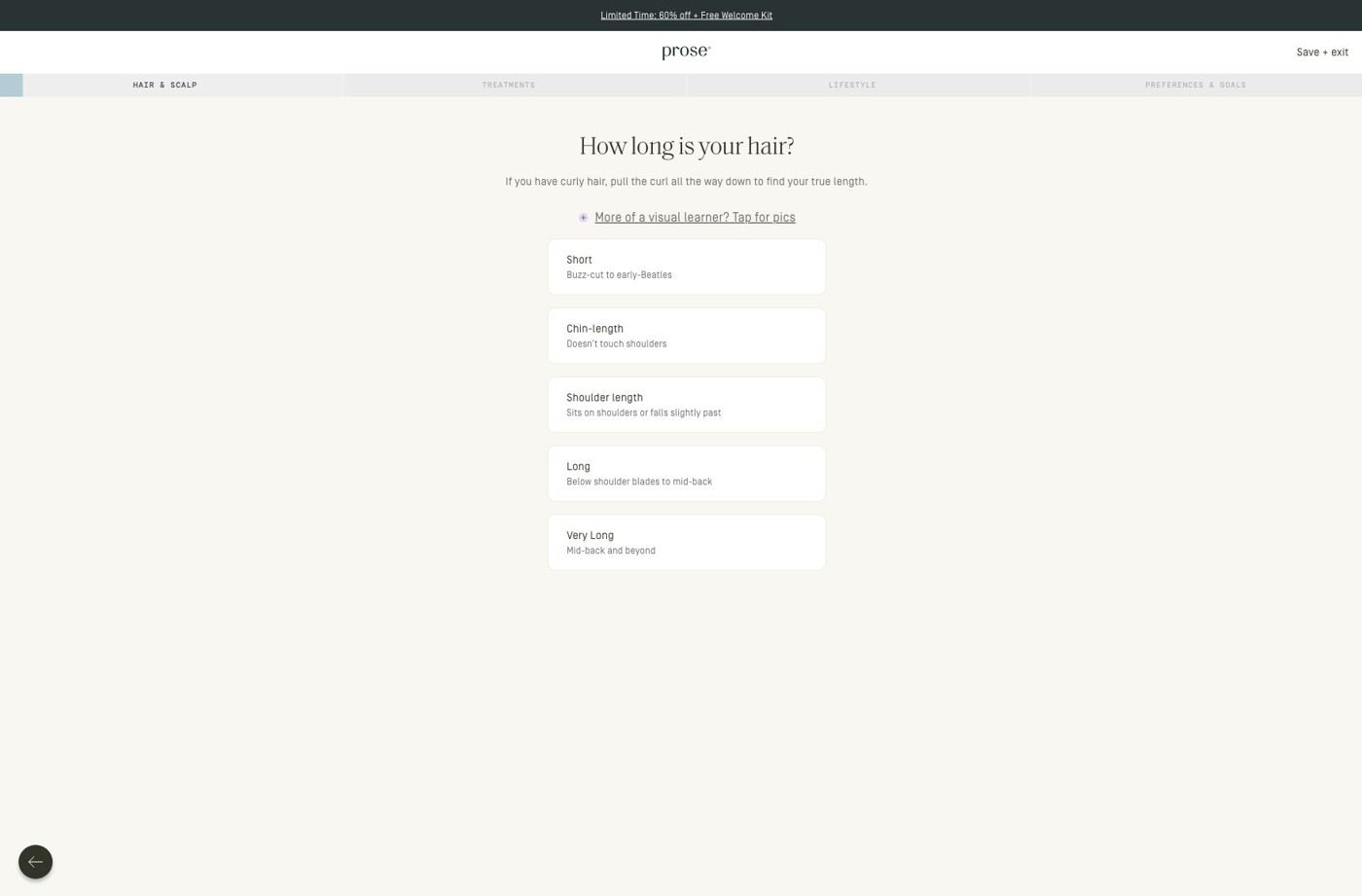
Visual reference: Loving my curls in 2026. Most selected ads go directly into the haircare consultation. The first-question URL redirects to a hair-length choice, with visible progress stages and a visual guide. No consultation answers were entered. Compare the creative with the destination and explore the other ads sharing this route.
- Brand
- Prose
- Observed offer
- Advertised custom haircare offer; subscription and gift conditions apply
- Creative angle
- Creator stories
- Page type
- Quiz entry
- Ad format
- Video · 0:47
- Listed start date
- Oct 19, 2026
- Captured
- Oct 22, 2026
- Library ID
- 1627659635486331
- Destination
- prose.com
Selected for its design and offer structure. Ad performance isn’t available in this collection.
What this ad does well
This one feels most like a native social post: a car selfie, a reaction to someone else's curls and on-screen social video interface, all of which make the ad read like something a friend shared. The story follows a real sequence the viewer can picture (she takes the consultation, washes, scrunches in curl cream, waits for it to dry), so the product is shown being used rather than described. The creator says the consultation took its time with her hair type, routine and where she lives, which explains personalization in her own words. A results-at-end caption keeps people watching for the payoff.
What's missing
The video never names the problem her curls had before, so the viewer sees an after but can't tell what changed or whether her own hair has the same issue. The creator says the shampoo cleared gunky buildup, and that's the closest the ad gets to a recognizable problem, but it arrives mid-video. If you make one like this, open with the before (a few seconds of the creator describing what her curls used to do), then let the car selfie be the reveal. The closing line is broad, so naming who it's for (curls that frizz or fall flat) would give the right viewer a clearer reason to click.
Beat by beat
- 0-3sA car selfie of defined curls carries the caption about loving my curls in 2026, with a second shot of fuller curly hair inset.
It opens on the outcome, which gives curly-haired viewers a look they want.
- 3-12sThe creator says someone else's curls are unreal, names Prose and says she's been seeing it everywhere, over social video footage.
It frames the ad as a personal try-it story sparked by social proof.
- 12-22sShe says she's impressed by the consultation, which asked about her hair type, routine and where she lives.
It explains personalization through her experience instead of a brand claim.
- 22-38sShe uses the shampoo, says it cleared buildup, then scrunches in curl cream and waits for it to dry.
It shows the specific moments of use, so the viewer can picture her own wash day.
- 38-47sShe shows how bouncy her curls are and closes with a broad line telling viewers they need Prose.
It delivers the payoff the opening caption promised.
The offer
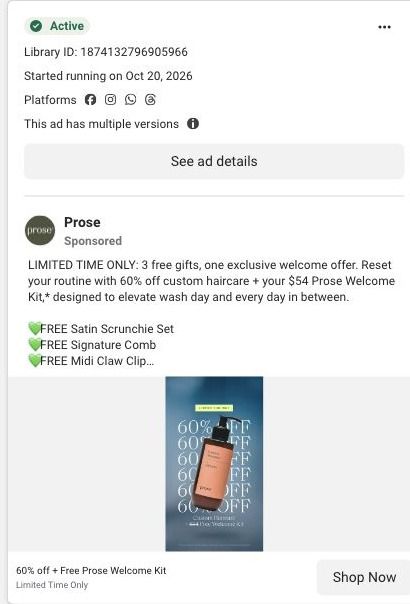
An on-screen sticker shows 60% off your first order, with fine print tying it to a haircare subscription, and the copy repeats the offer with no commitment.
Where it sends people
The ad links into the Prose haircare consultation, which the persona's ladder treats as often the best destination because a quiz diagnoses and then recommends. The captured entry screen has a compact promotion strip, progress navigation naming the stages and a hair-length question with large stacked choices. The creator already described the consultation, so a viewer who clicks knows a questionnaire is next, which is a clean hand-off. The page doesn't mention curls on its first screen, so if you run creator traffic like this, a brief line about building a curl routine at the top of the quiz would keep the story going.
The page it sends people to: How Prose starts its haircare quiz with one hair-length question
This is the first screen of Prose's haircare consultation: a slim promotion strip, a progress bar that names the consultation stages, and one hair-length question with large stacked choices and an optional visual guide. It's the destination for 64 ads in the Fluid library, mostly creator videos about curls and waves plus 60%-off offer ads.
How the page is built
- 01Promotion strip and header
A compact promotion strip sits above the logo and a save/exit control, so the offer stays visible and the visitor knows they can step out without losing their place.
- 02Progress stages
The consultation stages are named across the top, which answers "how much of this is there?" before the first tap.
- 03Hair-length question
One question with short explanatory copy, an optional visual guide and large stacked choices answers "what do I do here?" and makes the first answer easy to give.
- 04Back control
A back control lets people change an earlier answer, and the later consultation questions continue past what we captured.
The first fixes we would make
- Apart from the promotion strip, the entry screen doesn't restate what the visitor gets when they finish. Add one line under the progress stages that names the result (a formula built from these answers, plus the first-order offer the ads promised), so the effort of answering is tied to a reward.
- There's no proof on this screen, even though most of the ads sending people here are creator stories. A small strip with a customer quote or a still of a creator from the ads would carry that trust into the quiz without adding another step.
Read the full breakdown of this page
Three hooks you could test
- Show a specific moment of use. “Scrunched it in, waited for it to dry, and this is what happened.”
- Sell the outcome. “Curls that still look defined when you get back in the car.”
- Lead with the uncomfortable problem. “Your curls feel coated and heavy by day two? Start with the buildup.”
What to borrow for your brand
- Film the try-it story in the order the customer would live it (sign up, wash, style, wait, reveal), so the product is always being used on camera.
- Add a results-at-end caption early, so viewers have a reason to watch to the payoff.
- Let the creator describe your onboarding in her own words, which explains the mechanism without sounding like a brand script.
Transcript
Okay, so her curls are unreal. I want my hair to look like that She's been using this custom hair care brand called pros, and I've been seeing this everywhere, so we're gonna give it a try. So far, I'm really impressed by their consultation. They really took their time, getting to know my hair type, my hair routine, and where I live. This shampoo definitely got the gunky buildup out of my hair. I'm using the curl cream now, and this stuff is making my hair feel so filky. I've scrunched it all throughout. So now we wait for it to drive. Stop. Do you see how bouncing my curls are? It really worked. If you have hair on your head, you need pros.
Text on screen
- LOVING my curls
- in 2026
- She's been using this
- custom haircare
- brand called
- Custom
- Conditioner
- Kirsten
- When you suba call
- prose
- To hairosu
- 60%
- OFF
- YOUR FIRST ORDER
- prose-
- Shampoo
- prose:
- *When you subaction to maircare.
- 9:36
- Following 1 For You
- and I've been seeing this
- 60% OFF
- *When yo
- to haircare.
- 9.3K
- 342
- 104
- LIVE
- Following | For You
- EVERYWHERE
- 11.8K
- 945
- 11.1K
- *When you subscribe to haircare.
- 9.8K
- Results at end
- So far
- I'm really impressed by
- their consultation
- Before and after illustration taken by Monica H. after applying
One of 93 Prose ads in the Fluid Inspiration Library, captured from the Meta Ad Library on Oct 22, 2026. We record that an ad ran publicly, not how it performed.