

ProseSponsored
Esc
How Prose made oily roots and dry ends the case for custom haircare
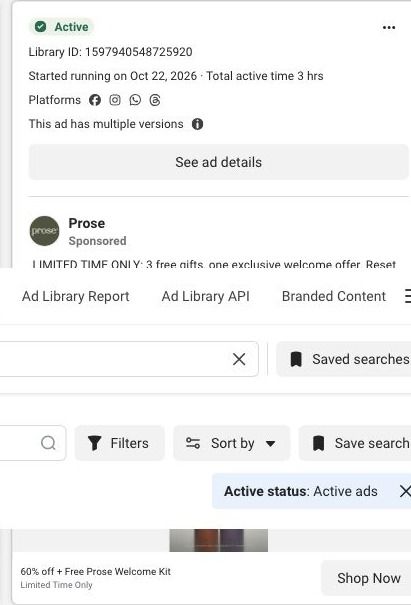
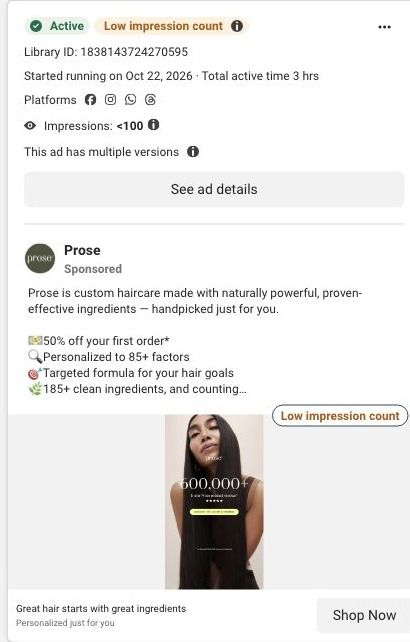
A 40-second Prose video that opens on a close-up of dry, frayed ends under a caption about dry ends and oily roots. The voiceover argues one shampoo can't fix two opposite problems, then covers the quiz, reviews and two named ingredients. The copy offers 60% off a first order with a subscription, and the ad links into the consultation.
Prose
64 creatives lead here1 / 64




















Prose · Haircare consultation
Public page captured October 22, 2026. Promotional sheets, chat, extension overlays and sticky cart bars were removed from the static reference; page layout and copy were preserved. No account, personal, health or payment details were supplied. Quiz captures show the observed entry screen, not the complete consultation.

Haircare for Your Unique Needs
Visual reference: What works for dry ends and oily roots. Most selected ads go directly into the haircare consultation. The first-question URL redirects to a hair-length choice, with visible progress stages and a visual guide. No consultation answers were entered. Compare the creative with the destination and explore the other ads sharing this route.
- Brand
- Prose
- Observed offer
- Advertised custom haircare offer; subscription and gift conditions apply
- Creative angle
- Creator stories
- Page type
- Quiz entry
- Ad format
- Video · 0:40
- Listed start date
- Oct 22, 2026
- Captured
- Oct 22, 2026
- Library ID
- 2310013583095984
- Destination
- prose.com
Selected for its design and offer structure. Ad performance isn’t available in this collection.
What this ad does well
The opening shot is the problem itself: fingers holding up dry, split ends, so a viewer with the same hair recognizes it before reading a word. The script explains the mechanism clearly (most shampoo does one job, and oily roots and dry ends need different ingredients), which makes custom haircare the logical answer rather than a luxury. It then gets specific about the formula, naming apple cider vinegar for an oily scalp and grape seed oil for dry ends, so the viewer can picture what's actually in the bottle. A phone screen recording of the quiz's hair-length question shows the exact screen the visitor will see after clicking.
What's missing
The video never mentions the offer, so the 60% discount lives only in the copy, and anyone who watches without reading the text gets no reason to act now. The proof is also thin on screen: the voiceover says thousands of five-star reviews while the screen shows a review panel, and there's no before-and-after or named customer. If you make one like this, add one line about the first-order offer near the end of the voiceover and a short result shot from a real customer. The screen recording also shows a seasonal promotion banner, which is worth checking against the offer the ad promises.
Beat by beat
- 0-3sA close-up of dry, frayed ends sits under the caption about dry ends and oily roots, while the voiceover says ends are begging for moisture.
It shows the exact problem, so the right viewer recognizes her own hair.
- 3-12sThe voiceover explains that most shampoo does one job, while oily roots and dry ends need different ingredients.
It gives the reason a single product falls short, which sets up personalization.
- 12-22sCustom bottles appear as the voiceover says Prose builds a formula around hair type, goals and zip code, with a review panel on screen.
It connects the problem to the mechanism and adds social proof.
- 22-30sA phone shows the quiz asking how long your hair is while the voiceover explains you take the quiz and get products shipped.
It previews the exact first step after the click.
- 30-40sThe voiceover names apple cider vinegar for an oily scalp and grape seed oil for dry ends, then tells viewers to take the quiz.
It makes the formula concrete and closes on one action.
The offer
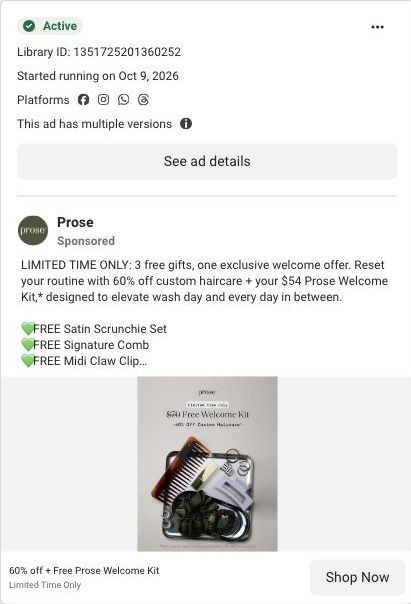
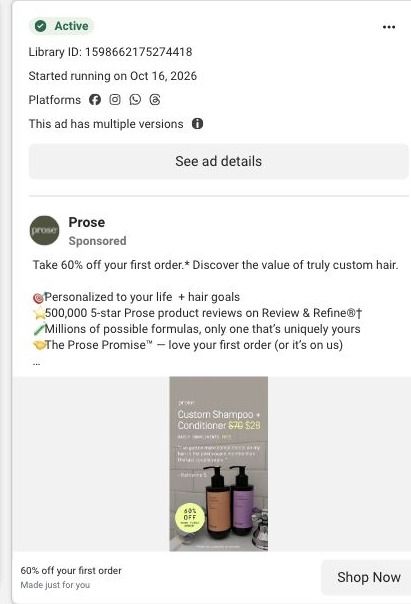
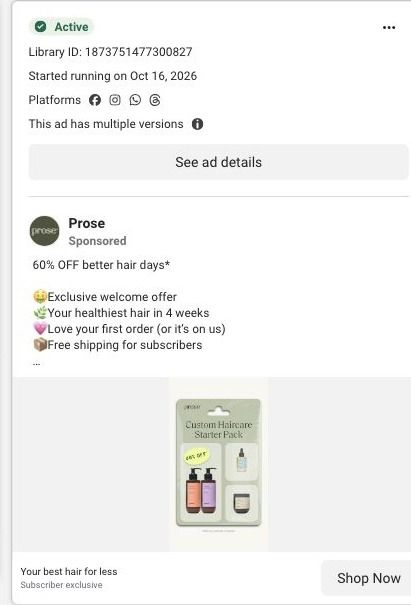
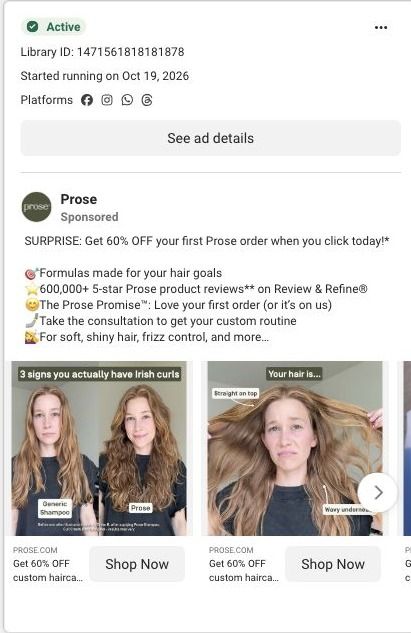
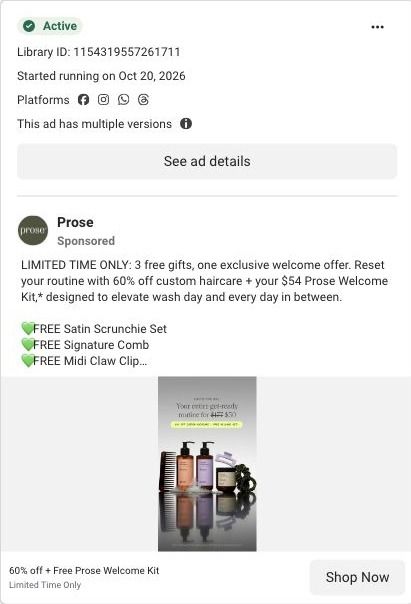
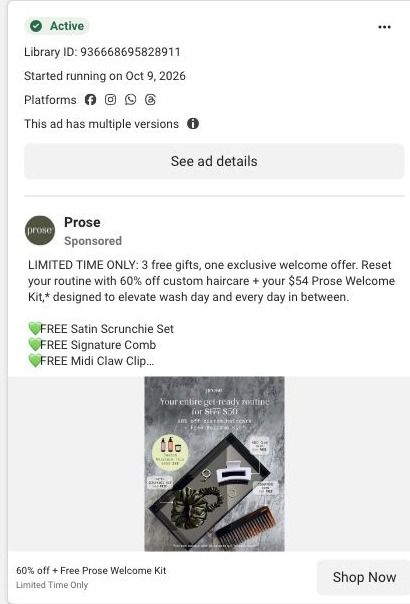
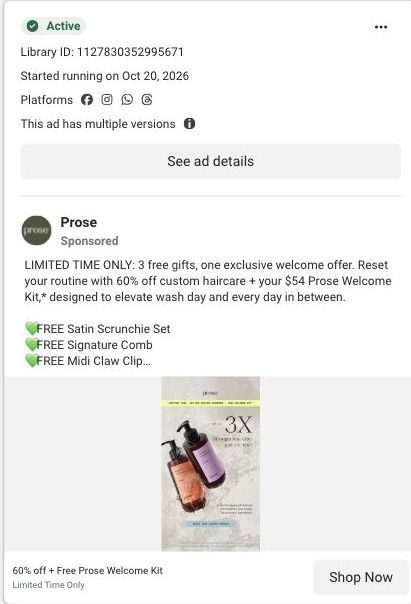
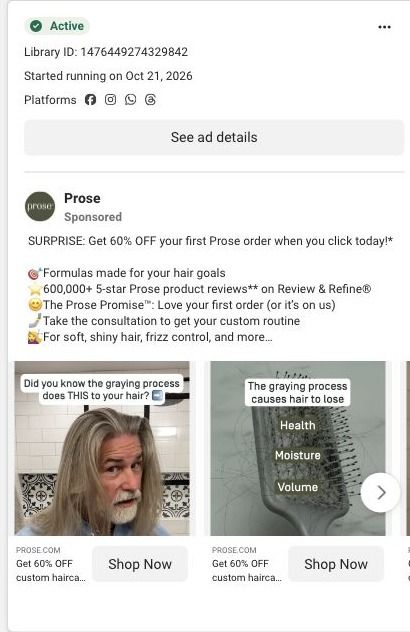
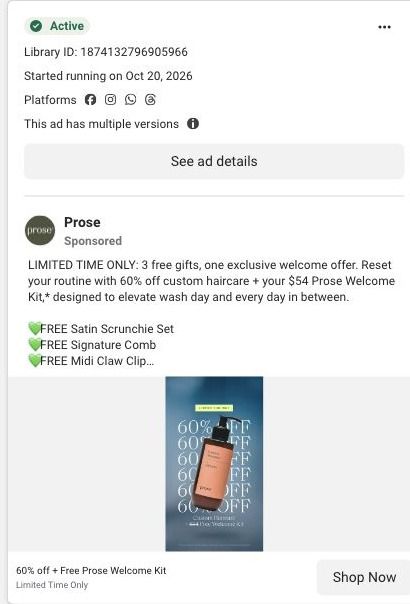
The copy offers 60% off a first order when you subscribe to haircare, with no commitment; the video itself doesn't mention it.
Where it sends people
The ad links into the Prose haircare consultation, a quiz, which the persona's ladder rates as often the best destination because it diagnoses before it recommends. The captured entry screen opens with a compact promotion strip, progress navigation naming the stages and a hair-length question with a visual guide and stacked choices. That first question is the same one the video shows on the phone, so the visitor clicks and lands on a screen she's already seen, which is about as close as message match gets. The next improvement is getting the roots-and-ends concern into the quiz early, so she sees her problem being asked about.
The page it sends people to: How Prose starts its haircare quiz with one hair-length question
This is the first screen of Prose's haircare consultation: a slim promotion strip, a progress bar that names the consultation stages, and one hair-length question with large stacked choices and an optional visual guide. It's the destination for 64 ads in the Fluid library, mostly creator videos about curls and waves plus 60%-off offer ads.
How the page is built
- 01Promotion strip and header
A compact promotion strip sits above the logo and a save/exit control, so the offer stays visible and the visitor knows they can step out without losing their place.
- 02Progress stages
The consultation stages are named across the top, which answers "how much of this is there?" before the first tap.
- 03Hair-length question
One question with short explanatory copy, an optional visual guide and large stacked choices answers "what do I do here?" and makes the first answer easy to give.
- 04Back control
A back control lets people change an earlier answer, and the later consultation questions continue past what we captured.
The first fixes we would make
- Apart from the promotion strip, the entry screen doesn't restate what the visitor gets when they finish. Add one line under the progress stages that names the result (a formula built from these answers, plus the first-order offer the ads promised), so the effort of answering is tied to a reward.
- There's no proof on this screen, even though most of the ads sending people here are creator stories. A small strip with a customer quote or a still of a creator from the ads would carry that trust into the quiz without adding another step.
Read the full breakdown of this page
Three hooks you could test
- Lead with the uncomfortable problem. “Greasy by noon at the roots, straw at the ends?”
- Call out the habit you're replacing. “You're using one shampoo to fix two opposite problems.”
- Turn the benefit into a picture people get in a second. “One ingredient for your scalp, a different one for your ends.”
What to borrow for your brand
- Open on a close-up of the problem itself, so the viewer recognizes her situation before she reads the caption.
- Name one or two real ingredients and the specific job each does, so the formula feels concrete instead of generic.
- Show the first screen of your quiz in the video, so the click lands on something the viewer has already seen.
Transcript
If your ends are begging for moisture, but your roots are too oily, it's time to stop using generic shampoo. Here's why. Most shampoo is made to do one job, but oily roots and dry ends are 2 problems that need different specific hair care ingredients. That's where pros comes in. They build you an entire custom hair care formula around your hair type, goals, and zip code, and they're backed by 1000s of five-star reviews. All you do is take the pros quiz, tell them all about your hair, and they'll ship you products right to your door. You'll get custom formulas with science-backed ingredients selected just for your problems, like apple cider vinegar to balance an oily scalp or hydrating grape seed oil to tackle dry ends. So if you're ready to give your scalp and ends exactly what they need, take the pros quiz and watch your hair transform.
Text on screen
- The only thing that works
- for dry ends AND oily roots
- If your ends are
- begging for moisture
- but your roots
- are too oily,
- it's time to stop
- using generic shampoo.
- Here's why,
- Most shampoo
- is made to do one job
- but oily roots and dry
- ends are two problems
- that need different
- specific haircare
- ingredients.
- prose
- Made just for you
- That's where Prose
- comes in.
- just for you
- They build you
- an entire custom
- Custom
- Alex
- Conditioner
- haircare formula
- around your hair type,
- Shampoo
- goals, and zip code,
- and they're backed
- sun Cream
- Black Friday Fatly Accoss 60% offic fron deluxe gift
- by thousands
- PROSE ROf 5-star feviềws.
- Custom beauty with
- 500K+
- 5-star reviews*
- With Review & Refine, our one-of-a-kind
- feedback tool, we gather real customer
One of 93 Prose ads in the Fluid Inspiration Library, captured from the Meta Ad Library on Oct 22, 2026. We record that an ad ran publicly, not how it performed.