

PoppiSponsored
Esc
How Poppi announced Sour Apple with a fully stocked fridge
A 10-second Poppi brand video that shows nothing but a cooler packed with green Sour Apple cans and whole apples. The angle is a flavor launch, and the caption calls it the newest flavor. There's no price or discount. Like every Poppi ad in the Fluid library, it links to the Poppi homepage.
Poppi
20 creatives lead here1 / 20


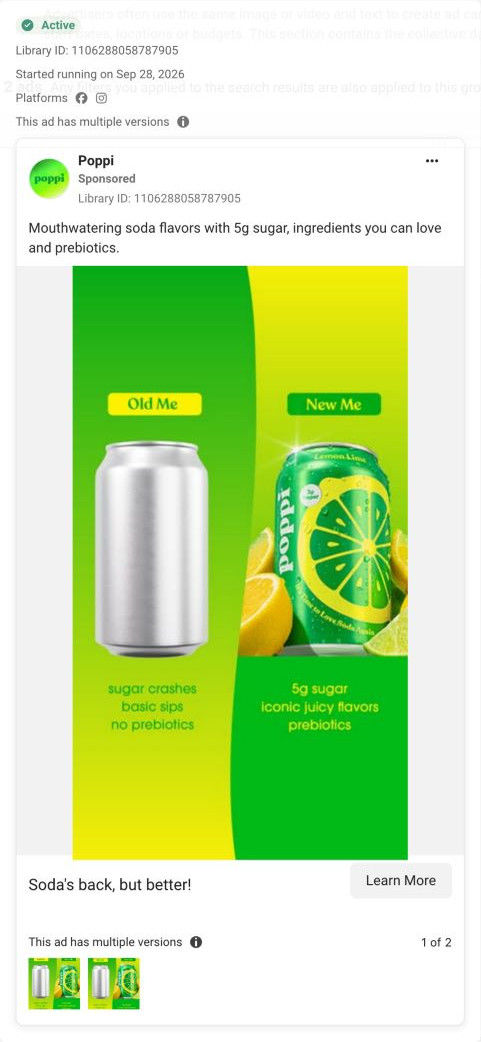
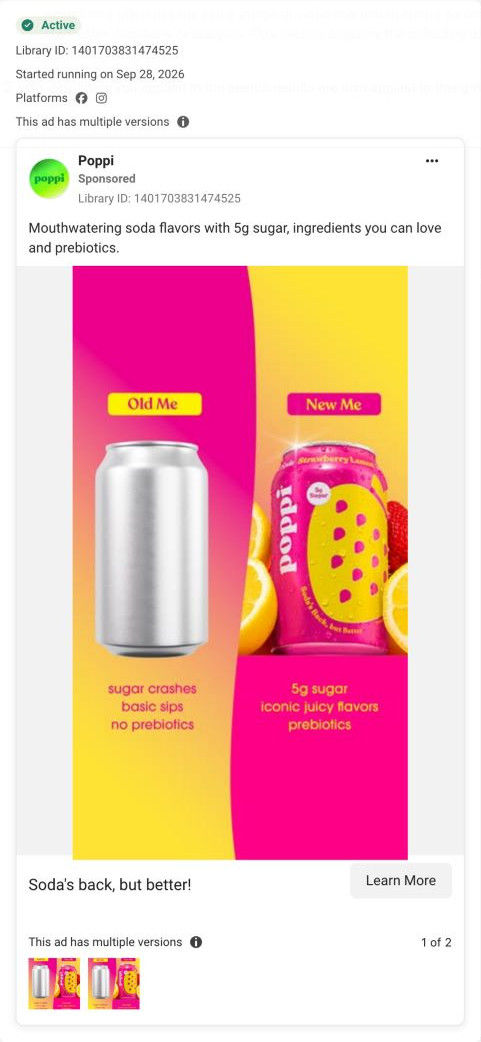


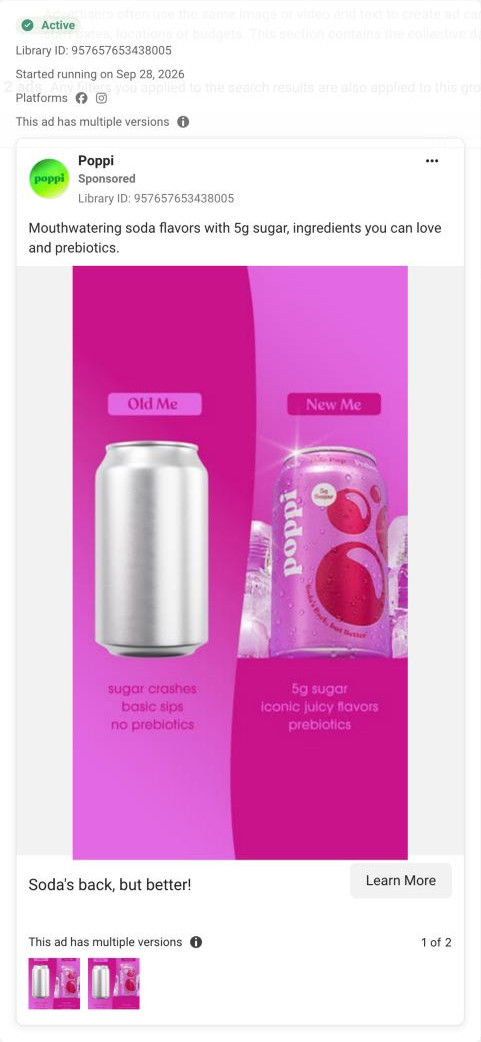


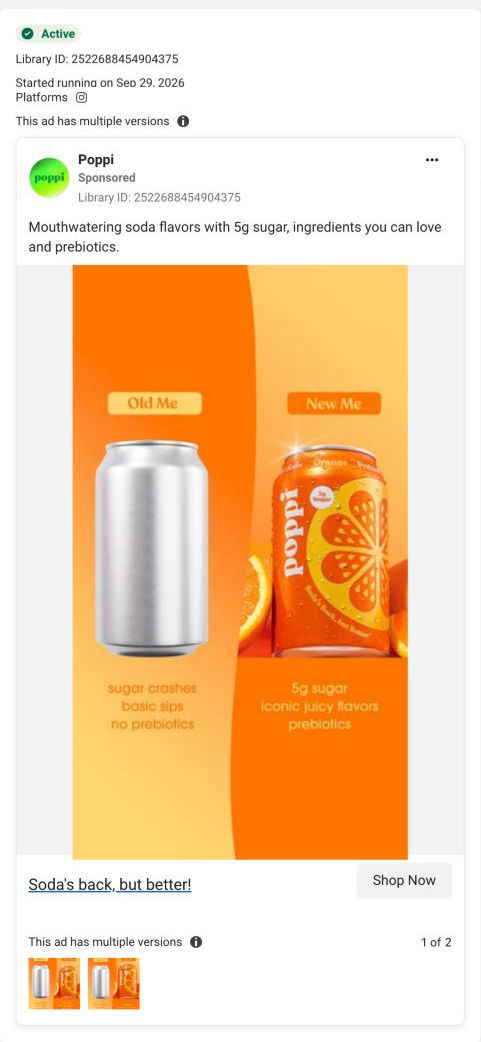
Poppi brand homepage
Native screenshot captured from the public Meta Ad Library. Destination captured while scrolling on October 20, 2026; current offers and default variants may differ from the original creative.
Poppi
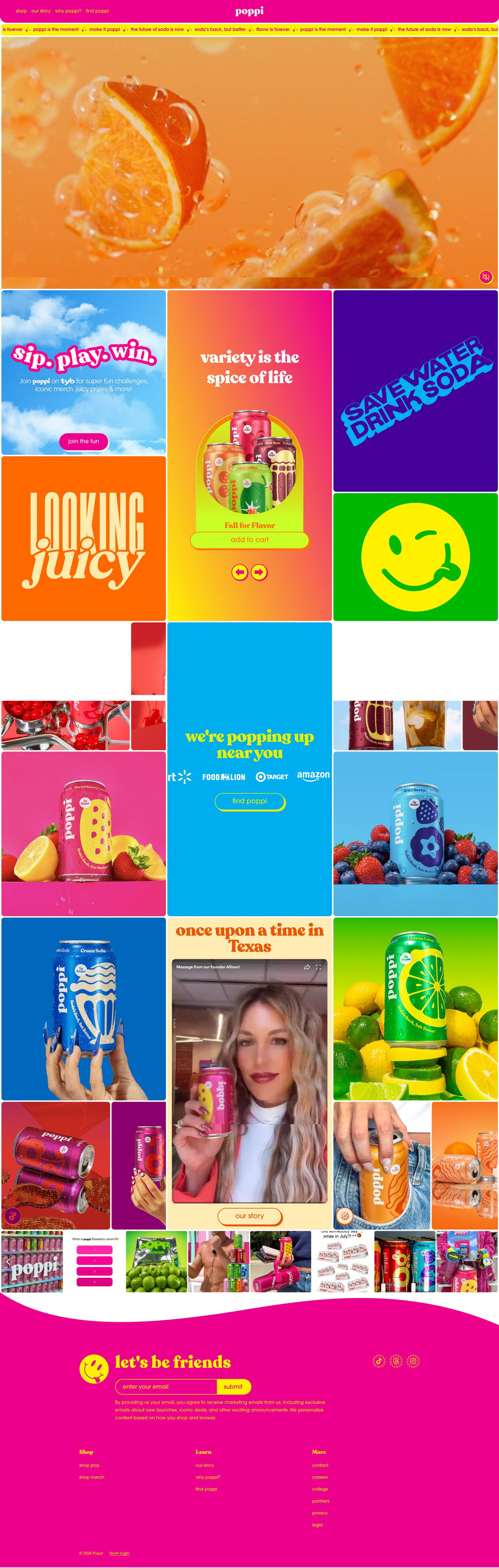
Rows of green Sour Apple Poppi cans and green apples fill a refrigerator. All 20 selected ads link to the same brand homepage. The observed destination leads with a colorful product video, then uses a tiled mix of flavor, shopping, community and retail content rather than a creative-specific sales page. Compare the creative with the destination and explore the other ads sharing this route.
- Brand
- Poppi
- Observed offer
- New Sour Apple flavor
- Creative angle
- Flavor launch
- Page type
- Homepage
- Ad format
- Video · 0:10
- Listed start date
- Aug 23, 2026
- Captured
- Oct 20, 2026
- Library ID
- 2162451094690765
- Destination
- drinkpoppi.com
Selected for its design and offer structure. Ad performance isn’t available in this collection.
What this ad does well
Poppi lets the product carry the whole scene here: shelf after shelf of the same bright green can, with a few green apples tucked between them, so the flavor reads before anyone sees a word. A stocked cooler also looks like a store shelf, which quietly tells you this is something you can go grab. The caption is short and in the brand's playful voice (“fridge looking extra crisp today”), and the color block is so strong it would stand out in a busy feed.
What's missing
The ad tells you Sour Apple exists but never tells you what it tastes like or where to buy it, so a viewer who's curious has nothing to act on. The caption also says “link in bio,” which reads like an organic post copied into an ad that actually has a Learn more button. If you make one like this, keep the fridge shot and add one on-screen line about the taste (tart, sweet, whatever is true) and one about where it's sold, then rewrite the caption to point at the button.
Beat by beat
- 0-3sThe camera opens inside a cooler with rows of green Sour Apple cans and whole green apples on every shelf.
A wall of one color stops the scroll and announces a new flavor without any text.
- 3-10sThe shot stays on the stocked shelves, where the Sour Apple name and Poppi logo on each can are the only words.
Repeating the can over and over makes the packaging do the branding work.
- CopyThe caption calls the fridge extra crisp and tells people to stock up on the newest flavor.
It frames the launch as a restock moment, which fits the cooler visual.
The offer
No discount or price. The only offer is the new Sour Apple flavor itself, framed as something to stock up on.
Where it sends people
The ad goes to the Poppi homepage, which sits at the weakest rung of the landing-page ladder because it isn't built around this ad's promise. The page opens with a wordless, muted video of fruit fizzing in liquid and no headline, so the Sour Apple launch isn't picked up on the first screen. A viewer has to scroll into the bento grid and find the variety-pack tile (the capture shows a Fall for Flavor pack with the green can in its photo) to see the flavor again. A Sour Apple product page, or a short launch page with the can, a taste line and an Add to Cart, would carry the fridge shot straight through.
The page it sends people to: How Poppi's bento-grid homepage handles traffic from every ad
Poppi's homepage is a colorful bento grid with a muted fruit video in place of a headline, then tiles for a variety pack, a loyalty program, a retail locator, a founder video and social posts. All 20 Poppi ads in the Fluid library link here, from Sour Apple launch videos and recipes to campus sweepstakes creators and Old Me / New Me statics.
How the page is built
- 01Header
A pink bar with shop, our story, why poppi? and find poppi links and a centered logo answers where to go next for each kind of visitor.
- 02Slogan ticker
A thin scrolling strip of taglines like soda's back, but better repeats the brand's lines so the page sounds like the ads.
- 03Hero video
A full-width muted macro video of fruit in fizzing liquid sets the mood but answers no buying question, since it has no headline or button.
- 04Bento grid: shop and loyalty
Tiles for the loyalty program, a variety-pack carousel with Add to Cart, and bold slogan and icon tiles answer what can I buy and why join.
- 05Retail locator
A popping up near you tile with retailer logos and a Find button, surrounded by flavor-can photos, answers where can I buy it in a store.
- 06Founder story
A tile with a storytelling headline, an embedded founder video and an Our Story button answers who's behind this brand.
- 07Social strip
A horizontal carousel of social posts and UGC thumbnails shows real people with the cans, which answers whether other people actually drink this.
- 08Newsletter and footer
A wavy band with a mascot, a let's be friends email sign-up, socials and link columns gives visitors who aren't buying today a way to stay in touch.
The first fixes we would make
- The hero has no headline, so a visitor arriving from a Sour Apple launch ad or a Kroger sweepstakes ad doesn't see their reason for clicking on the first screen. Either send the biggest ad groups to their own pages, or add a rotating tile right under the hero for the current launch (Sour Apple, with Add to Cart) and the current promotion.
- The campus creator ads ask viewers to submit a Kroger receipt for a Homefield gift card, and nothing on the page lets them do it. Add a sweepstakes tile to the grid with the receipt entry, the prize and the end date, placed next to the retail locator.
Read the full breakdown of this page
Three hooks you could test
- Make the product the whole scene. “Fill the frame with nothing but your new flavor, shelf after shelf, and let the color say it's here.”
- Show a specific moment of use. “Restocking the fridge before the weekend? Here's what's going on the top shelf.”
- Turn the benefit into a picture people get in a second. “Show a whole apple next to the can so the flavor lands before anyone reads a word.”
What to borrow for your brand
- Announce a new flavor by repeating the product until it becomes the background, so the packaging color does the talking.
- Put the real fruit next to the can in every shot, which tells viewers the flavor without a caption.
- Shoot the launch inside a store-style cooler so the ad also hints that the product is on shelves.
Transcript
There's no speech in this video. The on-screen text and music carry the message.
Text on screen
- addod
- poppi
- Iddod
- addori
- Idded
- rodori
- poppr
- SOUR APPL
- SOUR APPU
- Foda's Back, ben
One of 20 Poppi ads in the Fluid Inspiration Library, captured from the Meta Ad Library on Oct 20, 2026. We record that an ad ran publicly, not how it performed.