

BluelandSponsored
Esc
How Blueland sells a $10 paid trial of its bestseller tablets
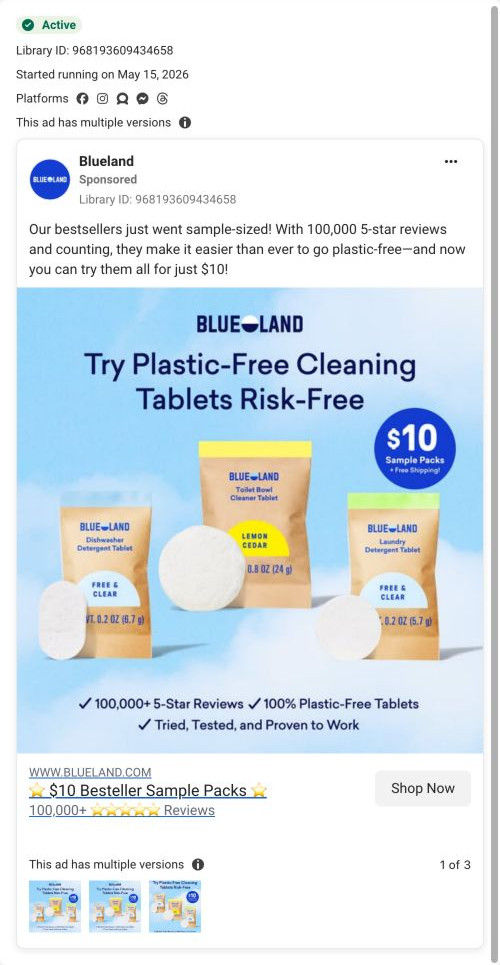
A Blueland static on Meta from May 15, 2026, headlined “Try Plastic-Free Cleaning Tablets Risk-Free.” Three sample pouches (dishwasher, toilet bowl and laundry tablets) sit on a sky background with a $10 sample-packs badge that adds free shipping. The copy leans on 100,000 five-star reviews, and the ad links to the Bestseller Sample Packs offer page.
Blueland
2 creatives lead here1 / 2
Bestseller Sample Packs
$10 Bestseller Sample Packs
The ad reduces the first purchase to a $10 sample-sized introduction to the brand’s bestsellers. The CTA opens the dedicated sample-pack offer page rather than the full catalog. Compare the creative with the destination and explore the other ads sharing this route.
- Brand
- Blueland
- Observed offer
- Advertised $10 bestseller sample pack
- Creative angle
- Paid trial
- Page type
- Dedicated offer
- Ad format
- Image
- Listed start date
- May 15, 2026
- Captured
- Oct 19, 2026
- Library ID
- 968193609434658
- Destination
- blueland.com
Selected for its design and offer structure. Ad performance isn’t available in this collection.
What this ad does well
The entry price is the loudest thing in the image: a blue $10 badge with free shipping tucked underneath it, so the cost of trying is clear in a glance. Blueland shows each tablet out of its pouch, which answers the first question a newcomer has (what does a tablet even look like?) before they ask it. The word “Risk-Free” in the headline lowers the stakes, and the checkmark row under the products stacks the review count with the plastic-free claim. It's a clean example of shrinking a whole product line into one small, easy first purchase.
What's missing
“Risk-Free” is doing heavy lifting without an explanation. The offer page shows a recurring charge after the trial, and this ad doesn't mention that the $10 starts a subscription, so the viewer meets that detail later. The ad also never says why someone would switch from what they already use, so it's mostly talking to people who are already curious. If you make a paid-trial ad, say plainly what happens after the trial (when it renews, how to cancel) and add one line about the problem the tablets replace, like jugs and pods.
Beat by beat
- ImageThree kraft pouches (dishwasher, toilet bowl cleaner and laundry) with a loose tablet in front of each, under a $10 Sample Packs + Free Shipping badge.
Seeing the tablets out of the pack tells a first-time buyer exactly what they're getting for ten dollars.
- Headline“Try Plastic-Free Cleaning Tablets Risk-Free” across the top.
It frames the purchase as a low-stakes test instead of a commitment.
- Proof rowCheckmarks for 100,000+ five-star reviews, 100% plastic-free tablets and a tried-and-tested line.
The review number is the trust signal that makes a small blind purchase feel safe.
- CopyThe copy says the bestsellers went sample-sized and you can try them all for $10.
It repeats the price and adds that this covers several products, not just one.
The offer
Three bestseller tablets as sample packs for $10 with free shipping, framed as a risk-free trial. The ad doesn't mention the recurring charge that the offer page shows.
Where it sends people
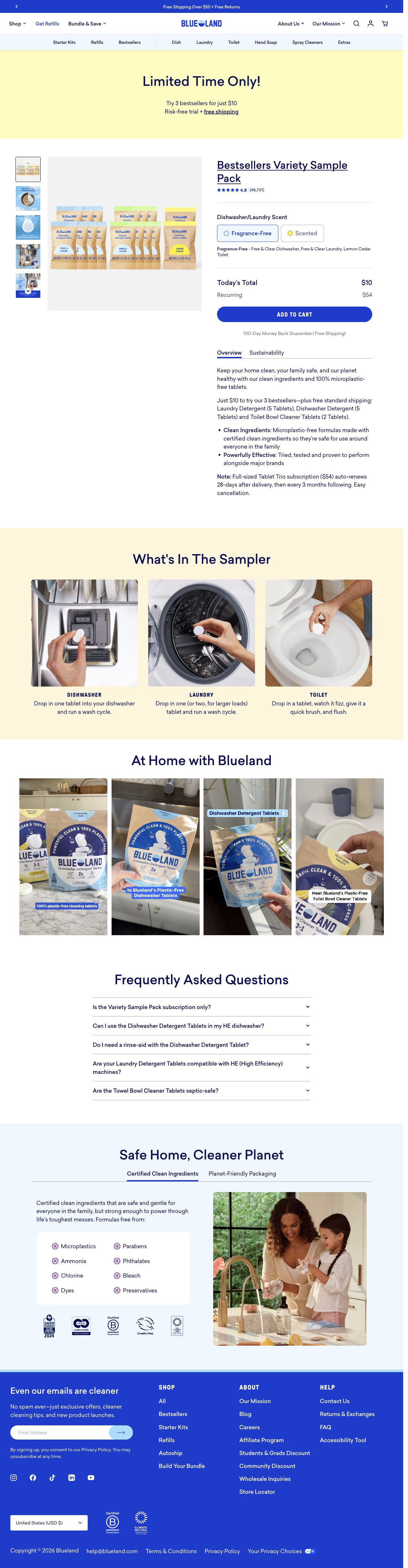
The ad links to Blueland's Bestseller Sample Packs page, a dedicated offer page built for this trial, which sits well above a homepage on the ladder. A pale yellow “Limited Time Only!” band restates the trial price, risk-free framing and free shipping right above the buy box, so the ad's promise is the first thing you read. The buy box then shows “Today's total” and “Recurring” as two price rows above Add to Cart, and the overview tab carries a note that the pack auto-renews with easy cancellation. A “What's in the sampler” row shows each tablet being used, and the FAQ opens with whether the pack is subscription-only, which is exactly the question this ad leaves open.
The page it sends people to: How Blueland built a paid-trial page for its $10 sample packs
Blueland's Bestseller Sample Packs page is a dedicated offer page for a paid trial. A “Limited Time Only!” banner restates the trial, the buy box shows today's total against the recurring charge, and sections cover what's in the sampler, customer photos, an FAQ and ingredient safety. Two ads in the Fluid library send people here, both pitching $10 sample packs.
How the page is built
- 01Announcement bar and header
A rotating shipping-and-returns line and full navigation answer whether this is a real, established store.
- 02Offer banner
A pale yellow “Limited Time Only!” band restates the trial price, risk-free trial and free shipping, answering is this the deal from the ad.
- 03Buy box
A pack shot, star rating, scent toggle, “Today's total” and “Recurring” rows and Add to Cart answer what do I pay today and after.
- 04Description tabs
Overview and Sustainability tabs, with a note disclosing the auto-renewing subscription, answer what am I signing up for.
- 05What's in the sampler
Three photo cards show each tablet in use with one instruction, answering how do I use these.
- 06At home
Four customer-style photos with captions answer what do these look like in a real home.
- 07FAQ
An accordion that starts with whether the pack is subscription-only, then compatibility, answers the trial's biggest doubt first.
- 08Safe home tabs
Ingredient and packaging tabs with a free-from card, certification logos and a parent-and-child photo answer is it safe around my family.
- 09Footer
A newsletter signup and links catch visitors not ready to start a trial.
The first fixes we would make
- There's no cleaning proof on the page beyond the star rating and the at-home photos. Add a before and after for at least one of the three tablets right under the buy box, so the trial is backed by a result.
- The page doesn't say what the recurring shipment contains or when it arrives in plain words near the button. Add one line under the “Recurring” row that names the refill and the timing.
Read the full breakdown of this page
Three hooks you could test
- Call out the habit you're replacing. “Done hauling jugs of cleaner home? Try three tablets for ten bucks.”
- Make the product the whole scene. “Three pouches, three tablets, one $10 box at your door.”
- Sell the outcome. “A cleaner kitchen, bathroom and laundry, tested for less than lunch.”
What to borrow for your brand
- Turn your bestsellers into a small paid sampler with one round price, so a new customer can try the range without choosing.
- Put the product out of its packaging in the shot, so a format people haven't used before is obvious at a glance.
- Set the trial price in a badge with the shipping terms underneath, so the full cost of trying is visible in one spot.
One of 9 Blueland ads in the Fluid Inspiration Library, captured from the Meta Ad Library on Oct 19, 2026. We record that an ad ran publicly, not how it performed.