
RoSponsored
Esc
How Ro uses Trisha Paytas to explain its free GLP-1 insurance check
A 20-second Ro video with Trisha Paytas speaking into her rhinestone TT microphone in front of pink fur and disco balls. The angle is not overpaying: cash-pay options plus a free insurance check where you submit your card and Ro handles the rest. It sends people to her Ro weight-loss quiz.
Ro
9 creatives lead here1 / 9
Ro · Trisha weight-loss quiz
Public page captured October 22, 2026. Promotional sheets and temporary interface overlays were dismissed or removed in the static reference. No personal or medical information was entered. Captured entry screens do not reproduce the complete consultation.
See if you qualify
Visual reference: Trisha · pink microphone testimonial. Pink testimonial, crystal-ball and product-table creatives lead to a Trisha-specific hero. The question-card structure matches the other weight-loss entrances; the captured next state follows the Learn about both option. Compare the creative with the destination and explore the other ads sharing this route.
- Brand
- Ro
- Observed offer
- Online GLP-1 assessment; medication and membership terms apply
- Creative angle
- Creator stories
- Page type
- Quiz entry
- Ad format
- Video · 0:20
- Listed start date
- Oct 8, 2026
- Captured
- Oct 22, 2026
- Library ID
- 976146568164181
- Destination
- ro.co
Selected for its design and offer structure. Ad performance isn’t available in this collection.
What this ad does well
The opening line, "Smart girls don't overpay," is a confident, slightly cheeky hook that sounds like Trisha talking to her own audience. The ad then explains a real mechanism: you submit your insurance card and Ro checks your coverage, and on-screen cards show what the coverage checker returns (a plan explanation per medication and supply alerts). That's the kind of specific, how-it-works detail most telehealth ads skip. The podcast-style set with her branded mic makes it feel like a segment from her own show rather than a produced spot.
What's missing
The ad tells you Ro checks your coverage, but it never shows a result, so the viewer has to imagine what they'd get back. Proof here would be a quick look at a filled-in checker screen, or Trisha saying what hers told her. The on-screen note that the checker covers certain GLP-1 pens only also flashes past quickly, which matters to anyone whose plan or medication isn't on that list. If you make one like this, show one real output of the tool and give the limitation a beat of its own so the click isn't a surprise.
Beat by beat
- 0-3sTrisha, holding her TT microphone, says smart girls don't overpay for their GLP-1s.
A playful jab at overpaying grabs attention and frames the ad around value.
- 3-9sShe says Ro offers cash-pay options and FDA-approved GLP-1s for many different types of people.
It widens the audience so viewers on any budget feel included.
- 9-16sShe explains the free insurance check while on-screen cards show the coverage checker's features.
Showing what the tool returns turns a claim into a process the viewer can picture.
- 16-20sShe says you just submit your insurance card and Ro handles the rest, then sends viewers to ro.co.
Making the step sound effortless lowers the bar for the click.
The offer
A free GLP-1 insurance coverage check and cash-pay options, with on-screen notes that the checker covers certain pens only and an additional Ro membership fee is required.
Where it sends people
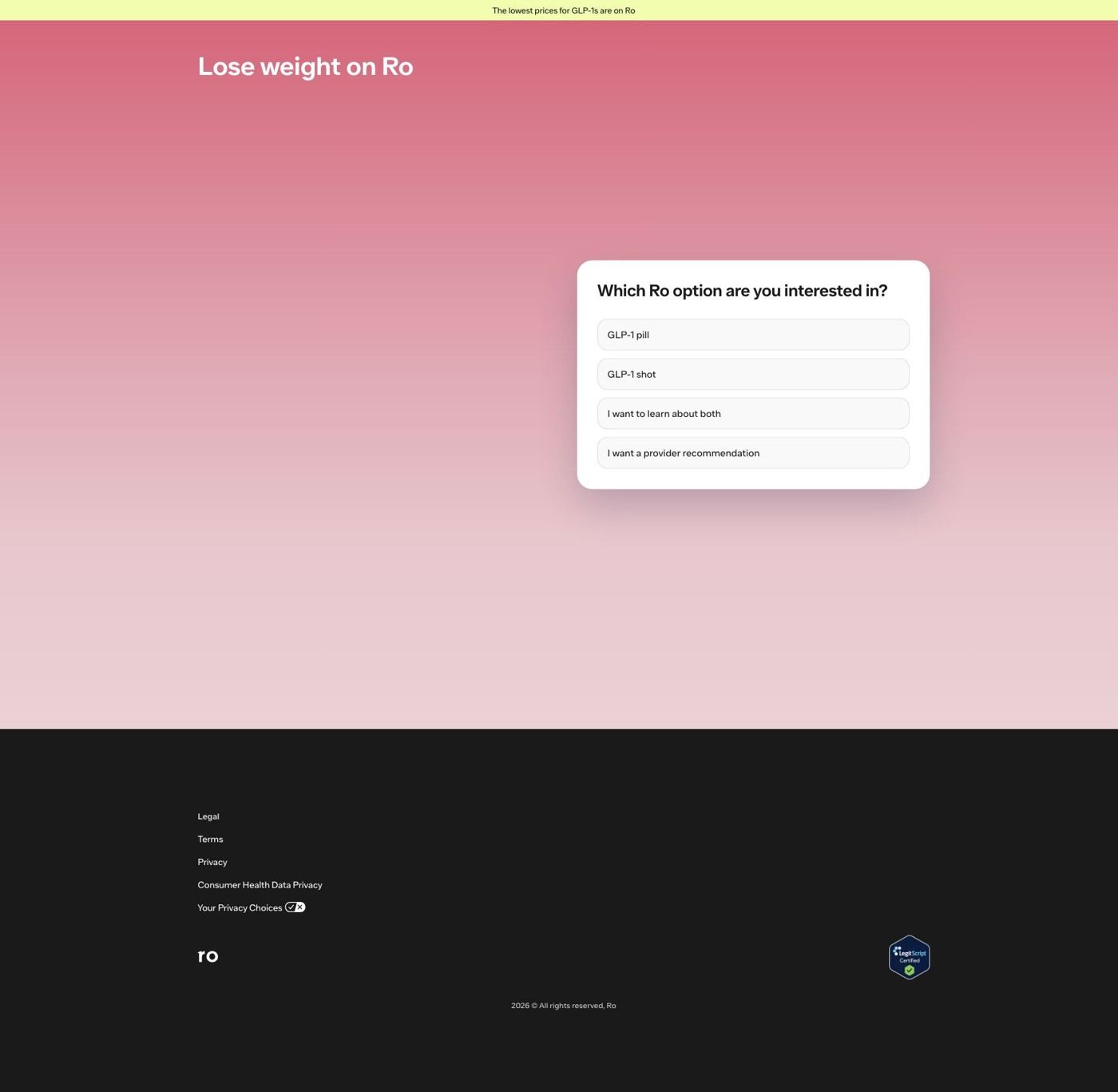
The ad sends people to Ro's Trisha weight-loss quiz, one of 9 ads in the Fluid library that land there. That's a quiz entry, usually the strongest place to send ad traffic: the page opens with the headline Lose weight on Ro and a single question card asking whether you're interested in a GLP-1 pill, a GLP-1 shot, both, or a provider recommendation. The pink gradient carries Trisha's palette across the click, and a yellow banner repeats the lowest-price line. The free insurance check, which is the whole point of this ad, isn't visible on that first screen. If you build a page like this, name the coverage check on the question card (or offer it as an option) so the viewer who clicked to check their insurance sees that path right away.
The page it sends people to: How Ro built a pink quiz page for its Trisha Paytas weight-loss ads
Ro's Trisha Paytas landing page is a quiz entry on a pink gradient, with Trisha holding a pen-style product beside the GLP-1 format question. It's the destination for 9 Ro video ads in the Fluid library, almost all creator-story videos (pink testimonial, crystal-ball and product-table creatives), each ending on See if you qualify.
How the page is built
- 01Announcement bar
The yellow strip claims the lowest prices for GLP-1s are on Ro, the page's only answer to 'what will this cost?'
- 02Headline
Lose weight on Ro, set in white on the pink gradient, confirms the category and brand right away.
- 03Treatment-format question
The card asks which Ro option you're interested in, so visitors arriving from the product-table ad can pick the format they saw.
- 04Trisha Paytas photo
Trisha holds a pen with sparkles around her and a Ro member label, answering 'is this the person from the video?' in the ads' own playful style.
- 05Weight-goal question
After Learn about both, the card asks how much weight you're looking to lose in ranges plus Not sure yet, continuing the quiz in place.
- 06Footer
Legal and privacy links and a LegitScript Certified badge give scrolling visitors a legitimacy check.
The first fixes we would make
- One of the ads here is a product-table creative, and the page drops the table entirely. Bring a compact version of that comparison into the format question (one line per option, in the ad's words), so the viewer who clicked to compare can do it right where they choose.
- The headline is the same Lose weight on Ro used on every weight-loss entrance, so the copy doesn't carry Trisha's voice the way the colors and photo do. Use a headline that echoes the line her testimonial videos open on, so the words match the look.
Read the full breakdown of this page
Three hooks you could test
- Call out the habit you're replacing. “Smart shoppers don't pay full price for [category]. Here's what they check first.”
- Turn the benefit into a picture people get in a second. “Snap a photo of your card. We tell you what's covered.”
- Lead with the uncomfortable problem. “Paying out of pocket for [product] when your plan might cover it?”
What to borrow for your brand
- Shoot the creator on their own recognizable set (their mic, their colors) so the ad reads like a clip from their show.
- Explain one tool step by step and show its screens as overlay cards while the creator talks.
- Open on a short line that flatters the viewer's judgment, then prove it with the mechanism.
Transcript
Smart girls don't overpay for JLP ones. They go on row for the hash pay options, row offers the most effective FDA approved GLP ones. There's so many options for so many different types of people. Rote offers, free insurance checks as well, so it can see if your covered for a GLP one shot. You just submit your insurance card and row handles the rest. So go to roe.co to see if you qualify.
Text on screen
- PROTECT
- PROT
- PROTE
- @partner and Ro member
- TECTED
- overpay for their GLP-1s.
- PRO
- PROTECE
- OTECT
- TED
- ROTO
- OTECTE
- Paid partnir and Fo member,
- the cash pay options.
- •TECTED
- pOT
- STED
- OTECTED
- ITECTED
- PRE
- Ro offers
- STUCTED
- Additional Ro membership fee required.
- ROT
- PECTED
- FDA-approved GLP-1s.
- Additional Ro membership fou required.
- PROTECTÉD
- LATED
- PROTECTED
- OTECTED,
- I ICTED
- for so many different
- OTEC
- -TED
- Ro offers FREE
- Ro checks insurance coverage for certain GLP-1 pens only:
- GLP-1 Insurance Coverage Checker™
- ether your
- a 350 credit for cem Ro accoures Me
One of 100 Ro ads in the Fluid Inspiration Library, captured from the Meta Ad Library on Oct 22, 2026. We record that an ad ran publicly, not how it performed.