How Everyday Dose opened a starter kit video on a kitchen counter
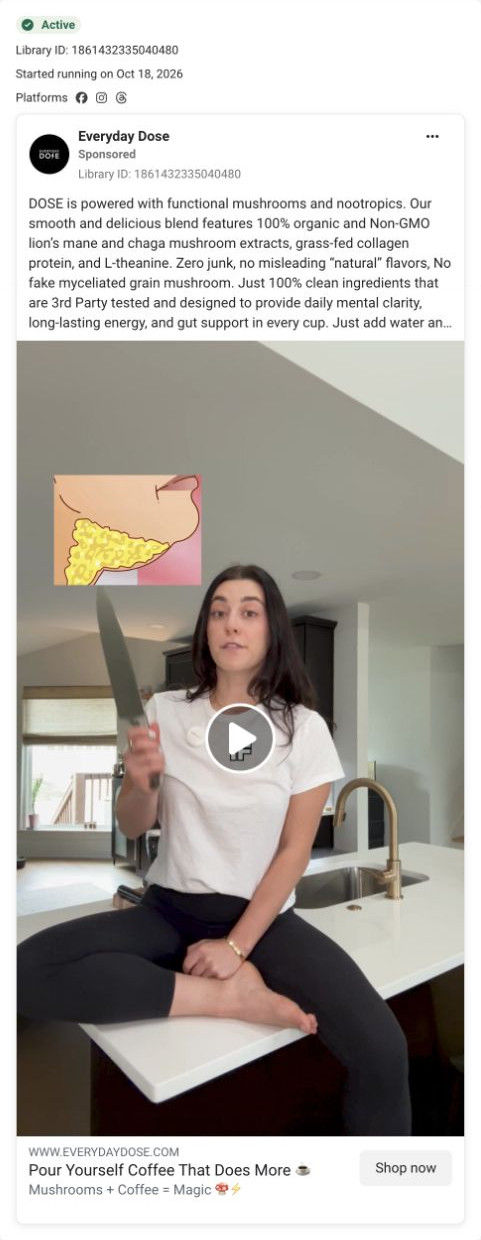
A creator video on Meta from Oct 18, 2026, captured as its opening frame and copy (no transcript). A woman sits barefoot on a kitchen counter holding a large knife beside an illustrated inset, under the brand's ingredient copy. It's framed around the starter kit and links to the mushroom coffee starter kit product page.


The core product, with the starter kit up front
A product-focused video leads to the main mushroom-coffee starter page, with a long sequence of product education, offer options, and customer proof. Compare the creative with the destination and explore the other ads sharing this route.
- Brand
- Everyday Dose
- Observed offer
- Mushroom coffee + free starter-kit framing
- Creative angle
- Starter kits
- Page type
- Product page
- Ad format
- Video
- Listed start date
- Oct 18, 2026
- Captured
- Oct 19, 2026
- Library ID
- 1861432335040480
- Destination
- everydaydose.com
Selected for its design and offer structure. Ad performance isn’t available in this collection.
What this ad does well
The opening frame is built to stop a scroll: a woman perched on a kitchen counter holding a chef's knife is an odd enough image that people want to know where it's going, and the illustrated inset in the corner signals that something is about to be explained. It's shot in a real kitchen in casual clothes, so it reads like a creator post instead of a brand ad. The copy underneath does the explaining, naming lion's mane and chaga extracts, collagen and L-theanine, the exclusions and the claimed benefits, which gives anyone who pauses a reason to read on.
What's missing
We only have the opening frame and the copy, and neither names a problem the viewer would recognize; the copy is the same ingredient paragraph the brand uses across its ads, so it doesn't add anything specific to this video. There's also no offer in the copy, even though the page it lands on leads with a free starter kit. If you make one like this, put the problem in a caption on the first frame (so the knife has a reason to be there) and add the starter kit and its free gifts to the copy, since that's what the page is selling.
Beat by beat
- Opening frameA woman sits barefoot on a kitchen counter holding a large knife, with an illustrated inset in the upper left corner.
An unexpected image in a real kitchen stops the scroll and feels like a creator post.
- CopyThe ingredient paragraph names lion's mane and chaga extracts, grass-fed collagen and L-theanine, then claims mental clarity, energy and gut support.
It gives a viewer who pauses the detail behind the product.
- HeadlinePour Yourself Coffee That Does More, with Mushrooms + Coffee = Magic and a Shop now button.
It states the category promise next to the tap target.
Where it sends people
The ad sends people to the mushroom coffee starter kit product page, a product page rather than a focused landing page, but one built around the offer. The first image carries a free-gifts value headline, the size cards pre-select the larger tier and list its gifts with a per-cup cost, and a What's inside row shows six gift cards with Free and struck-through values. Benefits, problem-filtered reviews, ingredient cards, a comparison with regular coffee and clinician reviews follow. Since the video copy never mentions the kit, the page is doing all the offer work; a viewer arriving from the knife frame meets a gift bundle they didn't know about.
The page it sends people to: How Everyday Dose makes a free starter kit its product page headline
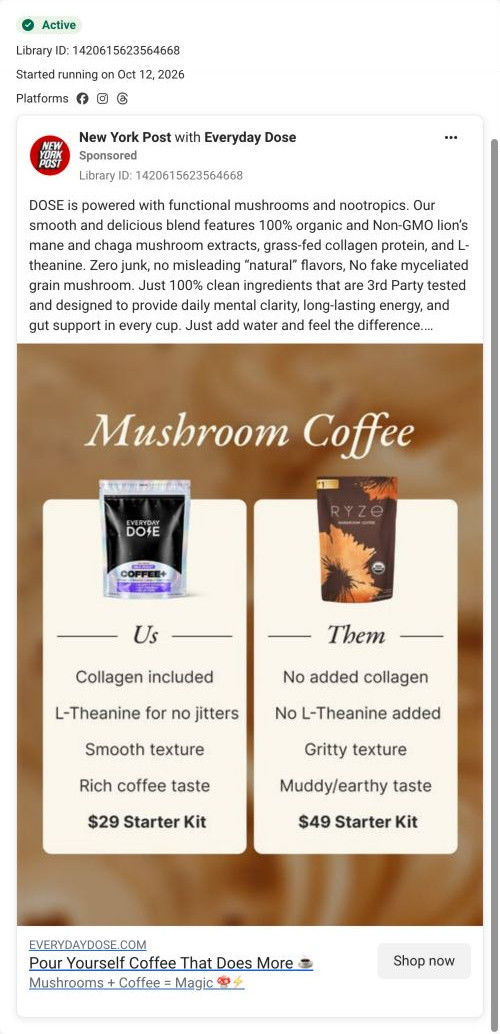
Everyday Dose's mushroom coffee starter kit page is a bundle-first product page: two buy boxes, a gift itemization, benefits, problem-filtered reviews, ingredients, a comparison with regular coffee, an FAQ and clinician reviews. It's where 2 Everyday Dose ads in the library land, a competitor comparison static and a creator video framed around the starter kit.
How the page is built
- 01Buy box
A carousel led by a kit shot with a free-gifts headline sits beside the bundle name, star rating and offer paragraph, answering what you get.
- 02Selector card
Strength and size radio cards, with the larger size pre-selected, a best-deal tag, struck-through price, gift list and per-cup cost, answering which option to pick.
- 03Commit area
A Get my starter kit button, a money-back line, three perks (refill reminder, cancel anytime, renewal price), a customer quote and four accordions answer what happens after you buy.
- 04Press marquee and second buy box
Scrolling publication logos, then a simpler buy box with a Free gifts pill and the price on the button, catch visitors who scrolled past the first one.
- 05Kit itemization
A What's inside row of six gift cards with struck-through values answers whether the free kit is worth anything.
- 06Benefits
A pour photo beside a two-by-two grid of benefit areas with ingredient notes answers what the coffee claims to do.
- 07Expectation band
A four-milestone checklist and a subscriber-survey line chart answer how long before you notice something.
- 08Problem-filtered reviews
Filter by problem chips for five concerns and tagged review cards answer whether people like me liked it.
- 09Ingredients and results
Five ingredient cards, a supplement facts link and a band of four survey figures with a methodology note answer what's inside and what the survey found.
- 10Preparation and comparison
A short how-to-prepare block and a nine-row table against regular coffee answer how to make it and why switch.
- 11FAQ and risk-free band
Eight questions on taste, caffeine, safety and cancelling, then a risk-free trial panel with a button, answer the last doubts.
- 12Clinician and customer reviews
Clinician cards with disclosure points, then a full reviews widget with an AI summary, filters and media, answer whether experts and customers back it up.
The first fixes we would make
- The comparison table only pits the product against regular coffee, while one of the ads that lands here compares it with a named mushroom coffee brand. Add a column (or a second table) for other mushroom coffees, so visitors from that ad see the argument they tapped on.
- Two full buy boxes sit back to back before the kit is explained, which pushes the gift itemization a long way down. Move the What's inside row up so it sits right under the first buy box, where people are deciding.
Read the full breakdown of this page
Three hooks you could test
- Lead with the uncomfortable problem. “If your 2pm crash has you eyeing the snack drawer, watch this.”
- Call out the habit you're replacing. “I cut out my second coffee and the afternoon snack in one swap.”
- Make the product the whole scene. “Everything in the starter kit, unboxed on my kitchen counter.”
What to borrow for your brand
- Open on an unexpected prop in an ordinary room so the first frame earns a pause before anything is said.
- Add a small illustrated inset to a talking-head shot to signal that the video explains something.
- Match the ad copy to the page's offer, so a starter kit page gets copy that names the kit and its gifts.
One of 4 Everyday Dose ads in the Fluid Inspiration Library, captured from the Meta Ad Library on Oct 19, 2026. We record that an ad ran publicly, not how it performed.