How Midi Health's HRT static pairs a named clinician with a review
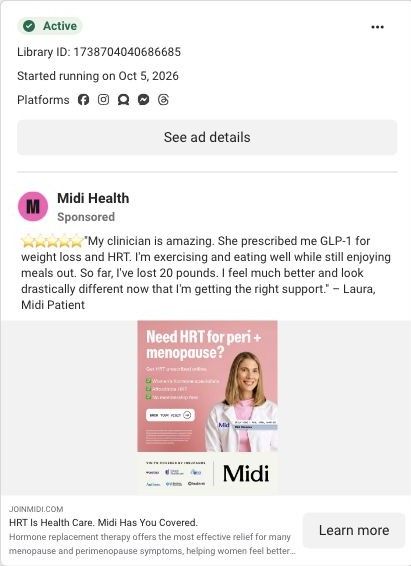
A static image Midi Health ran on Meta from Oct 5, 2026. Need HRT for peri + menopause? sits over three checkmarks (women's hormone specialists, affordable HRT, no membership fees) and a Book your visit button beside a named Midi clinician. The copy is a five-star patient quote, and it links to the HRT care page.

Native Meta creative and exact outbound link observed October 22, 2026. Redirects were followed to the captured public destination. Broader women’s HRT and longevity care; this record is not classified as peptide-specific. Advertiser claims are source material; activity does not establish performance. No personal, health or payment details were entered.

HRT Is Health Care. Midi Has You Covered.
An audience-focused care page connects a clear opening with treatment context, the clinician-led process, supporting information and a visit entry. Compare the creative with the destination and explore the other ads sharing this route.
- Brand
- Midi Health
- Observed offer
- HRT Is Health Care. Midi Has You Covered.
- Creative angle
- Social proof
- Page type
- Service landing
- Ad format
- Image
- Listed start date
- Oct 5, 2026
- Captured
- Oct 22, 2026
- Library ID
- 1738704040686685
- Destination
- joinmidi.com
Selected for its design and offer structure. Ad performance isn’t available in this collection.
What this ad does well
The headline is a question the right person answers yes to in a second, and Get HRT prescribed online tells her exactly what the service does. The three checkmarks cover expertise, cost and the membership-fee objection, and naming the clinician on the badge (Emily Hong with her credentials) puts a real person on the ad instead of a stock model. The insurer logo strip at the bottom answers whether visits are covered. Using a patient review as the whole copy block is a smart choice for a service, since it reads like proof rather than a pitch.
What's missing
The patient quote is about a GLP-1 and weight loss as much as HRT, so it pulls attention to a result (20 pounds) the HRT page doesn't talk about, and that review doesn't appear on the HRT page. The checkmarks also say affordable without a number. If you make one like this, pick a review about the treatment the ad is selling, and swap affordable for the actual cost cue the page shows (covered by insurance, or the self-pay visit price).
Beat by beat
- ImageNeed HRT for peri + menopause? and Get HRT prescribed online over a pink background.
A yes-or-no question qualifies the viewer instantly.
- ImageThree checkmarks (women's hormone specialists, affordable HRT, no membership fees), a Book your visit button and a clinician badge reading Emily Hong, Midi Clinician.
It answers expertise and cost objections and puts a real clinician on the ad.
- ImageVisits covered by insurance with Aetna, UnitedHealthcare, Cigna, Anthem, Blue Cross Blue Shield and Health Net logos.
Recognizable logos answer whether the visit is paid for.
- CopyA five-star quote from Laura, a Midi patient, praising her clinician and describing GLP-1 and HRT prescriptions and weight lost.
A patient review in the copy reads as proof rather than a sales pitch.
The offer
No discount. The creative claims affordable HRT, no membership fees and visits covered by insurance.
Where it sends people
The ad lands on Midi's HRT care page, a focused service landing page with a matching hero (Insurance-Covered Hormone Replacement Therapy) and a patch photo. Right after the social proof band, a Check Your Coverage section with a state search and insurer logos picks up the ad's insurance strip, and the page explains how HRT works, shows patient stories, lists five reasons Midi is different and breaks the treatment into safety, form and dosage. The patient stories here are different from the ad's quote, so Laura's weight-loss story doesn't carry over.
The page it sends people to: How Midi Health's HRT page puts the coverage search first
Midi's HRT page is a focused service landing page: an insurance-covered HRT hero with a patch photo, a state coverage search, a symptom carousel, patient stories, five reasons Midi is different, safety and dosage details, pricing, four steps and FAQs. It's where 1 Midi ad in the library lands, a static asking Need HRT for peri + menopause?
How the page is built
- 01Hero
Insurance-Covered Hormone Replacement Therapy with a patch photo and a line about an in-depth virtual visit answers what this is.
- 02Social proof band
Patient faces and more than 500,000 women answer whether others trust Midi.
- 03Coverage search
Accepted by Insurance, Nationwide with a state search, insurer logos and Medicaid and Medicare terms answer whether my plan works.
- 04Symptom carousel
How Hormone Replacement Therapy Works with cards for four symptom areas answers whether HRT relates to what I feel.
- 05Patient stories
Quotes from Stephanie P., Katy M. and Katherine G. answer whether it went well for others.
- 06Five reasons
Designed to Be Better In Every Way lists midlife-trained clinicians, HRT expertise, protocols, 24/7 access and flexible follow-ups.
- 07Safety, form and dosage
An accordion under Personalized Treatment, Prescribed By An Expert answers whether it's safe and how it's tailored.
- 08Costs and steps
An insurance and self-pay toggle, then four steps from booking to integrating Midi into your routine, answer cost and process.
- 09FAQ
Seven questions on benefits, coverage, safety, timing, duration, dose and hysterectomy answer the last doubts.
The first fixes we would make
- The ad's copy is a patient quote from Laura, but her story isn't among the page's patient stories. Add that quote (or the HRT part of it) to the stories section so the ad's proof carries over.
- The ad shows Emily Hong, a named Midi clinician; the page shows no clinicians at all. Add a short clinician section with names and credentials beside the five reasons.
Read the full breakdown of this page
Three hooks you could test
- Sell the outcome. “Get HRT prescribed by a women's hormone specialist, online, this week.”
- Call out the habit you're replacing. “No membership fee. Just a visit with a specialist your insurance covers.”
- Lead with the uncomfortable problem. “Hot flashes at work and your doctor says wait it out?”
What to borrow for your brand
- Open with a yes-or-no question that qualifies the viewer, then one line saying exactly what the service does.
- Put a named clinician with credentials on the creative instead of an anonymous model.
- Use a real customer review as the entire copy block, chosen to match the product the ad is selling.
One of 15 Midi Health ads in the Fluid Inspiration Library, captured from the Meta Ad Library on Oct 22, 2026. We record that an ad ran publicly, not how it performed.