

Zarina Yeva with MedicubeSponsored
Esc
How Medicube framed a retinal serum ad as a how-to lesson
A creator testimonial from Zarina Yeva with Medicube, running on Meta from Oct 5, 2026. She opens by listing fine lines, large pores and volume loss, says how you use a retinoid matters, then shows where she applies the Vita A Retinal Volume Booster. There's no price. It links to the retinal serum product page.
Medicube
1 creative lead here1 / 1
Vita A Retinal Volume Booster Serum
Page captured October 20, 2026. The current offer may differ from the original ad.
Zarina Yeva
A creator smiles and touches her cheek in a wood-paneled interior, opening a retinal-serum testimonial. The creator testimonial links to the actual retinal-serum page. Its purple-and-yellow product presentation leads into an ingredient overview, use guidance, FAQ controls and reviews. Compare the creative with the destination and explore the other ads sharing this route.
- Brand
- Medicube
- Observed offer
- Vita A Retinal Volume Booster; no price stated
- Creative angle
- Creator testimonial
- Page type
- Product page
- Ad format
- Video · 1:24
- Listed start date
- Oct 5, 2026
- Captured
- Oct 20, 2026
- Library ID
- 1736238610822759
- Destination
- medicube.us
Selected for its design and offer structure. Ad performance isn’t available in this collection.
What this ad does well
Zarina opens on a list of concerns a viewer recognizes (fine lines, large pores, volume loss) and turns the ad into a lesson with the line "How you use it makes all the difference." That framing gives people a reason to keep watching even if they already use a retinoid. She brings specifics, saying the serum contains 0.15% retinal and 5% Volufiline (her claims, not verified here), and she shows exactly where she applies it, under the eyes and along the smile lines. The copy repeats her personal result in plain words, which keeps the testimonial tied to one person's experience.
What's missing
The ad promises a how-to and the page doesn't finish the lesson: the capture shows the How to use accordion empty and the reviews section at zero with a be-the-first prompt. So someone who clicked to learn the right way to use it, or to see if others liked it, finds neither. The ad also has no offer or price cue to give a reason to buy now. If you make an educational testimonial like this, make sure the page carries the same steps (a short clip of the creator near the buy box is the easiest way) and some form of proof before you send traffic.
Beat by beat
- 0-8sThe creator lists fine lines, large pores and volume loss as the reasons people add retinoids.
It opens on concerns the viewer already has, so they know right away whether this is for them.
- 8-20sShe says using a retinoid is about how you use it, not only applying it, and offers to show how.
It reframes the ad as a lesson, which gives even current retinoid users a reason to keep watching.
- 20-60sShe names the serum, says it contains 0.15% retinal and 5% Volufiline, and applies it under her eyes and on her smile lines.
The specifics and the exact application zones make her claims concrete and easy to picture.
- 60-84sShe points out how smooth her skin looks and calls the serum the next step for an anti-aging routine.
It closes on her result and positions the product as an upgrade to what the viewer already does.
Where it sends people
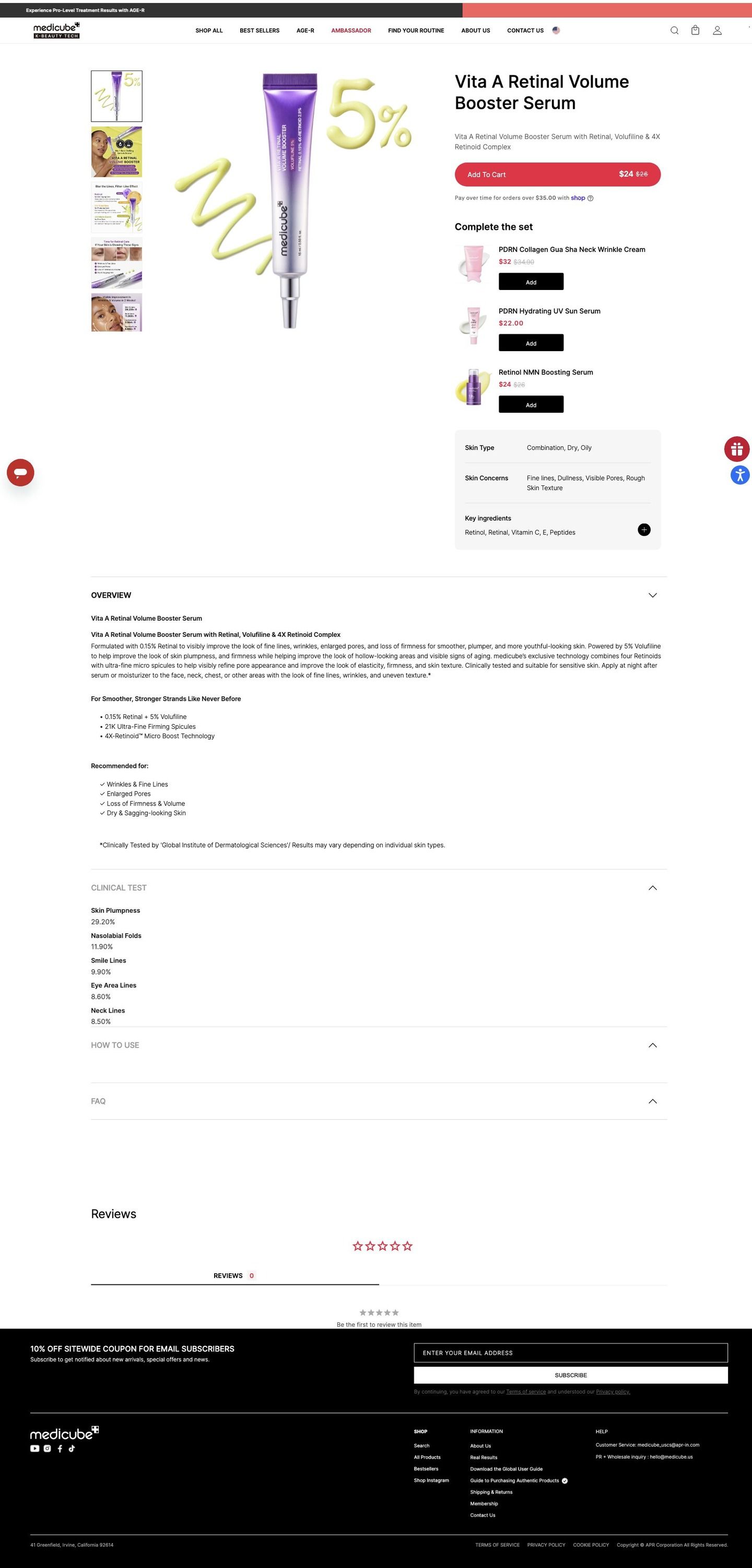
The ad lands on the Vita A Retinal Volume Booster product page, the only ad in the Fluid library sent there, which the persona would call a basic product page. The buy box is tidy: the price and struck-through price sit inside the Add to cart bar, a complete-the-set list sits right under it, and a spec card covers skin type, concerns and key ingredients. The open overview and clinical test accordions add ingredient detail and measured result labels. What's missing is the bridge from the ad: no creator content, an empty How to use accordion in the capture and no reviews yet, so the how-to promise and the testimonial both stop at the click.
The page it sends people to: How Medicube's retinal serum page sells with a single-button buy box
Medicube's Vita A Retinal Volume Booster Serum page is a short, plain skincare product page: a buy box with the price inside Add to cart, a Complete the set cross-sell, a spec card, open overview and clinical-test accordions, and an empty reviews block. One Medicube ad in the Fluid library links here, a creator testimonial.
How the page is built
- 01Announcement bar and nav
A two-color bar promoting a device line and the store nav with an ambassador link and a routine finder place the serum inside the wider brand.
- 02Buy box
Infographic, model and comparison thumbnails beside a pack shot, plus the name, subtitle and an Add to cart carrying the sale price, answer what it is and what it costs.
- 03Complete the set
Cross-sell rows with thumbnails, prices and Add buttons answer what pairs with the serum.
- 04Spec card
Skin type, concerns and key ingredients answer whether it suits your skin.
- 05Overview
A product description, ingredient bullets, a Recommended for checklist and a testing footnote explain what the brand says the serum does and who it's for.
- 06Clinical test and more
Result labels with figures the brand reports, followed by How to use and FAQ accordions that look empty in the capture.
- 07Reviews
An empty star row and a Be the first prompt show there are no reviews yet.
- 08Footer
A subscriber-coupon signup and link columns, including an authenticity guide, close the page.
The first fixes we would make
- Reviews are empty and there's no rating near the title, so the page has no customer proof at all. Until reviews come in, put the creator's testimonial video near the buy box and pull in any reviews from other channels where the serum sells.
- How to use and FAQ look empty, and a retinal serum is a product people have questions about before they start. Fill them with the brand's own usage directions and the questions shoppers ask most, and move a short version up near the spec card.
Read the full breakdown of this page
Three hooks you could test
- Lead with the uncomfortable problem. “Fine lines, big pores and that hollow look under your eyes? Start here.”
- Show a specific moment of use. “Here's exactly where I put it, and where I don't.”
- Call out the habit you're replacing. “If you just slap it on everywhere, you're using it wrong.”
What to borrow for your brand
- Frame a testimonial as a short lesson on using the category correctly, so viewers who already own a competitor still have a reason to watch.
- Have the creator point to the exact areas they apply the product, which turns a general claim into steps people can copy.
- Repeat the creator's how-to steps on the landing page before you send traffic, so the lesson continues after the click.
Transcript
My wrinkles are peeling. Fine lines and large pores and volume loss. These are exactly why so many people are adding retinoids to their skincare routine. But using retinoid isn't just about applying it. How you use it makes all the difference. Let me show you how to get the most out of it. Now, this made a cute retinal volume boost to cream has been a game changer for stretch marks. It contains 0.15 retinal, delivered through microspicles that add 22 times small than pores, to support skin renewal and help improve the look of uneven texture over time. It also contains 5% fall off line. So I burned up to my face for that extra plumbing care. I focus it on areas that tend to look a little less full, like my whole under eyes and smile lines to help them appear plumper, smoother, and fuller looking. In case you didn't know, wildfly in targets areas prone to fat loss and promotes the restoration of plumpness. It's also what goes into your clinical feelers. So, you know, it's a gym. Look at how smooth and plump my skin looks. If you look into level up your anti-aging routine, litter A retinal volume booster is the perfect next step.
Text on screen
One of 28 Medicube ads in the Fluid Inspiration Library, captured from the Meta Ad Library on Oct 20, 2026. We record that an ad ran publicly, not how it performed.