

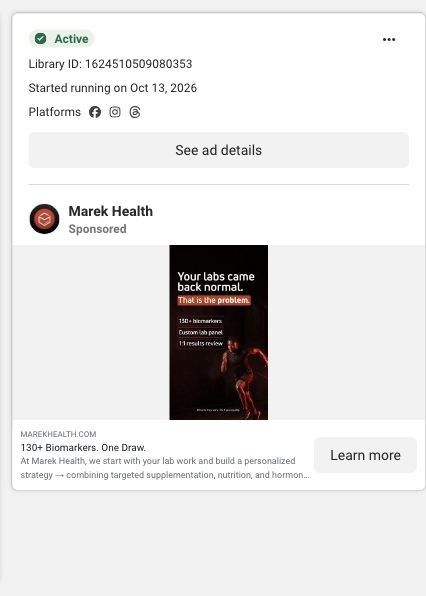
Marek HealthSponsored
Esc
How Marek Health uses a lab-method explainer as an ad
A 107-second talking-head video where a man explains why he says LC-MS/MS testing gives more accurate testosterone and estradiol readings than immunoassays, especially for people on synthetic hormones. On-screen captions and a "High sensitivity testosterone blood tests" title card back him up. The copy talks about an ongoing clinical team, and the click lands on the homepage.
Marek Health
4 creatives lead here1 / 4


Guided optimization · paid assessment entry
Native Meta creative and exact outbound link observed October 22, 2026. Redirects were followed to the captured public destination. These ads promote diagnostic testing, consultation or hormone care; they are broader-care examples. Advertiser claims are source material; activity does not establish performance. No personal, health or payment details were entered.

Clinical team · ongoing-care explanation
A care-program homepage presents a paid assessment, bloodwork-led positioning, treatment categories, program inclusions and client stories. Compare the creative with the destination and explore the other ads sharing this route.
- Brand
- Marek Health
- Observed offer
- Guided optimization · paid assessment entry
- Creative angle
- Expert explanation
- Page type
- Homepage
- Ad format
- Video · 1:47
- Listed start date
- Oct 13, 2026
- Captured
- Oct 22, 2026
- Library ID
- 3727161187431176
- Destination
- marekhealth.com
Selected for its design and offer structure. Ad performance isn’t available in this collection.
What this ad does well
This is education for a very specific, very informed viewer, and it doesn't water itself down. The speaker names the methods (liquid chromatography with tandem mass spectrometry versus immunoassay), credits immunoassays for efficiency, turnaround and price, and then explains where he says they fall short. That fairness makes the argument more credible than a one-sided pitch. He also describes testing his own blood both ways while on nandrolone, which is a personal, specific story that someone in that community will recognize and remember.
What's missing
The video never says Marek uses the more sensitive method, what a test costs or where to order one, so the viewer finishes the lesson with no clear next step. The post copy points elsewhere too, because it's about a clinical team and evolving plans and never mentions lab methods. And the click goes to the homepage, not to a testosterone panel that lists how it's tested. If you make one like this, end with one line tying the lesson to your product ("our panel uses this method") and send the click to the page where that's stated, like Marek's Pre-TRT Panel page, which names LC/MS on it.
Beat by beat
- 0-15sHe says accurate total testosterone needs LC-MS/MS and estradiol needs sensitive LC-MS testing, or results will be inaccurate.
It opens on a strong claim that tells an informed viewer this isn't a generic wellness ad.
- 15-30sA graphic lists the benefits of immunoassay testing (efficiency, turnaround, price), and he says it can be sufficient in many cases.
Giving the other method credit makes the argument sound fair.
- 30-70sHe explains why people assessing hormone use, hypogonadal status or estrogen production may want sensitive testing, and says synthetic steroids can cause cross-detection.
It narrows the audience to people for whom the difference matters.
- 70-107sHe describes testing his own blood both ways while on nandrolone, and says immunoassays can inflate readings, as a "High sensitivity testosterone blood tests" card appears.
A first-person test makes the claim concrete and memorable.
Where it sends people
The ad lands on the Marek Health homepage, one of four Marek ads in the Fluid library that go there. That's the weakest rung of the landing-page ladder for an ad this specific. The homepage leads with "Precision health, built on your bloodwork" and a $299 starting price, then featured therapies, but the captured hero says nothing about testing methods. A viewer who just learned why LC-MS/MS matters has to go find a panel that uses it. The Pre-TRT Panel page on Marek Diagnostics already names LC/MS and equilibrium dialysis, so it would pick up this video's argument directly.
The page it sends people to: How Marek Health's homepage sells bloodwork-first care
The Marek Health homepage opens on "Precision health, built on your bloodwork," a Get started button, a Trustpilot rating and a stats row ending in $299 To Get Started, then moves into featured therapies. Four Marek ads in the Fluid library land here: two creator videos, a lab-method expert explainer and a normal-labs static.
How the page is built
- 01Care-program hero
"Precision health, built on your bloodwork," a subhead naming lab panels, a coach and a provider, a Get started button, a Trustpilot rating and a stats row answer 'what is this, is it legit and what does it cost to start?'
- 02Treatment categories
Featured therapies cards for an advanced weight loss program and testosterone hormone therapy, with a Browse all link, answer 'what can you actually treat?'
- 03Testing and assessment process
The blueprint lists the testing and assessment process next, the section that explains how bloodwork leads to a plan.
- 04Program inclusions and entry offer
The blueprint then covers program inclusions and the entry offer, which answers 'what does the $299 get me?'
- 05Client stories and supporting information
Client stories and supporting information follow in the blueprint, answering 'has this worked for people like me?' in customers' words.
- 06FAQs and final CTA
The page closes with FAQs and a final call to action, catching remaining objections before a last chance to start.
The first fixes we would make
- The $299 figure appears in the hero without saying what it includes, and one of the ads landing here shows that the assessment also requires a minimum lab panel purchase. Put a single line under the stats row that says what $299 covers and what labs cost on top, so visitors aren't surprised later.
- Four quite different ads (a GLP-1 creator, a root-cause explainer, a lab-method lesson and a normal-labs static) all land on the same hero. Build focused landing pages for the biggest angles, starting with a GLP-1 page that opens on "start with the data first," so each ad's promise is the first thing its viewer sees.
Read the full breakdown of this page
Three hooks you could test
- Lead with the uncomfortable problem. “Your test said you're in range. Was it measured the right way?”
- Call out the habit you're replacing. “If you're still ordering the cheapest version of this test, here's what it can miss.”
- Sell the outcome. “Get a number you can actually make decisions with.”
What to borrow for your brand
- Let an expert explain a technical difference in your category and give the cheaper option fair credit, so the case for yours sounds honest.
- Include a first-person test or comparison, because a specific personal experiment is easier to remember than a claim.
- End technical education with one line connecting the lesson to your product and send the click to the page that proves it.
Transcript
If you are trying to get the most accurate rating of a total testosterone level, you need to be using liquid chromatography with tandem mass spectrometry, and for estradial, you also want to be using sensitive assay testing through LCMS as well, if you use immuno assay testing, you will have inaccurate test results. Now, for efficiency, turnaround price. There's a myriad of reasons why immunal assays can be totally sufficient and should not be ignored or not used, but when it comes to assessing somebody's hormonious in particular, but also somebody who's trying to assess their hypogonatal status or somebody who is assessing how much estrogen they still produce. There's a bunch of reasons why you would want to get sensitive testing, and when it comes to somebody who is suspected to be on hormones, and anabolic steroids that are synthetic, deriving from testosterone, in particular as well, potentially, you are going to get cross detection from even stuff that is not testosterone. I've done multiple anecdotal tests on myself with the exact same blood sample, where I would take, for example, Nandralone on its own, test my blood, show that there was no testosterone, essentially, short of a adrenal produced testosterone via the blood sample because I'm shut down on Nandralone. But then also test it using immun acid and it would show that, oh, your total test is in range and you're fine. And the same with extra dial. It's not reliable. It's not going to distinguish between synthetic anabolics, and also it's going to inflate oftentimes the perceived level through cross detection of actual endogenous compounds, too. Literally, other estrogens will inflate your estradial, and other testosterone metabolates could inflate your total T. It is not uncommon to see inflated totalties and astrodial levels from immunoacet tests.
Text on screen
- If you are trying
- to get the most
- accurate reading of
- a total testosterone level,
- you need to be using
- liquid chromatography
- with tandem mass
- spectromethy. (LC-MS/MS),
- and for estradiol, you
- also want to be using
- sensitive assay testing
- through LC-MS as well.
- If you use
- immunoassay testing,
- you will have
- inaccurate test results.
- Benefits of
- Immunoassay Testing
- • Efficiency
- Turn Around
- Efficiency
- Price
- There's a myriad
- of reasons why
- immunoassays can
- be totally sufficient
- and should not be
- ignored or not used.
- But when it comes to
- assessing somebody's
- hormone use,
- in particular.
- But also somebody
- who's trying
- to assess their
- hypogonadal status,
- or somebody who
- is assessing
- how much. estrogen
- they still produce
One of 16 Marek Health ads in the Fluid Inspiration Library, captured from the Meta Ad Library on Oct 22, 2026. We record that an ad ran publicly, not how it performed.