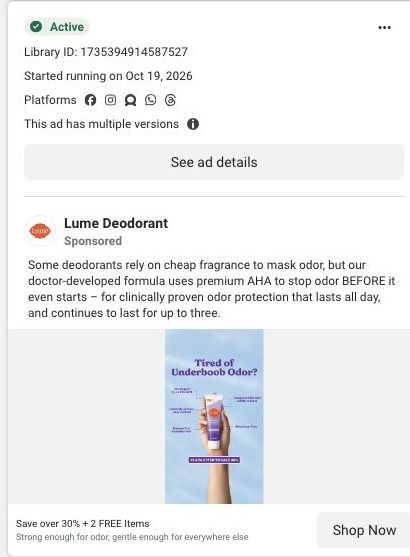
What this ad does well
The opening is a moment almost every viewer has lived: you shower, you feel fresh, and by the time you've blow-dried your hair and gotten dressed you're sweating again. That's a problem people recognize before they know what's being sold. Kreateyourfuture keeps the stick in frame (the 72Hr label is visible on the cap) and says one little swipe goes a long way, then walks through the places it can go, from under the bust to between the thighs to feet and the belly button. Her close turns the whole idea into a neat line about your day outlasting your freshness, which is easy to remember.
What's missing
There's no reason to act now anywhere in the video. She never mentions the starter pack, the free items or the price, and the headline ("Deo that doesn't disappoint.") doesn't either, so the click depends on curiosity alone. There's also no proof beyond her word. If you make one like this, keep the getting-ready opener and add a closing line about the offer, plus one proof point such as the 72-hour claim spoken out loud rather than left on the cap.
Beat by beat
- 0-5s
Kreateyourfuture describes showering, feeling fresh, then sweating again after blow-drying and getting ready.It opens on a moment the viewer has lived, so the problem lands before the product appears.
- 5-10s
She holds up the purple Lume whole body stick and says one little swipe goes a long way.It introduces the product as the answer to that moment and sets an easy-to-use expectation.
- 10-18s
She lists where it can go: under arms, under the bust, between the thighs, creases, feet and the belly button.Naming specific places widens the use case beyond the armpit.
- 18-22s
She closes with a line about your day lasting longer than your freshness and points to Lume.It restates the problem as a memorable line right before the click.
Where it sends people
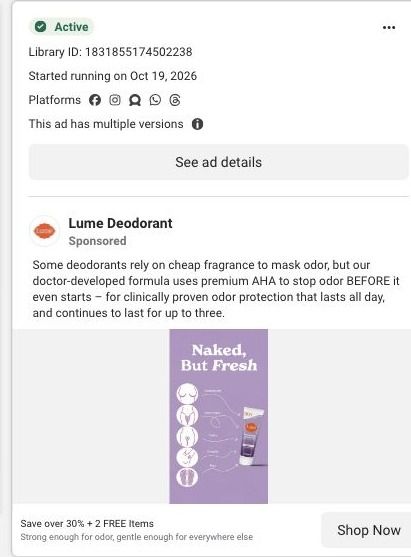
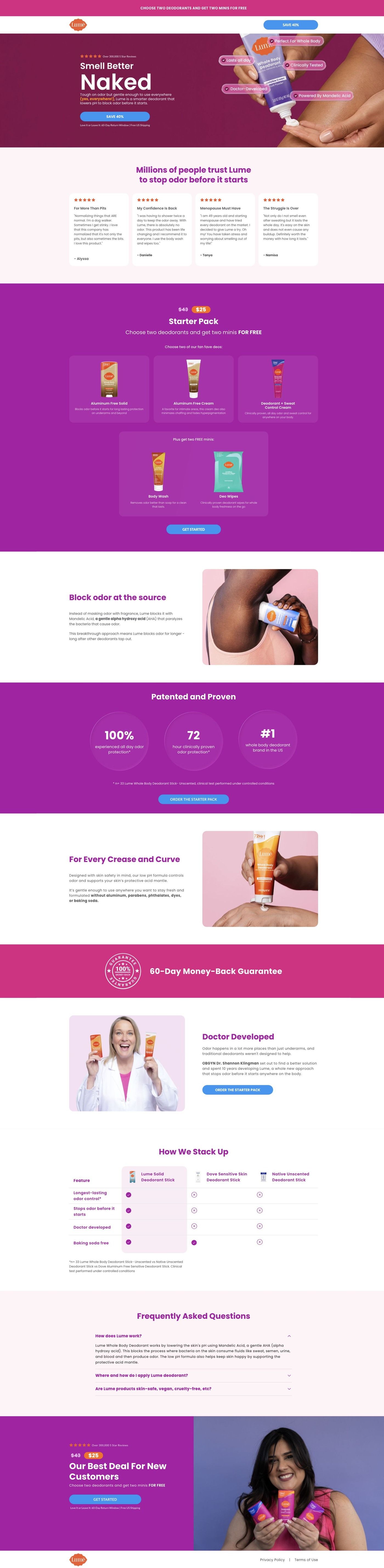
The ad sends people to Lume's starter-pack landing page, a focused page rather than the homepage. Her list of body areas is picked up by the whole-body use section and its application illustration, and the announcement header's savings CTA is the first time the viewer hears about a deal, which is a pleasant surprise but also a little abrupt. The getting-ready moment she opens with doesn't appear in the hero, which leads with a reviews eyebrow and a general benefit headline. If the ad mentioned the offer, the header and starter-pack section would feel like a continuation instead of a new topic.
The page it sends people to: How Lume's Smell Better Naked page sells a $25 starter pack
Lume's Smell Better Naked page is a long-form sales page for a $25 starter pack. It moves from a benefit hero through reviews, the offer, ingredient education, study proof, founder story and a comparison table, then repeats the offer. It's where 60 Lume ads in the Fluid library point, mostly creator stories, savings offers and product benefits.
How the page is built
- 01
Announcement and headerA simple logo header with a savings CTA keeps the discount visible and gives the visitor nowhere else to go.
- 02
Split heroA reviews eyebrow, a large benefit headline, body copy and a CTA sit beside a product-use image, answering "what is this and why would I want it?"
- 03
Customer storiesReview cards with stars and short quotes answer "do people like me actually use this?" before any price appears.
- 04
Starter-pack offerPrice treatment, product choices, free-gift tiles and a CTA answer "what do I get and what does it cost?"
- 05
Ingredient mechanismAn image and an explanation of a highlighted ingredient answer "how is this supposed to work?" in Lume's own terms.
- 06
Study proofProminent study metrics with a methodology footnote answer "is there evidence behind the claim?"
- 07
Whole-body useAn application illustration and reassurance copy answer "is it okay to use this beyond my underarms?"
- 08
Founder storyA portrait and origin explanation with a CTA answer "who's behind this and why should I trust them?"
- 09
Comparison tableA highlighted Lume column against alternatives answers "why this instead of what I use now?"
- 10
FAQ and repeated offerAn accordion handles the last objections, then the starter-pack offer repeats above the policy footer so the decision and the button sit together.
The first fixes we would make
- Many of the ads that land here lead with a specific use ("For Boobs That Run Hot"), but the hero speaks to the whole body and the matching reassurance sits much further down in the whole-body section. Send each ad headline to a hero that repeats it (Lume already runs a hero variant on another URL) so the visitor sees their problem in the first screen.
- The blueprint shows no guarantee anywhere on this page, while Lume's sweat-control page has one. Put the guarantee inside the starter-pack panel and again by the final offer, since that's exactly where a first-time buyer hesitates.
Read the full breakdown of this page
Three hooks you could test
- Show a specific moment of use. “Fresh out of the shower, and I'm already sweating by the time my hair's dry.”
- Sell the outcome. “Still fresh at the end of the day, even on the days that run long.”
- Lead with the uncomfortable problem. “Why do you smell again before you've even left the house?”
What to borrow for your brand
- Open on the exact moment the problem shows up in your customer's routine, described in her own words, before you show the product.
- Keep the product in the creator's hand for the whole video so the label does quiet work while she talks.
- Close with a line that restates the problem as a phrase people repeat, then add the offer so the memorable line has a next step.
Transcript
There's something about showering, feeling fresh, and then you blow dry hair, you get ready, you're sweating again. This is your lumi's whole body dude, right? One little swipe will go a long way. Not only is it okay for under arms because that's not the only place to sweat. You can put it under the jugs in between your thighs. Any creases that you have that sweat, your feet, your belly button. You name it, you can put this there. So if your day left, longer than your freshness, go check out Loomi's whole body deodorant.
Text on screen
One of 100 Lume ads in the Fluid Inspiration Library, captured from the Meta Ad Library on Oct 22, 2026. We record that an ad ran publicly, not how it performed.