

Lume DeodorantSponsored
Esc
How Lume runs a street-interview trial for whole-body deodorant
A 48-second street-interview video from Lume, filmed outside an ice cream and slush stand. An interviewer asks a passerby where she puts deodorant, introduces the whole-body stick as made by an OB-GYN, and lets her try Vanilla Bliss. The video closes on 40% off a starter pack with free shipping and links to a long-form starter-pack page.
Lume
60 creatives lead here1 / 60


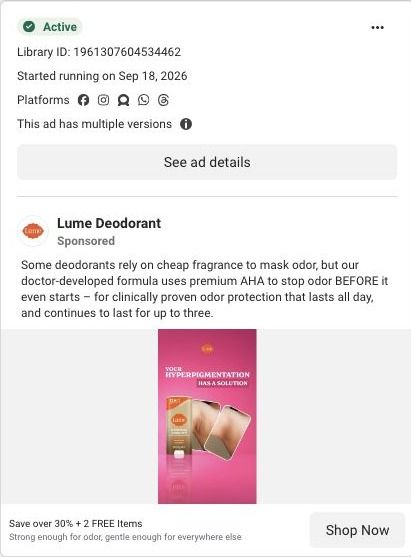
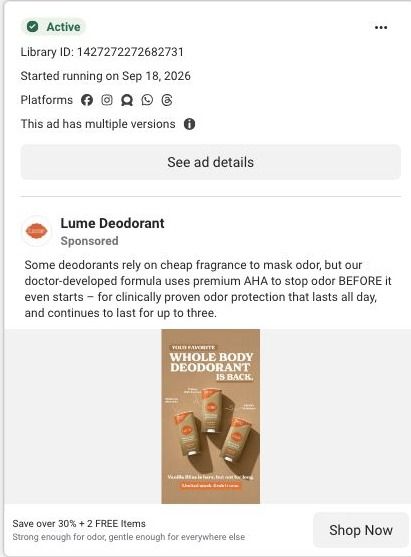
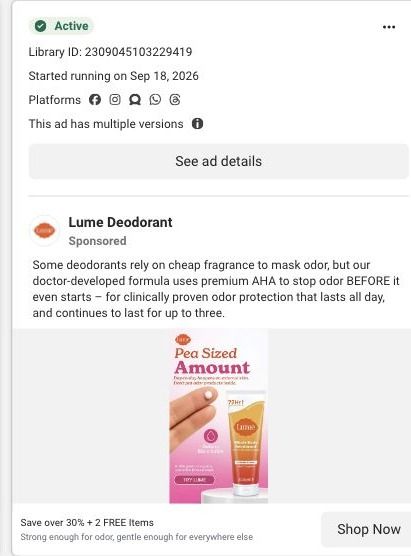


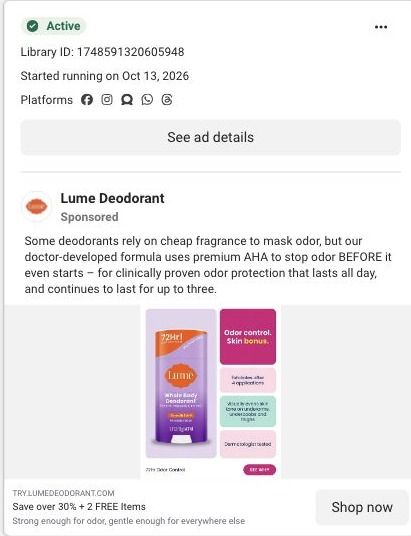
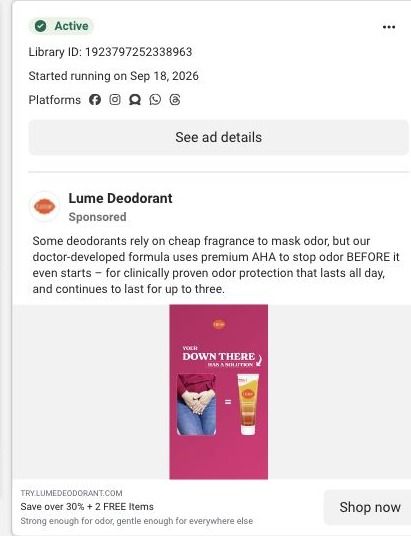

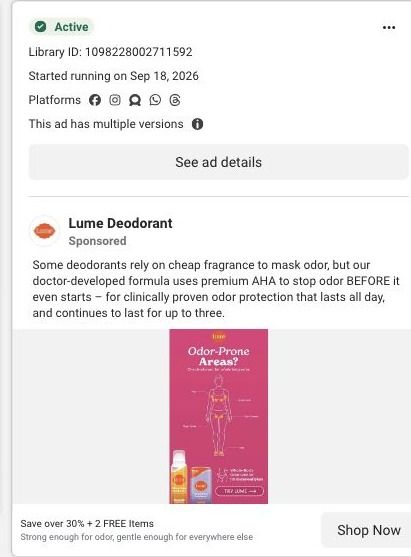

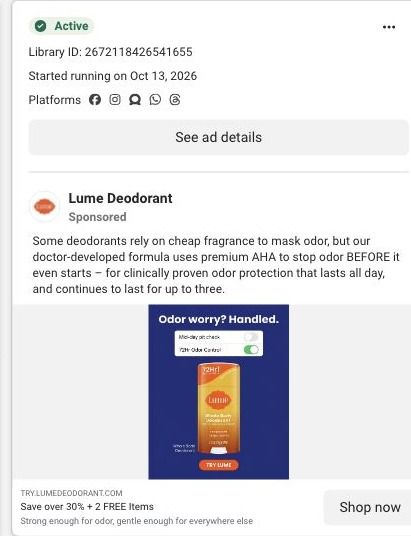


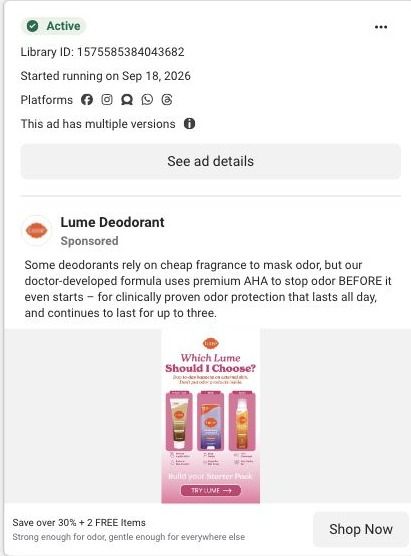

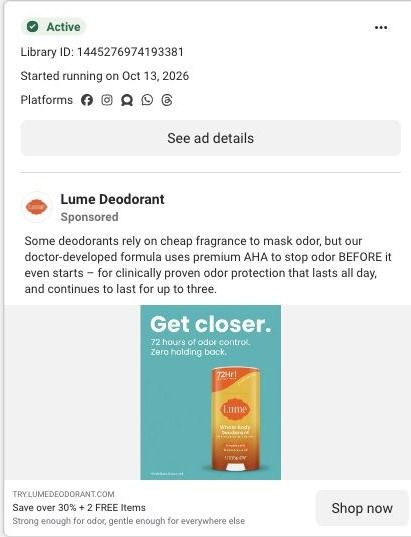
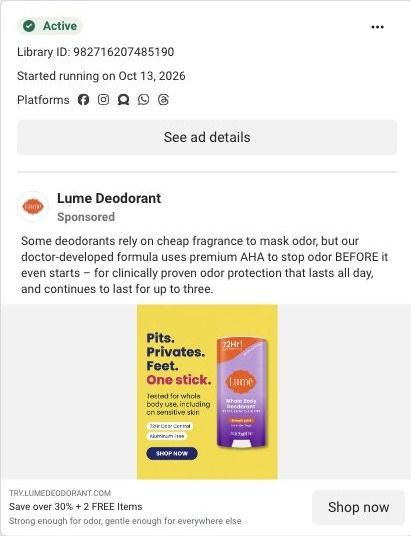
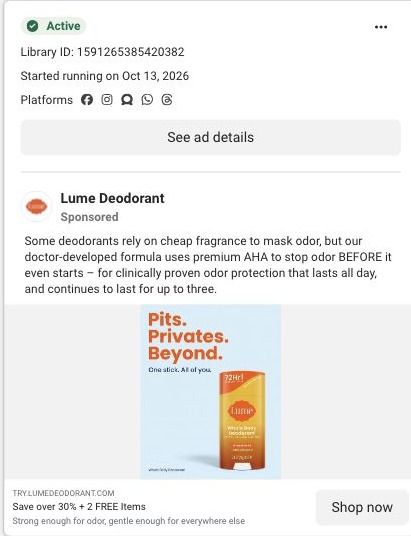
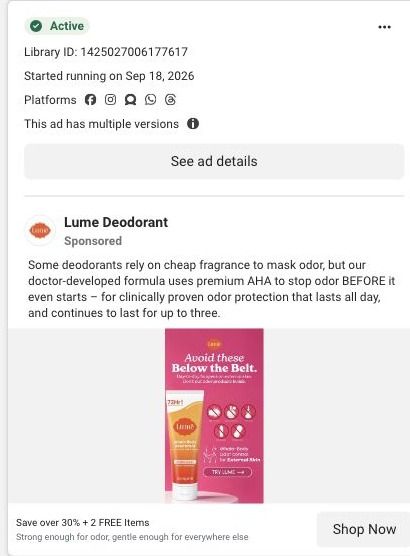
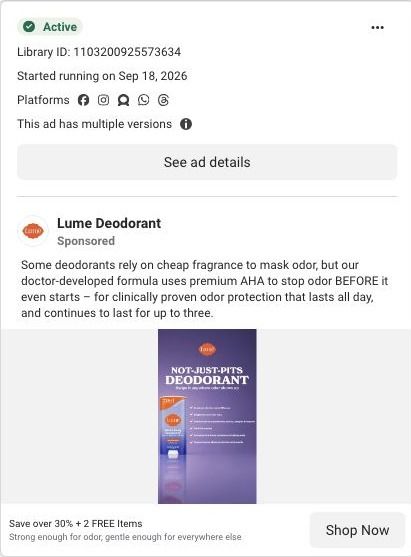
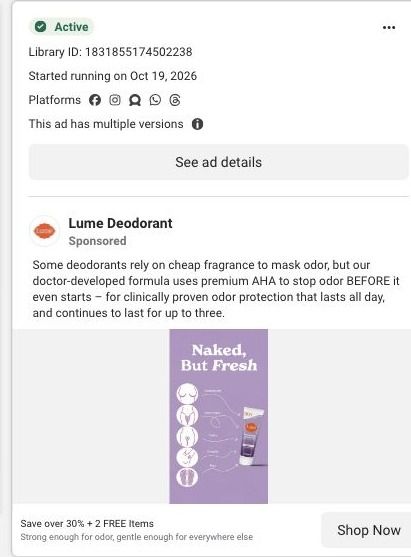
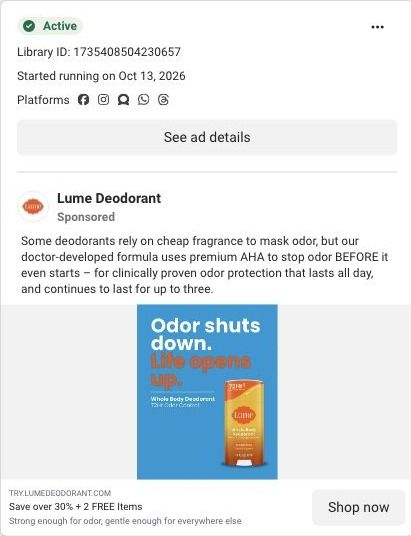
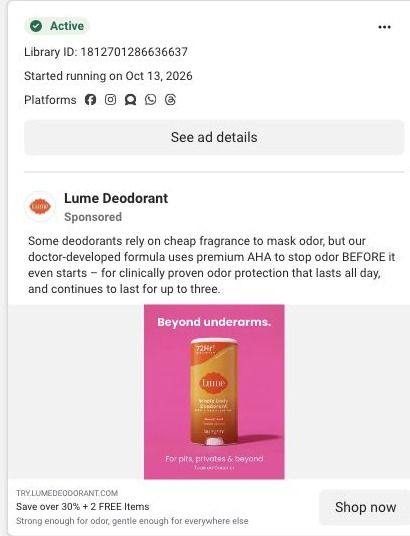
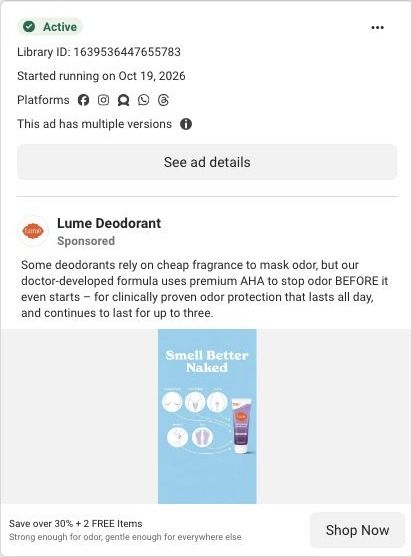

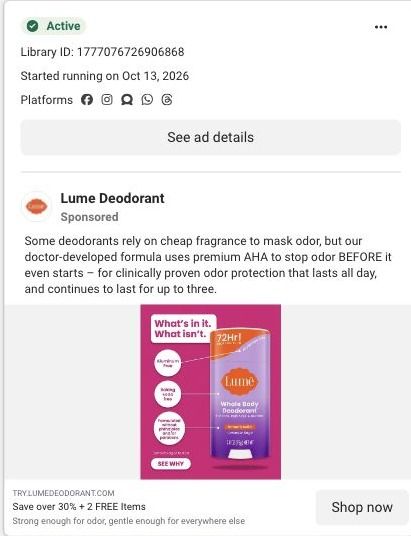
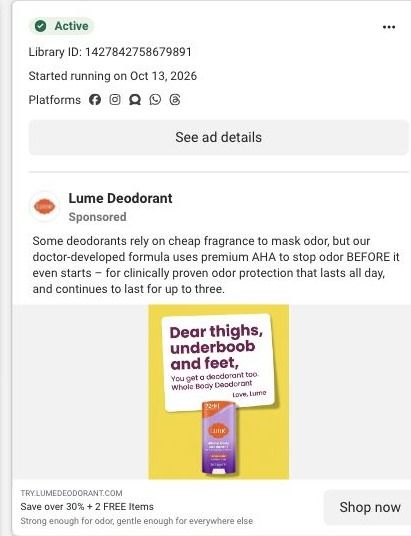
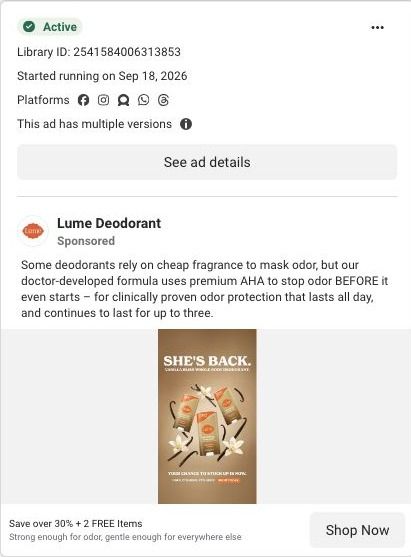
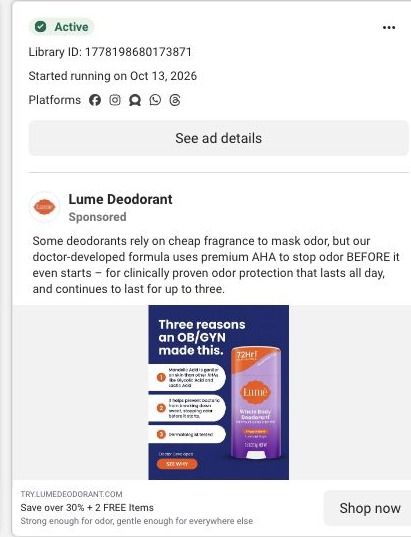
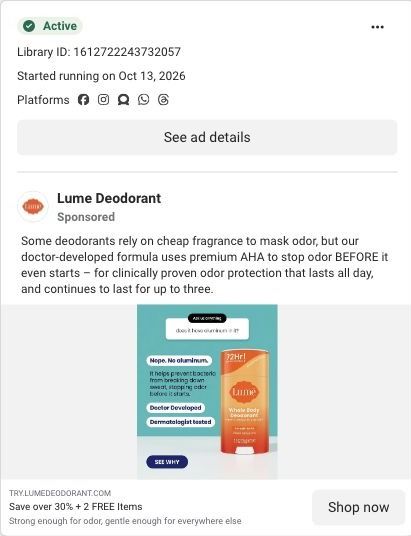


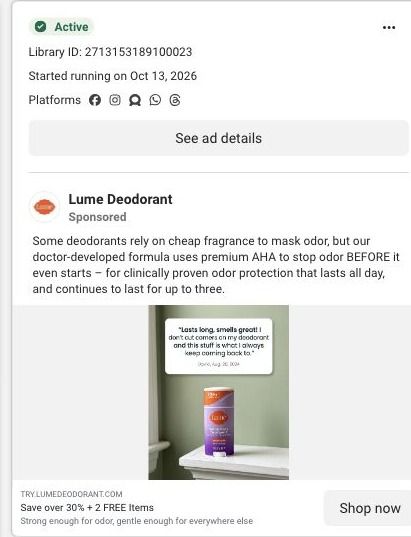

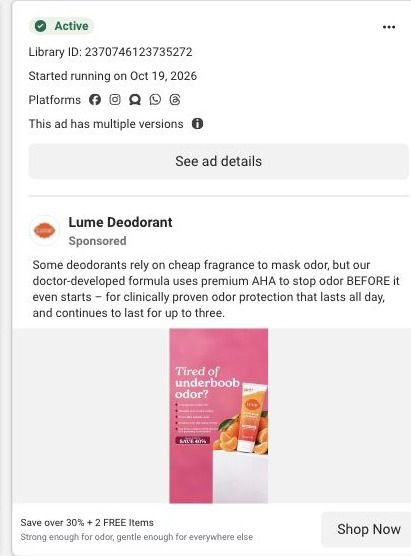


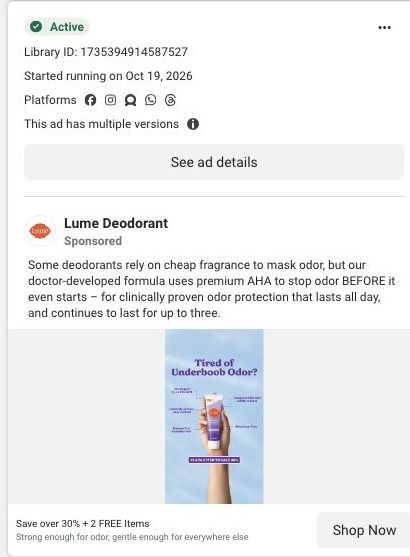


Lume · Smell Better Naked
Public page captured October 22, 2026. Promotional sheets, chat, extension overlays and sticky cart bars were removed from the static reference; page layout and copy were preserved. No account, personal, health or payment details were supplied. Quiz captures show the observed entry screen, not the complete consultation.
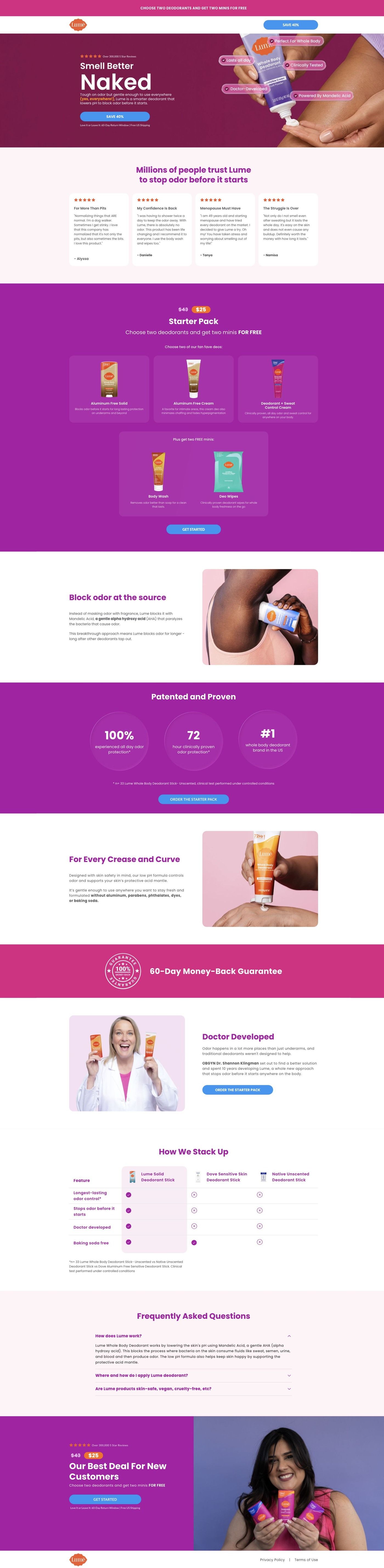
Save over 30% + 2 FREE Items
Visual reference: Outdoor feet demo · founder-style video. Creator stories, price objections and product stills converge on a long-form $25 starter-pack offer. Reviews, product education, founder credibility and a comparison table lead to the kit builder. Compare the creative with the destination and explore the other ads sharing this route.
- Brand
- Lume
- Observed offer
- Starter-pack savings or product offer; original ad and destination terms apply
- Creative angle
- Education
- Page type
- Starter-pack offer
- Ad format
- Video · 0:48
- Listed start date
- Sep 1, 2026
- Captured
- Oct 22, 2026
- Library ID
- 1797978961630945
- Destination
- try.lumedeodorant.com
Selected for its design and offer structure. Ad performance isn’t available in this collection.
What this ad does well
The best moment is the question “Where do you typically put deodorant on?”, because the woman answers under her arms and under her breast, so the whole-body need comes from her and not from the brand. The video opens on her reaction to how it feels on the skin, which puts a real person's sensation ahead of any claim. The setting adds a reason without anyone selling it: the conversation mentions South Florida, and the heat makes the use case obvious. Captions follow the conversation, and an on-screen label names Dr. Shannon Klingman, MD when the interviewer says an OB-GYN made it.
What's missing
The proof here is a first impression. The interviewer delivers the claims (the transcript says mandelic acid targets odor bacteria, 72 hours, clinically tested), and the woman's verdict is conditional: “If it works good, I will tell the whole world.” She's reacting to feel and scent, not results. The offer also doesn't match: the video says 40% off, while the link headline says over 30%. If you make one like this, open with a text hook that names the problem in the first two seconds, add a quick follow-up or a review card for proof, and make the offer numbers agree.
Beat by beat
- 0-5sA passerby reacts to the feel of the product on her skin while captions show her words.
Starting mid-reaction drops viewers straight into a real moment instead of an intro.
- 5-12sThe interviewer asks where she usually applies deodorant, and she says under her arms and under her breast.
Her answer sets up the whole-body angle in the customer's own words.
- 12-22sThe interviewer introduces Lume as a whole-body deodorant made by an OB-GYN, with a caption naming Dr. Shannon Klingman, MD.
The credential arrives right when the intimate-areas claim needs it.
- 22-32sShe smells and tries the Vanilla Bliss scent and says she likes it.
A scent test gives the viewer something sensory to imagine.
- 32-40sThe interviewer says it's made with mandelic acid, lasts 72 hours and is clinically tested.
This is where the claims land, framed as conversation rather than a pitch.
- 40-48sShe says she'd recommend it, and the interviewer offers viewers 40% off a starter pack with free shipping.
The close turns her approval into an offer for the viewer.
The offer
The closing line and text offer 40% off the starter pack with free shipping, while the link headline under the video says Save over 30% + 2 FREE Items. The two numbers don't match.
Where it sends people
Viewers land on Lume's long-form starter-pack page, a focused landing page rather than a homepage, and the starter-pack offer section with its price treatment and free-gift tiles picks up the video's closing offer. The founder story section, with a portrait and origin explanation, continues the OB-GYN credential the caption introduced, and the customer stories near the top give the proof the video's one first impression couldn't. The mismatch to fix is the discount: someone who heard 40% in the video and sees a different number on the page has a reason to hesitate.
The page it sends people to: How Lume's Smell Better Naked page sells a $25 starter pack
Lume's Smell Better Naked page is a long-form sales page for a $25 starter pack. It moves from a benefit hero through reviews, the offer, ingredient education, study proof, founder story and a comparison table, then repeats the offer. It's where 60 Lume ads in the Fluid library point, mostly creator stories, savings offers and product benefits.
How the page is built
- 01Announcement and header
A simple logo header with a savings CTA keeps the discount visible and gives the visitor nowhere else to go.
- 02Split hero
A reviews eyebrow, a large benefit headline, body copy and a CTA sit beside a product-use image, answering "what is this and why would I want it?"
- 03Customer stories
Review cards with stars and short quotes answer "do people like me actually use this?" before any price appears.
- 04Starter-pack offer
Price treatment, product choices, free-gift tiles and a CTA answer "what do I get and what does it cost?"
- 05Ingredient mechanism
An image and an explanation of a highlighted ingredient answer "how is this supposed to work?" in Lume's own terms.
- 06Study proof
Prominent study metrics with a methodology footnote answer "is there evidence behind the claim?"
- 07Whole-body use
An application illustration and reassurance copy answer "is it okay to use this beyond my underarms?"
- 08Founder story
A portrait and origin explanation with a CTA answer "who's behind this and why should I trust them?"
- 09Comparison table
A highlighted Lume column against alternatives answers "why this instead of what I use now?"
- 10FAQ and repeated offer
An accordion handles the last objections, then the starter-pack offer repeats above the policy footer so the decision and the button sit together.
The first fixes we would make
- Many of the ads that land here lead with a specific use ("For Boobs That Run Hot"), but the hero speaks to the whole body and the matching reassurance sits much further down in the whole-body section. Send each ad headline to a hero that repeats it (Lume already runs a hero variant on another URL) so the visitor sees their problem in the first screen.
- The blueprint shows no guarantee anywhere on this page, while Lume's sweat-control page has one. Put the guarantee inside the starter-pack panel and again by the final offer, since that's exactly where a first-time buyer hesitates.
Read the full breakdown of this page
Three hooks you could test
- Show a specific moment of use. “We stopped strangers on a 90-degree day and asked where they sweat.”
- Lead with the uncomfortable problem. “Where do you actually get sweaty? Most people don't say underarms first.”
- Make the product the whole scene. “One stick, one stranger, one honest reaction.”
What to borrow for your brand
- Ask strangers a question that makes them name your use case themselves, then show the product as the answer.
- Film where the problem is obvious (heat, a gym, a commute) so the setting explains why the product matters.
- Add an on-screen caption with your expert's name at the moment a credential is mentioned, so the claim has a face.
Transcript
Oh, it feels very nice on the skin. Yeah? Oh, yes. That's nice. How does it feel? Good, better. Where do you typically put deodorant on? Mainly just under my arms and under my breast. So, I'm actually here with Lumi today. This is our whole body deodorant. You can use it anywhere on your body. Even some of the intimate parts because it's actually made by an OBGYN. Wonderful. That's nice, especially here in South Florida. So, do you want to try it out today? Yes. Okay, let's do it. Here you are. This is our scent vanilla bliss. What do you think about the scent? Nice. Vanilla Bliss. Oh, that feels good. Yeah? It's actually made with mandelic acid, which kale is the bacteria of body odor. so that you don't smell at all for 72 hours, and it's clinically tested. I'm impressed, really gonna come in handy. Yes. Are you going to recommend this to any other people? Absolutely. If it works good, I will tell the whole world. I'm so glad you love it. And for you guys at home, get 40% off your started pack and free shipping.
Text on screen
- HEF SAIT:
- EARTH
- AT A CONE
- Slush
- Feels very nice
- ATA COM
- oh, yes.
- ATA CONE
- How does it feel?
- Coldee
- Where do you
- Coffee
- deodorant on?
- HELP SAVY
- BAT A CONE
- under my arms
- actually here with
- SAT A COME
- This is our whole body
- Lume
- anywhere on your
- body.
- AT A COME
- even some of the
- Dr. Shannon Klingman, MD
- Wonderful.
- especially here
- So, do you want
- okay, let's do it.
- Its our scent.
- HIP SAVE
- about the scent?
- HELP SAIT E
- Nice.
- Yeah?
- Mandelic Acid
- the bacteria
- Conice
- so that you don't
- 172 hours,
One of 100 Lume ads in the Fluid Inspiration Library, captured from the Meta Ad Library on Oct 22, 2026. We record that an ad ran publicly, not how it performed.