

Lume DeodorantSponsored
Esc
How Lume pairs a confidence caption with a product-in-hand moment
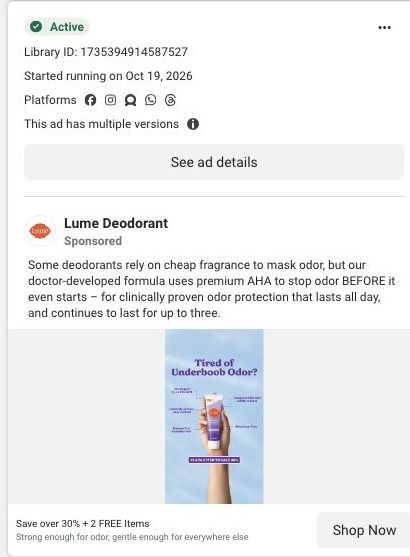
A 10-second silent Lume video. A smiling woman at home squeezes a pink tube of Lume into her palm under a caption saying her days of feeling self-conscious about how she smells are over. The headline offers over 30% off plus 2 free items, and it links to Lume's starter-pack landing page.
Lume
60 creatives lead here1 / 60


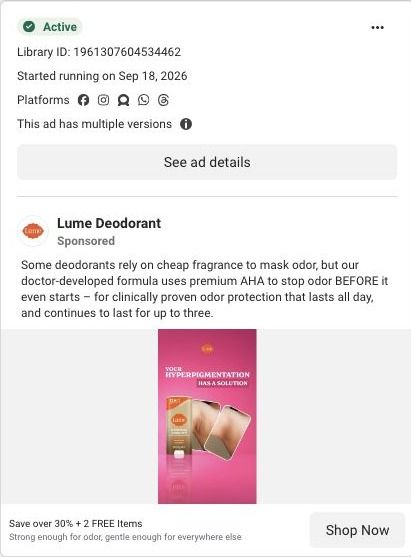
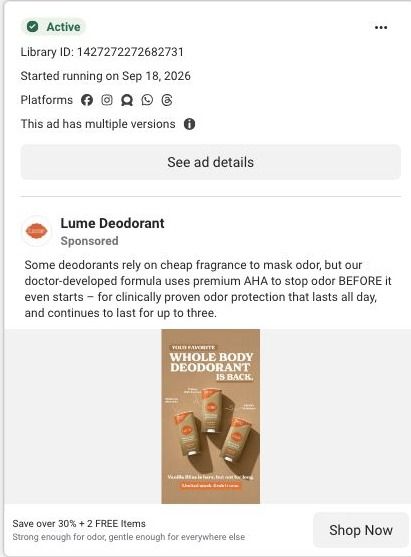
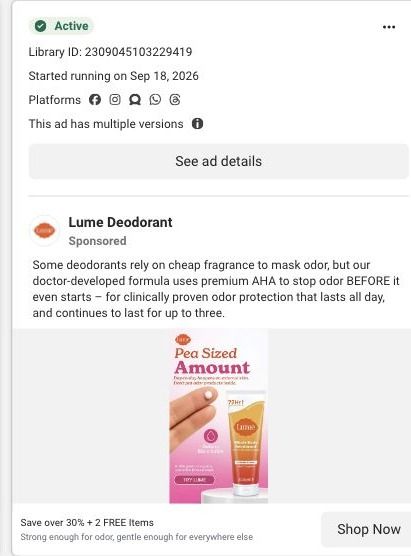


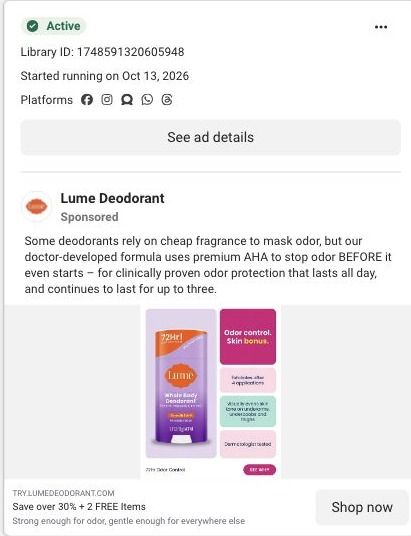
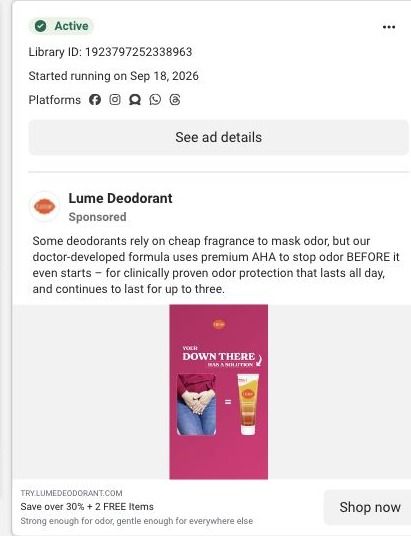

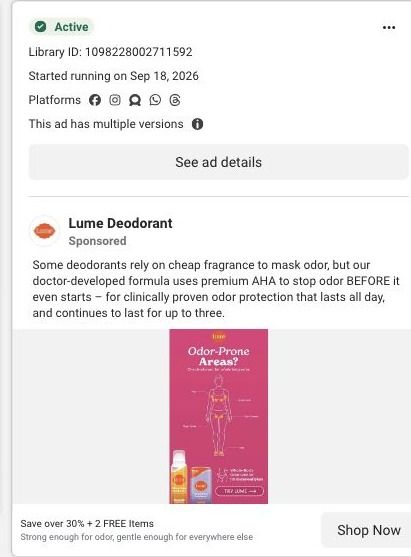

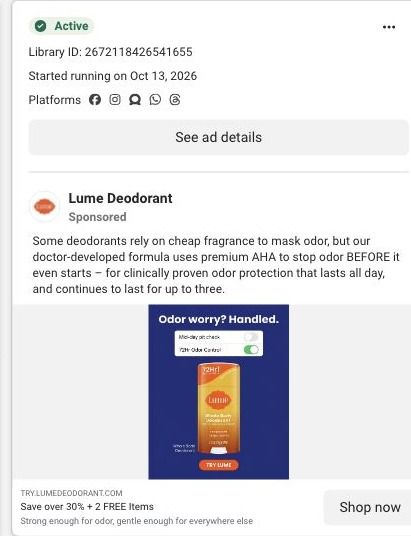


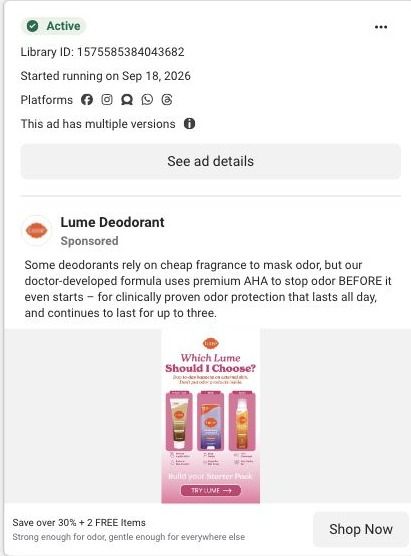

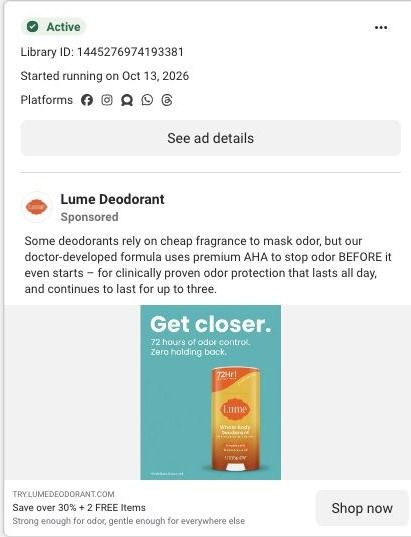
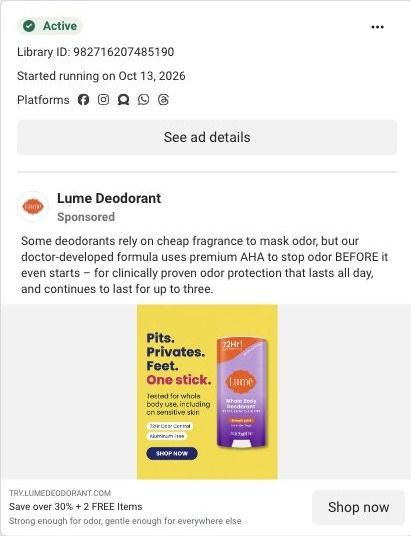
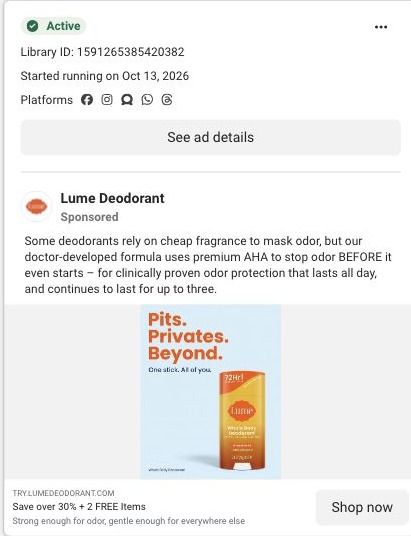
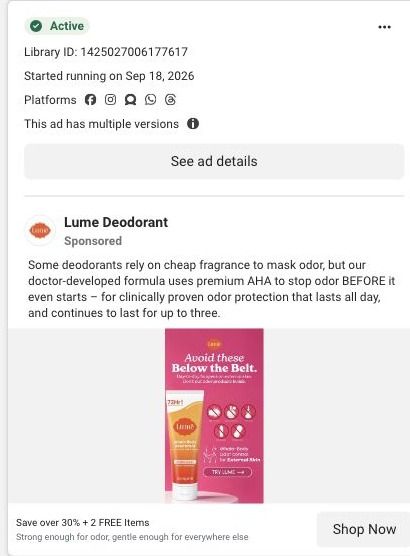
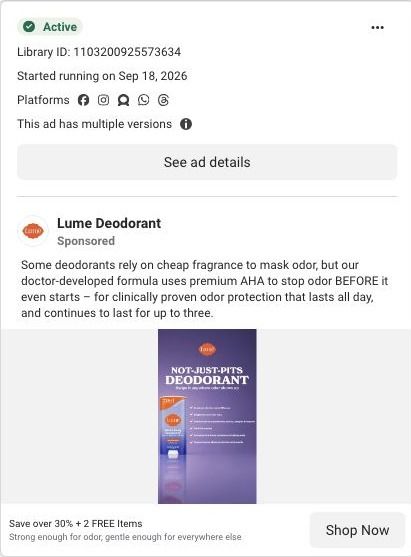

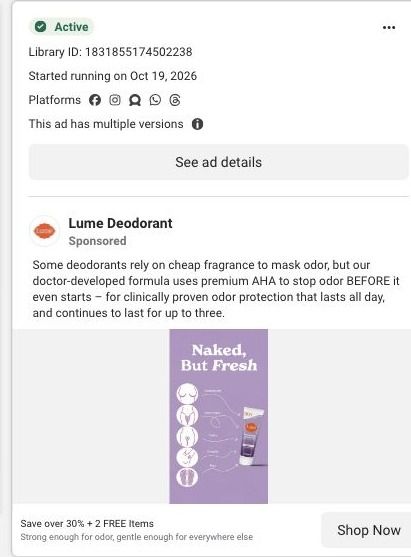
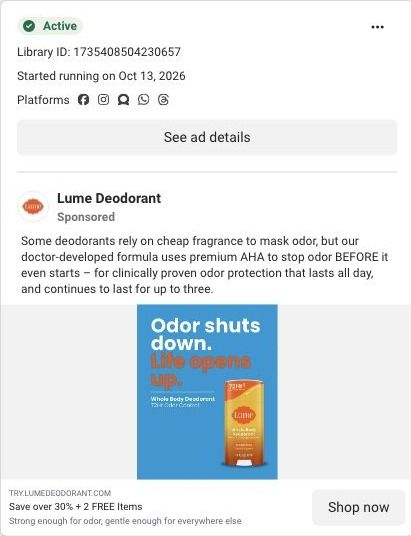
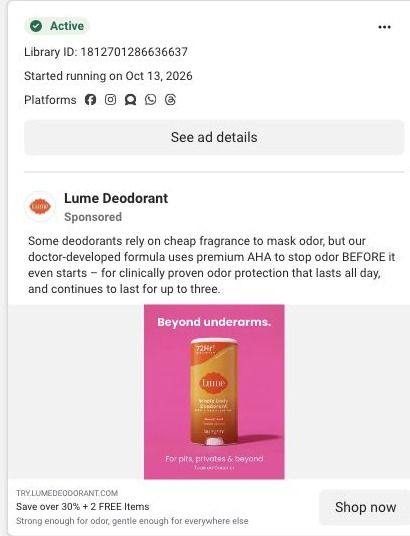
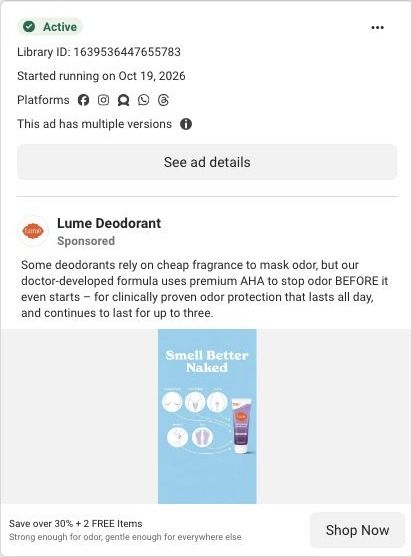

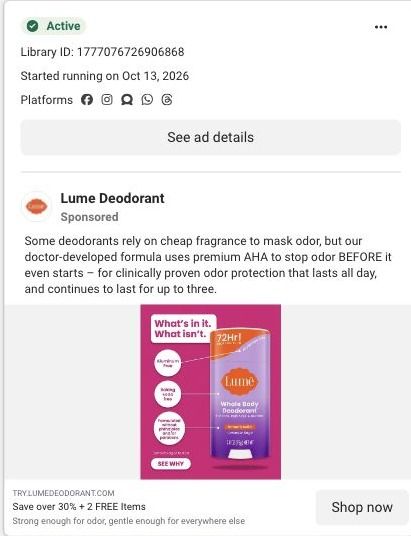
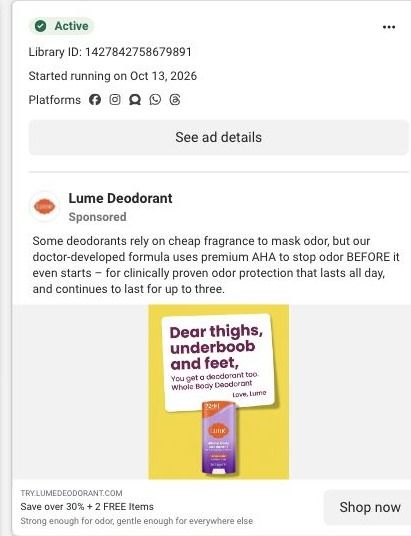
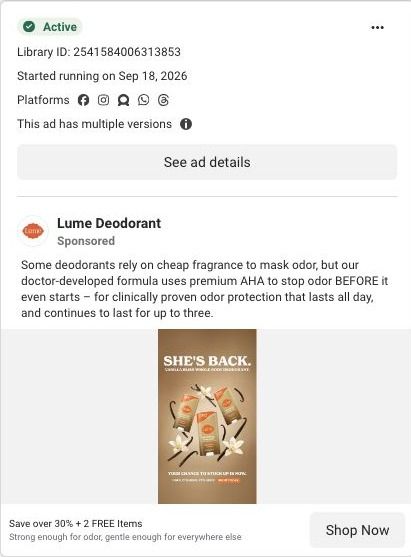







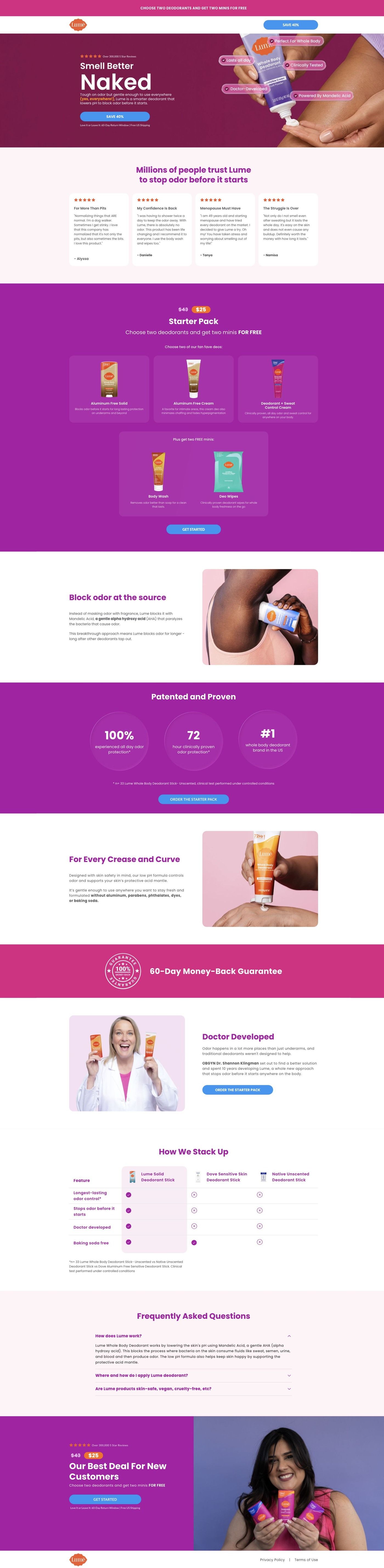
Lume · Smell Better Naked
Public page captured October 22, 2026. Promotional sheets, chat, extension overlays and sticky cart bars were removed from the static reference; page layout and copy were preserved. No account, personal, health or payment details were supplied. Quiz captures show the observed entry screen, not the complete consultation.
Save over 30% + 2 FREE Items
Visual reference: Pink-tube confidence · mirror routine. Creator stories, price objections and product stills converge on a long-form $25 starter-pack offer. Reviews, product education, founder credibility and a comparison table lead to the kit builder. Compare the creative with the destination and explore the other ads sharing this route.
- Brand
- Lume
- Observed offer
- Starter-pack savings or product offer; original ad and destination terms apply
- Creative angle
- Creator stories
- Page type
- Starter-pack offer
- Ad format
- Video · 0:10
- Listed start date
- Oct 19, 2026
- Captured
- Oct 22, 2026
- Library ID
- 1819373685633031
- Destination
- try.lumedeodorant.com
Selected for its design and offer structure. Ad performance isn’t available in this collection.
What this ad does well
Lume runs this same caption over a gym locker-room clip too, and this version improves on it by putting the product in her hands from the first frame. You see her squeeze the pink tube into her palm while the caption plays, so the outcome and the product arrive together. Her smile does quiet work: it shows the relief the caption promises. At ten seconds with no voice, it's built for people scrolling with the sound off, and the headline carries the concrete part (over 30% off plus 2 free items).
What's missing
The video still doesn't say what the product is or where it goes, so the tube could be anything to someone who doesn't know Lume. There's no proof either; the copy mentions 'clinically proven' protection but trails off at 'up to three' without finishing the thought. If you make one like this, add a final frame that names the product and where it's used, and fix the copy so the proof claim reads clearly.
Beat by beat
- 0-4sA smiling woman squeezes a pink tube into her palm as the caption begins.
Showing the product in use from the first frame ties the coming promise to something real.
- 4-10sThe caption completes: her days of feeling self-conscious about how she smells are over.
It sells the emotional outcome, and her smile shows what that relief looks like.
The offer
The headline offers over 30% off plus 2 free items with a Shop now button. The video has no offer.
Where it sends people
The ad goes to Lume's starter-pack landing page, a focused page rather than the homepage. The announcement header's savings CTA matches the headline offer, and the starter-pack offer section shows the product choices, which is where the viewer finally learns what the pink tube is. The customer stories section's review cards echo the confidence the caption sells. The hero leads with a reviews eyebrow and a general benefit headline, so repeating the 'self-conscious' language there would make the jump from the ad feel seamless.
The page it sends people to: How Lume's Smell Better Naked page sells a $25 starter pack
Lume's Smell Better Naked page is a long-form sales page for a $25 starter pack. It moves from a benefit hero through reviews, the offer, ingredient education, study proof, founder story and a comparison table, then repeats the offer. It's where 60 Lume ads in the Fluid library point, mostly creator stories, savings offers and product benefits.
How the page is built
- 01Announcement and header
A simple logo header with a savings CTA keeps the discount visible and gives the visitor nowhere else to go.
- 02Split hero
A reviews eyebrow, a large benefit headline, body copy and a CTA sit beside a product-use image, answering "what is this and why would I want it?"
- 03Customer stories
Review cards with stars and short quotes answer "do people like me actually use this?" before any price appears.
- 04Starter-pack offer
Price treatment, product choices, free-gift tiles and a CTA answer "what do I get and what does it cost?"
- 05Ingredient mechanism
An image and an explanation of a highlighted ingredient answer "how is this supposed to work?" in Lume's own terms.
- 06Study proof
Prominent study metrics with a methodology footnote answer "is there evidence behind the claim?"
- 07Whole-body use
An application illustration and reassurance copy answer "is it okay to use this beyond my underarms?"
- 08Founder story
A portrait and origin explanation with a CTA answer "who's behind this and why should I trust them?"
- 09Comparison table
A highlighted Lume column against alternatives answers "why this instead of what I use now?"
- 10FAQ and repeated offer
An accordion handles the last objections, then the starter-pack offer repeats above the policy footer so the decision and the button sit together.
The first fixes we would make
- Many of the ads that land here lead with a specific use ("For Boobs That Run Hot"), but the hero speaks to the whole body and the matching reassurance sits much further down in the whole-body section. Send each ad headline to a hero that repeats it (Lume already runs a hero variant on another URL) so the visitor sees their problem in the first screen.
- The blueprint shows no guarantee anywhere on this page, while Lume's sweat-control page has one. Put the guarantee inside the starter-pack panel and again by the final offer, since that's exactly where a first-time buyer hesitates.
Read the full breakdown of this page
Three hooks you could test
- Show a specific moment of use. “A dab in her palm before she gets dressed, and she won't think about it again today.”
- Sell the outcome. “She doesn't know it yet, but she's done second-guessing herself.”
- Make the product the whole scene. “The tube, her hands and a smile. That's the whole story.”
What to borrow for your brand
- Run one caption over several different clips (gym, bathroom, bedroom) to learn which setting makes the promise feel real.
- Put the product in the creator's hands from the first frame of a silent ad so the caption's promise attaches to it.
- Let the creator's expression show the outcome instead of saying it, and keep the words to one caption.
Transcript
There's no speech in this video. The on-screen text and music carry the message.
Text on screen
- She doesn't know it yet, but her
- days of feeling self-conscious
- about how she smells are over
- She doesnt know it yet, but her
One of 100 Lume ads in the Fluid Inspiration Library, captured from the Meta Ad Library on Oct 22, 2026. We record that an ad ran publicly, not how it performed.