What this ad does well
The opening calls out one audience and promises useful information, with four labeled head illustrations (aura, vestibular, cervicogenic, chronic) that show the ad knows the subject. The script then gives the viewer something to check in their own cupboard: a crossed-out list of ingredients the ad says can be triggers in electrolyte products, such as sugar, sucralose, stevia and natural flavors. It shows a journal abstract on screen while making its case, and it attributes its hydration claim to a university-led trial. It ends with a lifetime discount for people managing a neurological condition and a month to try it with a money-back promise.
What's missing
The ad makes several health statements in quick succession (what neurologists recommend, how electrolytes relate to migraine sensitivity), and a skeptical viewer may want sources for each, not just the study shown on screen. At 87 seconds, the offer also arrives at the very end. If you make one like this, put a source on screen for every health statement and bring the risk-free trial and discount into the first half, so viewers who leave early still know the terms.
Beat by beat
- 0-5s
The presenter says if you get migraines, watch this, over four labeled migraine-type illustrations.It calls out the exact viewer and signals expertise.
- 5-20s
He says people often make migraines worse trying to fix them and that neurologists often recommend hydration, as the ad claims.It sets up a surprising problem and borrows authority, which keeps the viewer watching.
- 20-45s
A crossed-out list names sugar, sucralose, stevia, monk fruit and natural flavors as ingredients the ad calls triggers.It gives the viewer something concrete to compare against what they use now.
- 45-65s
He says Buoy has no sugar, sweeteners or flavors, is third-party tested and cites a university-led trial on hydration.It positions the product as the answer and adds the brand's proof.
- 65-87s
He offers 35% off for life for anyone managing a headache, migraine or neurological condition and a month risk-free.It ends with the audience-specific offer and a reason to try it now.
The offer
35% off for life through the chronic illness discount for anyone using Buoy for headaches, migraines or a neurological condition, plus a month risk-free with money back; the copy adds free shipping.
Where it sends people
The ad sends people to Buoy's Chronic Illness Support page, a focused landing page built around one audience and one offer, which is a strong rung on the landing-page ladder. Its hero reads "Get 35% Off For Life" under a Chronic Illness Support Program badge and a 4.7/5 rating from 12,248 reviews, with free shipping, a 30-day guarantee and an Approval in 2 minutes button, followed by a timeline of product standards, an FAQ, condition-tagged creator videos, best sellers and a reviews wall. The video's discount and risk-free trial are the first things the hero repeats, and the standards timeline continues the list of excluded ingredients. The FAQ's question about conditions supported is where a migraine viewer would look next.
The page it sends people to: How Buoy turned a lifetime discount into a chronic illness program
Buoy's Chronic Illness Support page frames a lifetime 35% discount as a program with quick approval, then backs it with product standards, an FAQ, condition-tagged creator videos, best sellers, a donation callout and a reviews wall. Six of the 10 Buoy ads in the Fluid library send people here, mostly migraine and chronic illness creator videos and benefit statics.
How the page is built
- 01
HeaderMenu, Shop All, logo, account and cart with no announcement bar keep the focus on the program.
- 02
HeroA 4.7/5 rating from 12,248 reviews, the program badge, the 35% for life headline, three perks and the approval button answer what's the offer and how do I get it.
- 03
Standards timelineA study-based hydration claim, clinical study and third-party test links and six standards (no sugar or sweeteners, no unnecessary additives, third-party tested and more) answer is this product safe for my sensitivities, as the brand describes it.
- 04
FAQ with videoA pour video beside accordions on conditions supported, what to expect, ingredients avoided and commitment answer the program questions.
- 05
Creator carousel"We didn't just go viral, we found our community" with videos tagged by condition answers does anyone like me use this.
- 06
Best sellersThree product cards that each restate the discount and use a Shop your discount link answer which product should I start with.
- 07
Donation calloutThree nonprofit logos and a line about donating with every order answer what does this brand stand for.
- 08
Reviews wallA two-column wall of text reviews with product thumbnails answers what do other customers say.
- 09
FooterSupport, socials, a disclaimer and an email signup with a first-order offer close the page.
The first fixes we would make
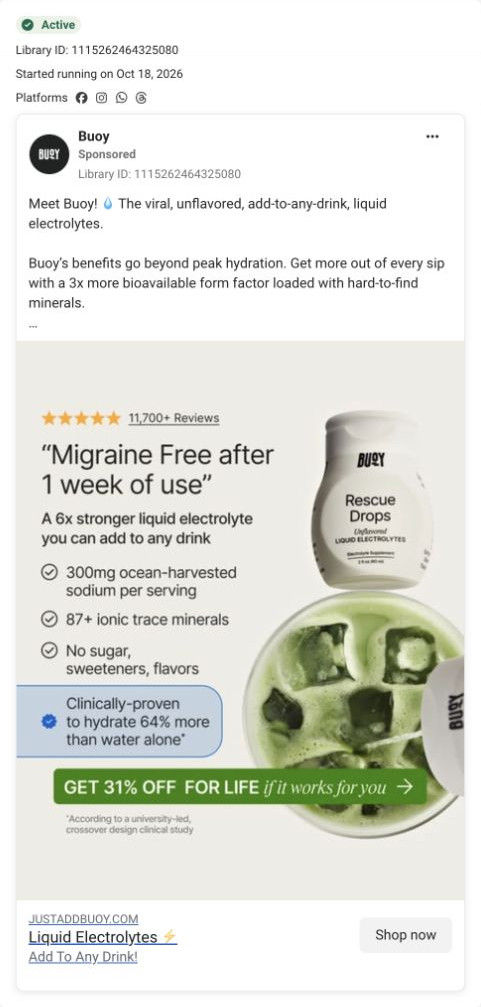
- Several ads that land here quote 31% (the review-led static and the matcha Q&A copy), while the hero says 35%. Align every ad to 35% for life, or add a line explaining the difference, so visitors don't wonder which deal is real.
- The approval step is promised in two minutes, but the page doesn't say what you'll be asked or whether you need proof of a diagnosis. Add one sentence under the button explaining the application so people with privacy worries aren't put off.
Read the full breakdown of this page
Three hooks you could test
- Lead with the uncomfortable problem. “If your go-to fix has a long ingredient list, read it before your next bad day.”
- Call out the habit you're replacing. “Your sugar-free packet still has sweeteners in it. Here's what to look for instead.”
- Turn the benefit into a picture people get in a second. “Cross out every ingredient you can't pronounce. This is what's left.”
What to borrow for your brand
- Open by naming one audience and promising specific information, so the right viewer stays and others scroll on.
- Show a crossed-out list of ingredients you leave out, which gives viewers something to check against their current product.
- Put the study you're citing on screen while you talk about it, and name where it was published.
Transcript
If you get migraines, watch this, because a lot of people accidentally make them worse trying to fix them. Neurologists often recommend hydration and electrolytes for day to day management of headaches and migraines. Your brain relies on electrolytes to regulate nerve signals and fluid balance, and when those levels drop, migraine sensitivity can increase. The problem, most electrolytes on the market contain ingredients that can be migraine fruiters. If you have this type of migraine, You're likely incredibly sensitive to what goes into your body. So blood sugar spikes, sweeteners, even the naturally derived, like stevia, natural flavors, with 100 plus ingredients, like melted dextrin, can really set you back. This is why so many people with headaches and migraines, use buoy. No sugar, sweeteners, flavors, or artificial ingredients, and our line of purposely unflavored liquid electrolytes are able to be added to any drink. We third party test and publish all results on our website, and it's clinically proven to hydrate 64% more than water alone. According to a university led clinical trial, also published in the Academic Journal Nutrients. And because we see reviews like this every single day, In fact, a 3rd of our 11,000 reviews are about headaches and migraines. We offer 35% off for life to anyone using buoy to manage a headache, migraine, or any neurological condition as part of our chronic illness lifetime discount that helps offset your healthcare costs. Curious, you can try Buy 100% risk free in all of your favorite drinks for a month. And if you don't like it, get your money back.
Text on screen
- If you get
- Migraines
- AURA
- VESTIBULAR
- CERVICOGENIC
- CHRONIC
- migraines,
- WATCH
- THIS!
- COMMON MIGRAINE TRIGGERS IN
- ELECTROLYTES
- X Sugar
- Artificial
- sweeteners like
- Sucralose
- Natural
- sweeteners:
- (Stevia, Monk
- Fruit, Erythritol
- + sugar alcohols)
- X Natural and
- artificial flavors
- X Artificial dyes
- accidentally make
- Natural and
- fix them.
- Neurologists often
- Severe Headache or Migraine History Is Inversely Correlated With Dietary
- Sodiom Intake: NHANES 1999-2004
- •Author elenabia • Articlenotes. » Copyright and Liceme eforma
- stract
- stive
- restigated worther dirtary sodiura locake from respondents of a cational cross
- al mitreiced trady differed by lieury of migraise ce severe beadaches.
- es of evidence support a derspcion of sodium boccostasis la migraise.
- population was 5819 adules in the 1999-2004 National Health and Nutricion.
- orary INHANES) with relable dara on diet and headache history: We dian
- so teported a binary of ingraine or severe beadaches as hasng probatie
- ior: To radore the disgeonic confic from medicatias overine biradachie
- desis who reposed taking analgerie medicadora. Dietary sodium luke!
One of 10 Buoy ads in the Fluid Inspiration Library, captured from the Meta Ad Library on Oct 19, 2026. We record that an ad ran publicly, not how it performed.