

Bio.meSponsored
Esc
How Bio.me opened a fiber ad with an intake statistic
A 26-second education video from Bio.me. A creator scoops from the Daily Prebiotic Fiber pouch while captions cite a statistic about Americans missing the recommended daily fiber, then says one scoop gets her 25% closer to her goal in 10 seconds. No price. It ran on Meta from Oct 15, 2026 and links to the product page.
Bio.me
18 creatives lead here1 / 18
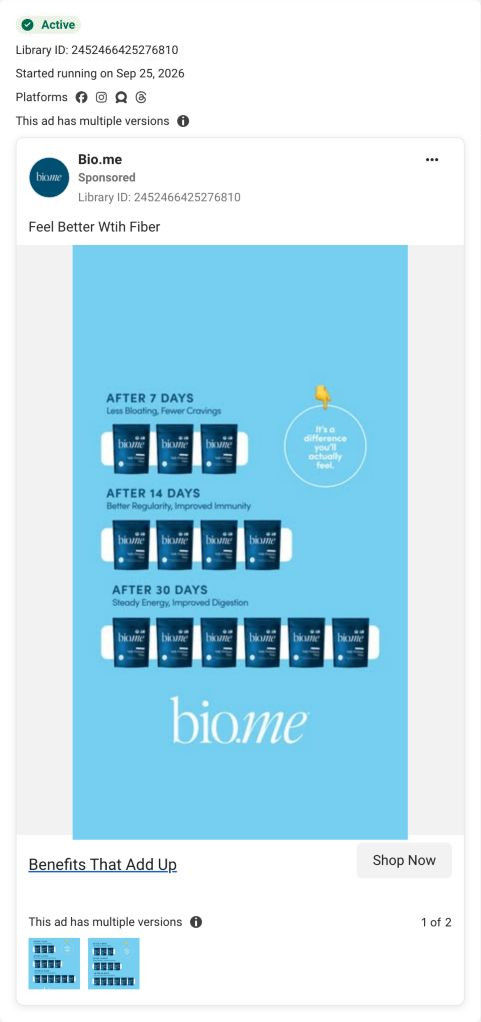
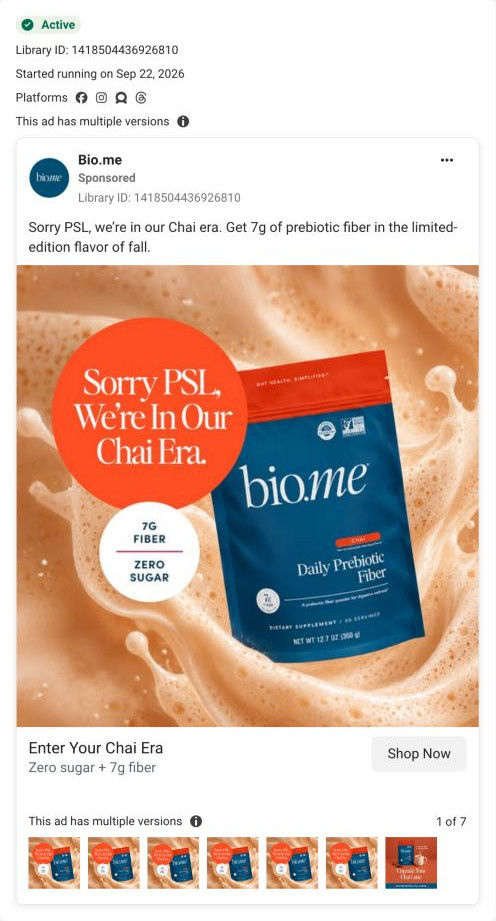
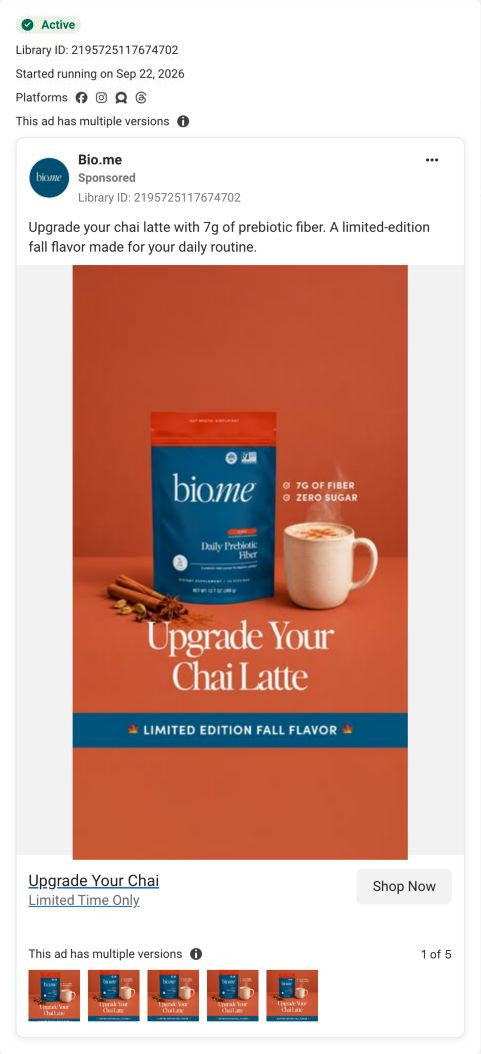
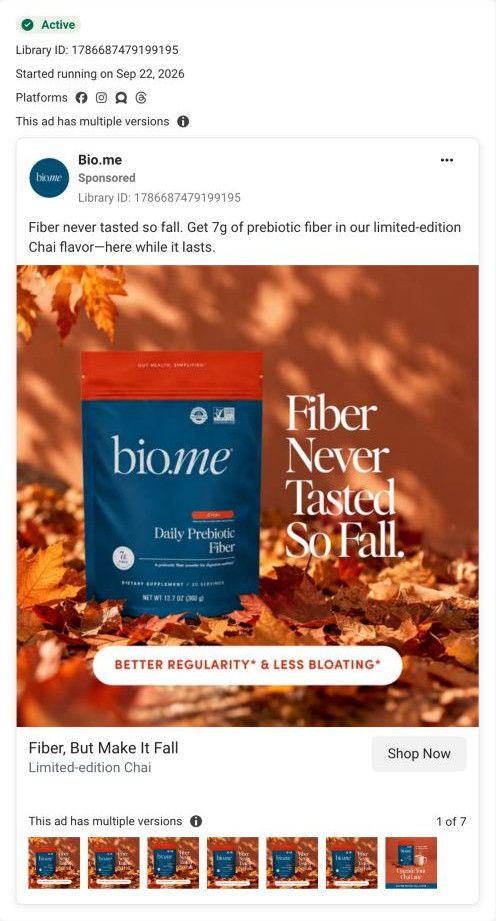
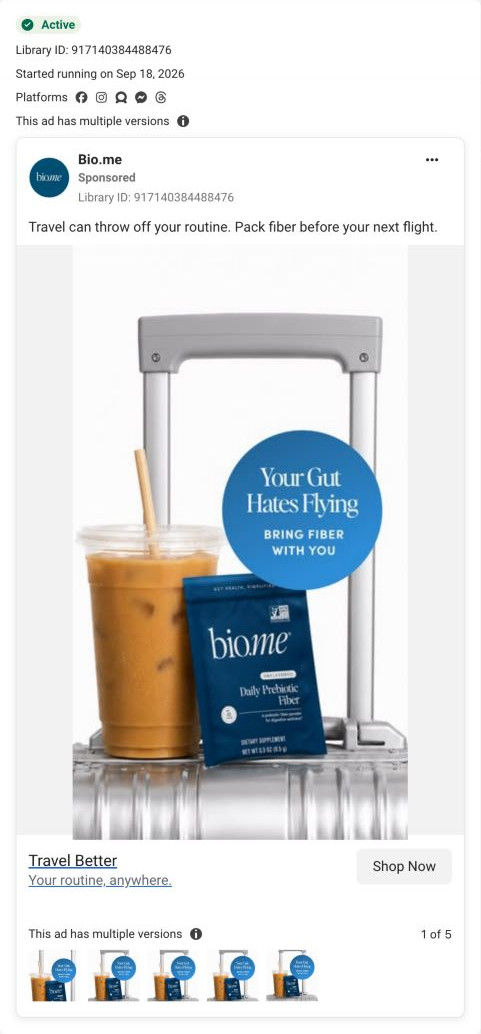
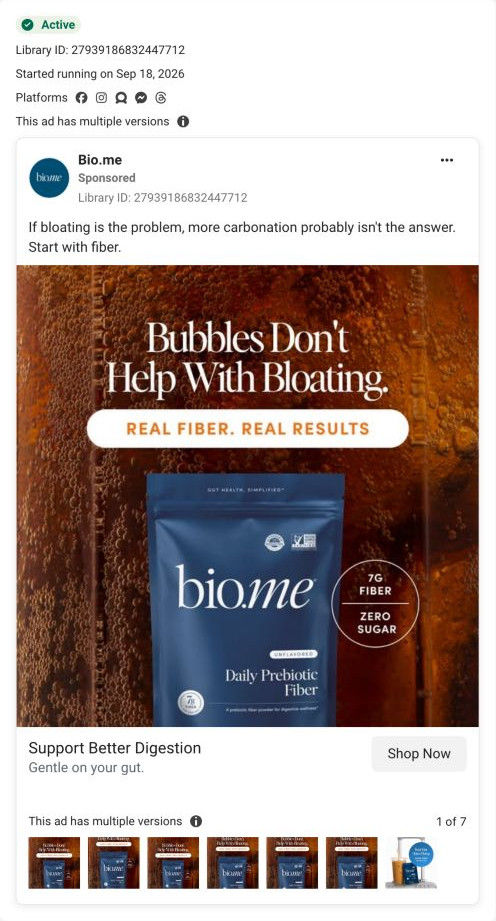
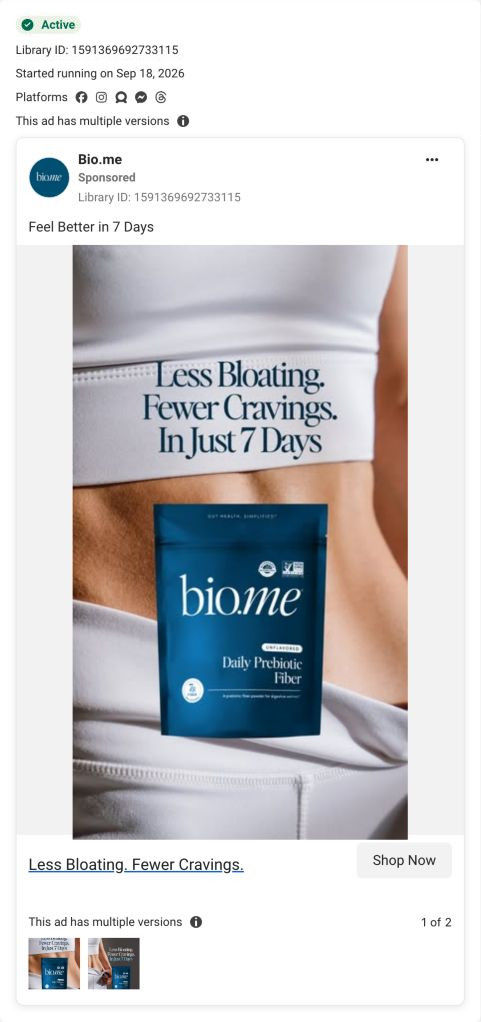
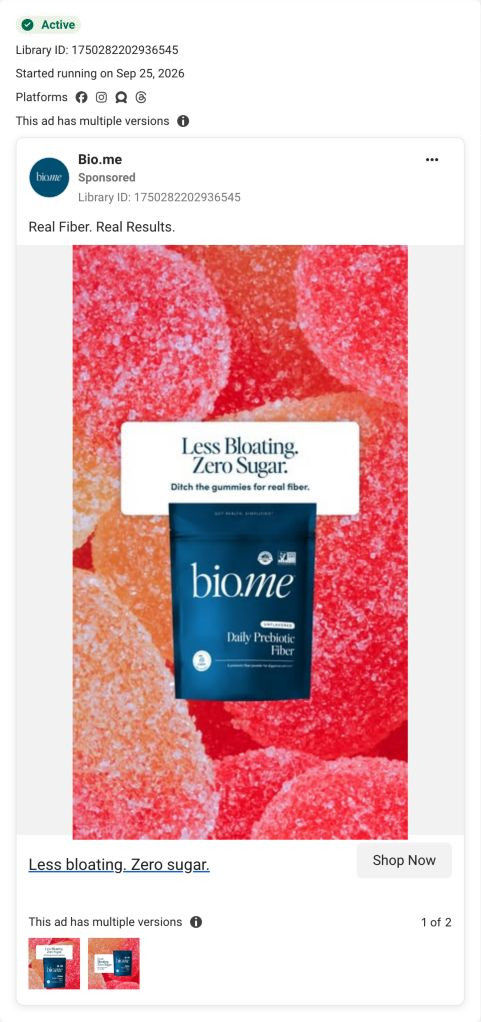


Bio.me · Daily Prebiotic Fiber
Advertiser benefit claims are shown as advertising examples. The landing page was captured on October 20, 2026 and may show a different offer from the ad.
Getting Enough Fiber?
A creator scoops from the pouch while an on-screen fiber-intake statistic sets up the daily-habit message. Compare the creative with the destination and explore the other ads sharing this route.
- Brand
- Bio.me
- Observed offer
- 7g of fiber in one scoop advertised; no discount stated
- Creative angle
- Education
- Page type
- Product page
- Ad format
- Video · 0:26
- Listed start date
- Oct 15, 2026
- Captured
- Oct 20, 2026
- Library ID
- 1125970949847194
- Destination
- bio.me
Selected for its design and offer structure. Ad performance isn’t available in this collection.
What this ad does well
The ad does simple math the viewer can follow. It opens with the creator's statistic about recommended daily fiber, then makes it personal: one scoop gives her 7 grams, takes 10 seconds, and in her words gets her 25% closer to her daily goal. That turns an abstract gap into a fraction of a day you can picture. The scoop is moving from the first frame, and the copy repeats the same close-the-gap idea, so the message stays consistent.
What's missing
The statistic is about Americans in general, not the person watching. A viewer can agree with the number and still assume they're one of the people getting enough. If you make one like this, follow the statistic with a quick test the viewer can run on their own day (what did you eat today, and how much fiber was in it?) before you show the scoop. The ad also has no offer, so close on the subscription price the page shows.
Beat by beat
- 0-4sCaptions cite a statistic that most Americans aren't hitting the recommended daily fiber while she opens the pouch.
The number gets attention and frames fiber as a gap.
- 4-10sCaptions add the recommended range of 25 to 38 grams a day.
It gives the viewer a target to compare against.
- 10-17sShe says two ingredients, totally flavorless, and one scoop gets her 7 grams.
It introduces the product as the easy way to close the gap.
- 17-22sShe adds it to water and says 10 seconds gets her 25% closer to her daily goal.
The math and the time make the habit concrete.
- 22-26sShe closes on choosing Bio.me as an easy way to close the fiber gap.
It repeats the ad's single idea at the call to action.
The offer
No discount. The ad frames 7g of fiber in one scoop as the easy way to close a daily fiber gap.
Where it sends people
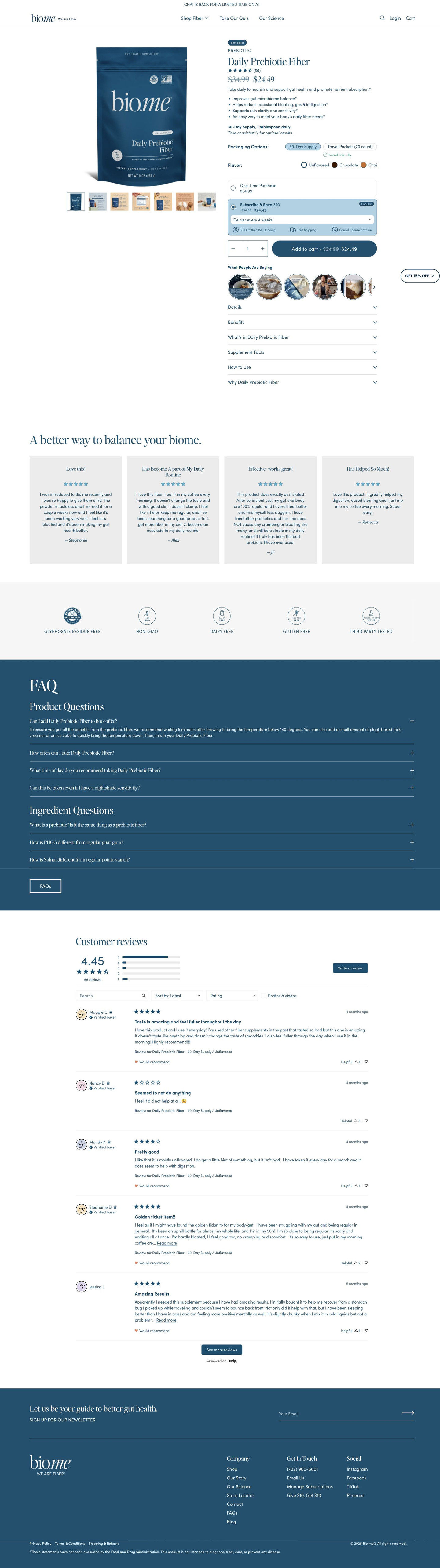
It sends people to the Daily Prebiotic Fiber product page, which sits on the weakest rung of the landing-page ladder (a standard product page rather than a page built around one problem, or the quiz Bio.me already links in its header). The buy box bullets include a line about meeting your body's daily fiber needs, and the dosage line says one tablespoon daily, so the close-the-gap idea carries over. The page doesn't repeat the math (7 grams against a daily target) anywhere in the blueprint. Putting that comparison next to the price would let the page finish the calculation the ad started.
The page it sends people to: How Bio.me's Daily Prebiotic Fiber page sells a subscription
Bio.me's Daily Prebiotic Fiber product page is short and subscription-first: the buy box carries the price, flavors, a pre-selected Subscribe & Save card and customer videos, with reviews, trust icons and an FAQ below. 18 ads in the Fluid library send people here, from Chai launch statics and habit-switch images to creator stories and comment replies.
How the page is built
- 01Announcement bar
A single limited-time line about the seasonal Chai flavor answers whether there's anything new worth buying now.
- 02Buy box
A pack shot with a gallery of infographic, lifestyle and supplement-facts images sits beside the badge, rating, price, a one-line promise, benefit bullets, a dosage line and the packaging and flavor selectors, answering what it is, what it costs and which version to pick.
- 03Purchase options
A one-time card and a pre-selected Subscribe & Save card with a delivery dropdown and perk icons answer how to save and whether a subscription locks you in.
- 04Customer videos
A row of round UGC thumbnails titled What people are saying sits directly under Add to cart and answers whether real people use it.
- 05Buy-column accordions
Details, benefits, ingredients, supplement facts, how to use and why this product answer the label reader's questions without making the page longer.
- 06Review highlight
A headline and quote cards with titles, stars and first names answer whether it works for people like the buyer, in customers' words.
- 07Trust strip
Line icons for residue free, non-GMO, dairy free, gluten free and third-party tested answer whether it's clean and safe to try.
- 08FAQ
Product and ingredient questions on a brand-color band handle the remaining objections before checkout.
- 09Full reviews
An average rating, distribution bars, search, sort and filters let a careful buyer dig into the reviews.
- 10Newsletter and footer
A newsletter band and the footer with the supplement disclaimer catch visitors who aren't ready to buy.
The first fixes we would make
- Many of the ads sell a specific flavor or format (Chai, Chocolate, travel packets), but the observed page opens on the Unflavored 30-day pouch. Link each ad to its matching variant so the selector and main image already show what the click promised.
- Several ads lead with bloating, while the page's opening promise is broad gut health. Build a bloating landing page, or route those ads into the quiz Bio.me already links in its header, so the page starts on the problem the ad named.
Read the full breakdown of this page
Three hooks you could test
- Lead with the uncomfortable problem. “Most people miss this daily target. Want to check if you're one of them?”
- Turn the benefit into a picture people get in a second. “Ten seconds, one scoop, a quarter of the way there.”
- Show a specific moment of use. “Water bottle, scoop, shake. Done before the kettle boils.”
What to borrow for your brand
- Open with a gap statistic, then turn it into a fraction the viewer can picture (one scoop gets you a quarter of the way).
- Put a time on the habit (10 seconds) so effort stops being an objection.
- Repeat the same single idea in the copy and the closing line so the ad says one thing.
Transcript
95% of Americans aren't hitting, recommended 25 to 38 grams of fiber a day. I started taking this from bio meat as an easy way to help me close the gap, between ingredients, totally flavorless, and yum scoop gives me 7 grams of fiber. I add it to my water or whatever I'm drinking, 10 seconds, and I'm 25% closer to my daily fiber goals. If you want an easy way to close the fiber gap, I choose Iomi.
Text on screen
- 95% of Americans aren't hitting the
- recommended
- Daily Prebir
- biome
- DIETARY PR
- 1 in 1118.
- 25 to 38 grams of fiber la day.
- Daily Prebit
- 25 to 38 grams of fiber a day.
- Daily Prebiotic
- I started taking this from Bio.me
- as an easy way to
- help me close the gap
- help me close the gap.
- Two ingredients. totally flavorless.
- and one scoop
- gets me 7 grams of fiber.
- I add it to my water
- or whatever I'm drinking
- 10 seconds and I'm
- 25% closer to my daily fiber goals
- If you want an easy
- way to close the fiber gap
- Ild choose Bio me.
One of 20 Bio.me ads in the Fluid Inspiration Library, captured from the Meta Ad Library on Oct 20, 2026. We record that an ad ran publicly, not how it performed.