Glow up with Melissa with The Absorption CompanySponsored
Esc
How The Absorption Company handles the needle objection with a creator
A 58-second talking-head video of a creator named Melissa, in glasses and a denim jacket, holding up what looks like an injection pen as she says needles and prescriptions lose her. She introduces WLP-1 as a daily, stimulant-free capsule. There's no discount. It sends people to The Absorption Company's needle-free GLP-1 advertorial.
The Absorption Company
10 creatives lead here1 / 10
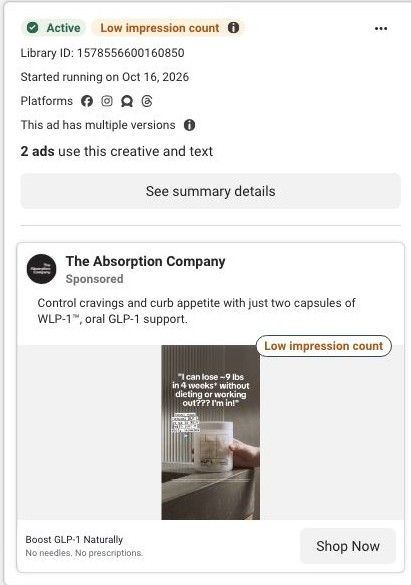
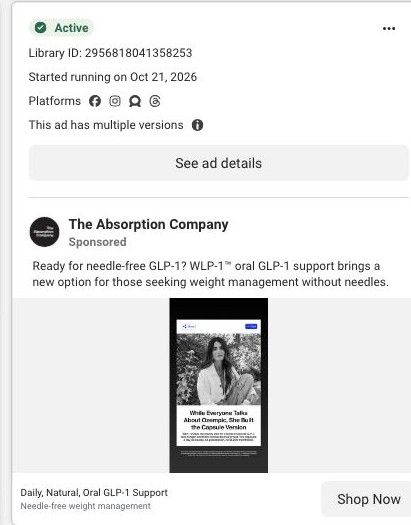
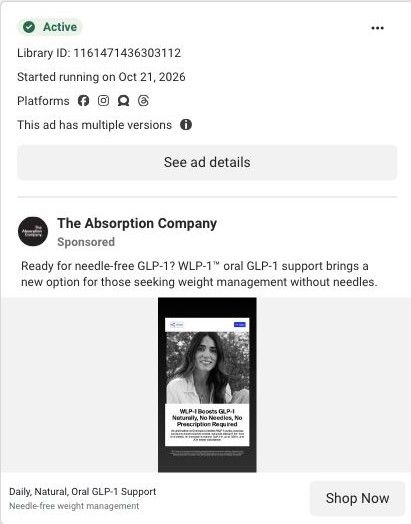
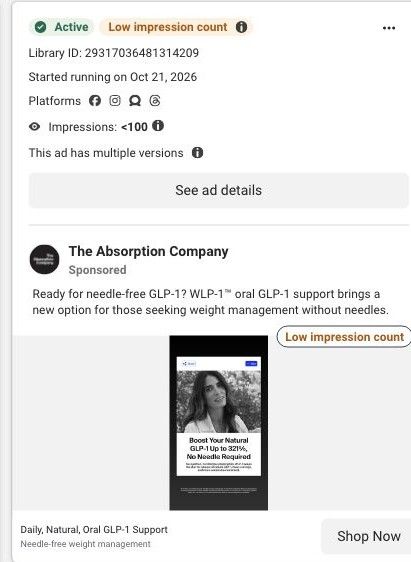
The needle-free GLP-1 guide
Captured directly from Meta and the linked page on October 20, 2026. Live offers may change.

No Prescriptions. No Needles. No Synthetics.
A creator in glasses introduces the product while holding a drink. The creator’s opening promise continues into an editorial introduction, repeated purchase options, customer stories, and FAQs. Compare the creative with the destination and explore the other ads sharing this route.
- Brand
- The Absorption Company
- Observed offer
- No Prescriptions. No Needles. No Synthetics.
- Creative angle
- Creator testimonial
- Page type
- Advertorial
- Ad format
- Video · 0:58
- Listed start date
- Oct 7, 2026
- Captured
- Oct 20, 2026
- Library ID
- 1130839793212524
- Destination
- absorbmore.com
Selected for its design and offer structure. Ad performance isn’t available in this collection.
What this ad does well
Melissa opens by waving what looks like an injection pen at the camera, so the objection is on screen before she says it. Her script then moves through the questions a GLP-1-curious viewer actually has: she says it isn't a medication, that it's built around three clinically studied branded ingredients, and that it's stimulant free ('because I know somebody's thinking this'). That last line is a smart move, since it answers the doubt in the viewer's head in her own voice. The link headline, 'No Prescriptions. No Needles. No Synthetics.', repeats the same three exclusions.
What's missing
The video spends nearly all its time on what WLP-1 isn't and very little on what someone would notice after taking it, so the outcome stays abstract. The close leans on her claim that it's selling out fast, and nothing in the ad shows that. If you make one like this, keep the pen-prop opener and the objection handling, then add one specific moment of use (what changed at dinner, the afternoon snack she skipped), and swap the scarcity line for a concrete reason like the landing page's refund promise.
Beat by beat
- 0-5sMelissa holds an injection pen toward the camera and says The Absorption Company just put GLP-1 support into a capsule.
Showing the thing people fear in the first frame stops anyone who's been put off by injections.
- 5-20sShe says she gets why everyone's talking about GLP-1s, but prescriptions and needles lose her.
Agreeing with the trend and then naming her objection makes her sound like the viewer, not a salesperson.
- 20-40sShe explains WLP-1 is a daily capsule meant to support the body's own GLP-1 system, built on three clinically studied ingredients, and stimulant free.
Answering the 'is this just another trendy bottle?' and 'is it full of caffeine?' questions before anyone asks builds trust.
- 40-58sShe speaks to viewers who are curious about GLP-1s but stop at the needle, says it's selling fast and affordable, and points to the link.
The close hands the viewer a label for themselves and a next step.
The offer
No price or discount. The value is framed as avoiding needles and prescriptions, with 'Try Oral GLP-1 Support Now' and a 'Shop now' CTA.
Where it sends people
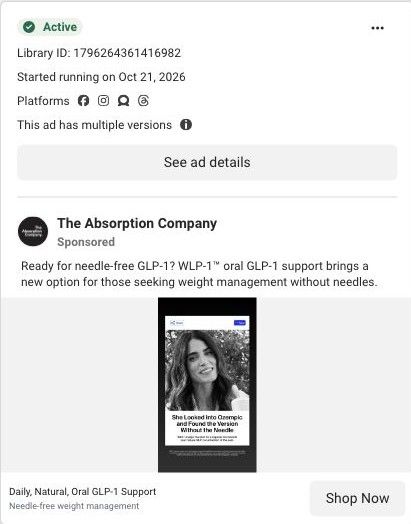
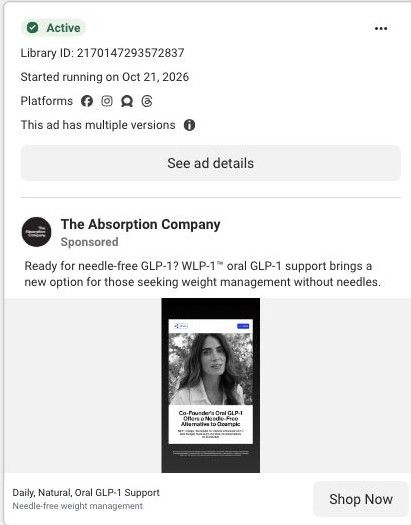
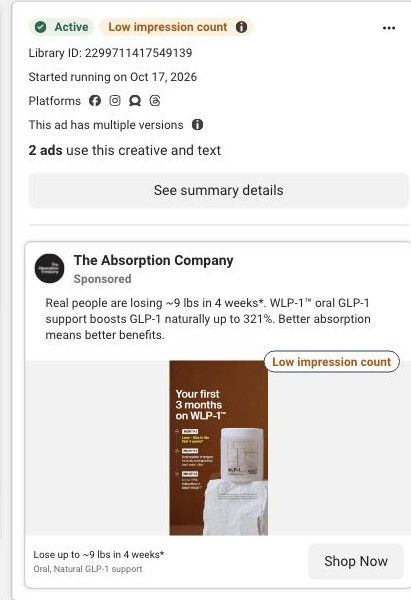
The ad goes to the needle-free GLP-1 advertorial, a focused landing page. The blueprint opens with 'Skip the shot,' which matches Melissa's opener almost word for word, then lays out five reasons people choose the injection-free route (no needles or prescription, absorption, three pathways, side effects, the two-capsule routine), customer reports, the product block, FAQs and a refund promise. Everything she raises in the video has a section waiting for it, which is about as close a message match as you'll see. Ten ads in the Fluid library point to this page.
The page it sends people to: How The Absorption Company wrote a needle-free GLP-1 advertorial
An advertorial for WLP-1 that frames the product as a needle-free route, with a co-founder byline, three benefit tiles, an early plan box, five numbered reasons, customer reports, FAQs and a refund guarantee. 10 Absorption Company ads in the Fluid library link here, mainly editorial-style statics and creator videos about no needles and no prescription.
How the page is built
- 01Skip-the-shot hero
States the GLP-1 claim, the no-needle framing and the price-from line with a study disclaimer, answering what this is and why read on.
- 02Founder byline and intro
Opens in the co-founders' voice with the brand's case against injections, answering who is talking and what problem they see.
- 03Benefit tiles
Names fullness, quieter cravings and burning more at rest, answering what the product is claimed to do.
- 04Early plan box
Offers 3-month, 6-month and monthly plans with badges and the guarantee, answering how to buy right away.
- 05Five reasons
Numbered sections on cost, absorption, three pathways, side effects and the routine, answering the main objections one at a time.
- 06Customer reports
Shares what customers report, answering whether people like the reader have tried it.
- 07Product block
Restates WLP-1 with its plans, answering how to order after reading.
- 08FAQs
Covers remaining questions, answering the last doubts before purchase.
- 09Refund guarantee
Promises a refund if it doesn't work, with free shipping and cancel-anytime tiles, answering what happens if it doesn't suit you.
The first fixes we would make
- The free-shipping line here says orders over $75, while the site's product pages say $50+. Align the threshold across every page an ad can land on, because a mismatch at checkout reads as a bait and switch.
- Creator videos send traffic here, but the page is written entirely in the founders' editorial voice. Embed one short creator clip near the benefit tiles so video viewers see the format and face that brought them.
Read the full breakdown of this page
Three hooks you could test
- Call out the habit you're replacing. “Everyone's talking about [popular option]. Here's what I picked instead.”
- Lead with the uncomfortable problem. “The second someone mentions [scary part], you're out?”
- Make the product the whole scene. “Hold the old way in one hand, your product in the other, and let people compare.”
What to borrow for your brand
- Put the thing your customer is avoiding in the first frame as a prop, so the objection is visible before a word is said.
- Write an 'I know somebody's thinking this' line into the creator brief to answer the top doubt in their own voice.
- Match the landing page headline to the creator's opening line so the click feels like the same conversation continuing.
Transcript
Skip this because the absorption company literally just put GLP one support into a capsule because listen, I do understand why everyone is talking about GLP ones right now. The 2nd you start talking to me about prescriptions and sticking myself with the needle, you lost me. This is the only option I wanted to know about. It's called WLP one and instead of being a GLP one medication. It's a daily capsule designed to support your body's own natural GLP one system. So without painful injections and needles or expensive prescriptions. And what I really like is that they didn't just throw GLP one on the front of a random supplement and call it a day. They built this formula around 3, clinically studied branded ingredients, including one that uses enhanced delivery technology for better absorption, because I know somebody's thinking this. No, they did not load it with caffeine or stimulants either. It's completely stimulant free. So if you've been GLP one curious, but the actual injection part is where you immediately check out, this is the category I'd be looking into because I didn't want another trendy GLP one bottle. I wanted to know what my options were that didn't involve a needle. This is blowing up right now and it's selling out so fast, such an affordable alternative, and I'll go ahead and like it right down below for you.
Text on screen
One of 188 The Absorption Company ads in the Fluid Inspiration Library, captured from the Meta Ad Library on Oct 20, 2026. We record that an ad ran publicly, not how it performed.