Glow up with Melissa with The Absorption CompanySponsored
Esc
How The Absorption Company used an article-style ad to sell WLP-1
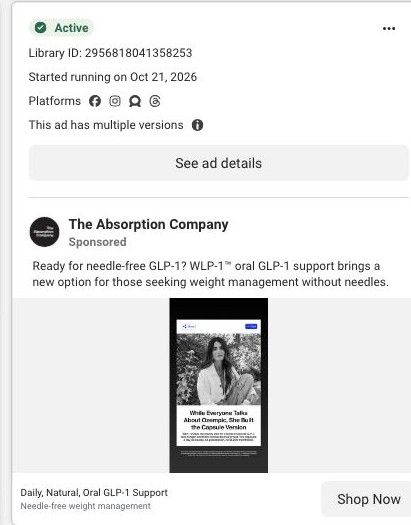
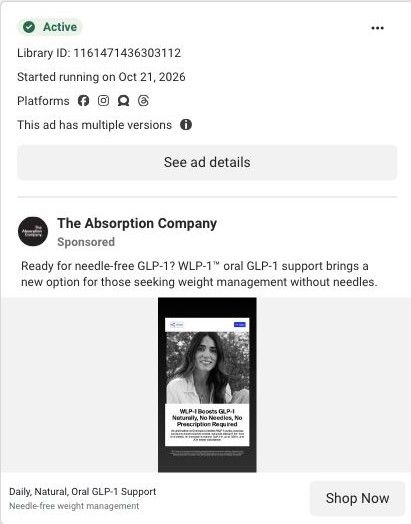
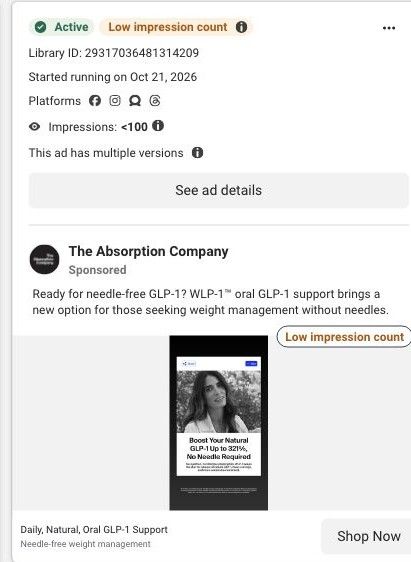
A static Meta ad made to look like a phone-screen news article, with a black-and-white portrait of a woman and the headline 'While Everyone Talks About Ozempic, She Built the Capsule Version.' The copy asks if you're ready for needle-free GLP-1. It sends people to a needle-free GLP-1 advertorial page built around five reasons.
The Absorption Company
10 creatives lead here1 / 10
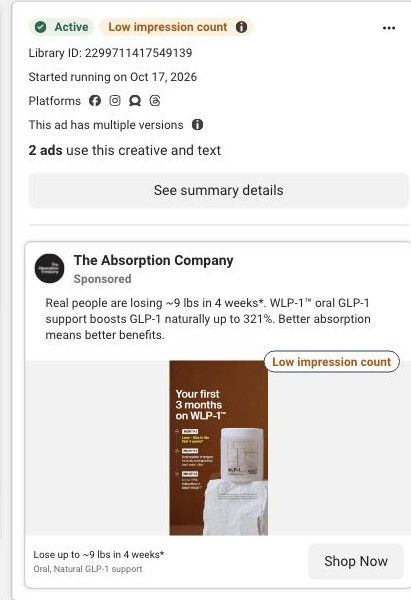
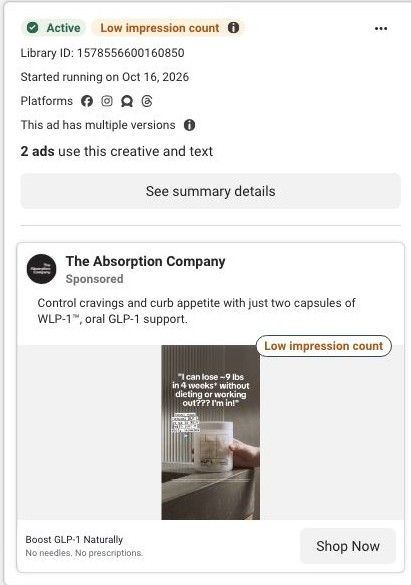
The needle-free GLP-1 guide
Active ad and exact outbound link observed in Meta Ad Library on October 22, 2026. The page image and section source are the existing October 20 capture of this destination. Offers and product selections may change. Selection reflects creative and page structure; performance is not available.

Daily, Natural, Oral GLP-1 Support
She built the capsule version · editorial-style creative. The creator’s opening promise continues into an editorial introduction, repeated purchase options, customer stories, and FAQs. Compare the creative with the destination and explore the other ads sharing this route.
- Brand
- The Absorption Company
- Observed offer
- Daily, Natural, Oral GLP-1 Support
- Creative angle
- Editorial advertorial
- Page type
- Advertorial
- Ad format
- Image
- Listed start date
- Oct 21, 2026
- Captured
- Oct 22, 2026
- Library ID
- 2956818041358253
- Destination
- absorbmore.com
Selected for its design and offer structure. Ad performance isn’t available in this collection.
What this ad does well
The article styling buys a different kind of attention than a product shot: it reads like a story about a person, so people who scroll past ads may stop for it. The headline rides a conversation everyone has heard about (Ozempic) and introduces a founder-style character, which gives the product an origin instead of a spec sheet. It sends people to an advertorial, so the 'keep reading' promise of the creative is actually kept on the next screen. It's one of 10 ads in the library that point to that page.
What's missing
The creative promises a story about her, but the copy below it is a plain product line about needle-free weight management, so the ad drops the character it just introduced. Nothing names who she is or why she's credible. If you make one like this, write the primary text as the first paragraph of the article (who she is, what she noticed, why she built it), and keep the product claims attributed. A specific, believable detail about the founder does more for trust than a broad needle-free promise.
Beat by beat
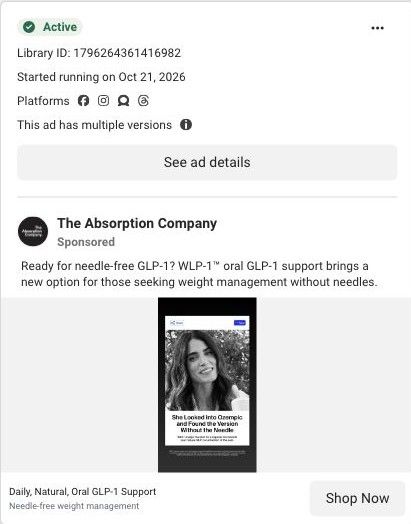
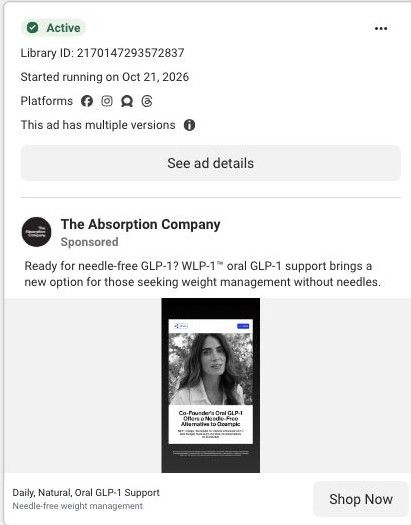
- ImageA phone-screen mockup of an article page with a black-and-white portrait of a smiling woman.
It looks like editorial content, which earns a read from people who skip obvious ads.
- HeadlineAn article headline about building the capsule version while everyone talks about Ozempic.
It hooks into a topic the viewer already knows and promises a person's story behind the product.
- Copy'Ready for needle-free GLP-1?' followed by a line introducing WLP-1 as a new option without needles.
It qualifies the reader as someone curious about GLP-1 without injections.
Where it sends people
This is the closest match on the ladder short of a quiz: an advertorial page built for the same reader. It opens with a 'skip the shot' hero and the page's own claim about boosting natural GLP-1 by up to 321%, then three quick benefits, and five numbered reasons people choose the injection-free route (no needles, no prescription and no $1,000+ monthly bill; absorption; three pathways; no side-effect trade-off; two capsules before your largest meal). Customer reports, the product block, FAQs and a refund promise close it out. The page delivers the article feel the ad sets up, though the woman from the ad's headline doesn't appear in the captured section names, so the story thread could be stronger.
The page it sends people to: How The Absorption Company wrote a needle-free GLP-1 advertorial
An advertorial for WLP-1 that frames the product as a needle-free route, with a co-founder byline, three benefit tiles, an early plan box, five numbered reasons, customer reports, FAQs and a refund guarantee. 10 Absorption Company ads in the Fluid library link here, mainly editorial-style statics and creator videos about no needles and no prescription.
How the page is built
- 01Skip-the-shot hero
States the GLP-1 claim, the no-needle framing and the price-from line with a study disclaimer, answering what this is and why read on.
- 02Founder byline and intro
Opens in the co-founders' voice with the brand's case against injections, answering who is talking and what problem they see.
- 03Benefit tiles
Names fullness, quieter cravings and burning more at rest, answering what the product is claimed to do.
- 04Early plan box
Offers 3-month, 6-month and monthly plans with badges and the guarantee, answering how to buy right away.
- 05Five reasons
Numbered sections on cost, absorption, three pathways, side effects and the routine, answering the main objections one at a time.
- 06Customer reports
Shares what customers report, answering whether people like the reader have tried it.
- 07Product block
Restates WLP-1 with its plans, answering how to order after reading.
- 08FAQs
Covers remaining questions, answering the last doubts before purchase.
- 09Refund guarantee
Promises a refund if it doesn't work, with free shipping and cancel-anytime tiles, answering what happens if it doesn't suit you.
The first fixes we would make
- The free-shipping line here says orders over $75, while the site's product pages say $50+. Align the threshold across every page an ad can land on, because a mismatch at checkout reads as a bait and switch.
- Creator videos send traffic here, but the page is written entirely in the founders' editorial voice. Embed one short creator clip near the benefit tiles so video viewers see the format and face that brought them.
Read the full breakdown of this page
Three hooks you could test
- Call out the habit you're replacing. “Everyone's talking about the expensive option. She found a simpler one.”
- Sell the outcome. “The routine that fits in a pill case, not a pharmacy bag.”
- Lead with the uncomfortable problem. “You don't want a needle in your fridge forever. Neither did she.”
What to borrow for your brand
- Dress a static as an article page with a portrait and a news-style headline so it gets read like content instead of skipped like an ad.
- Tie your product to a conversation people are already having, then introduce the person behind your version of it.
- Send article-style ads to an article-style page, so the reader who clicked to keep reading finds more story and not a checkout.
One of 188 The Absorption Company ads in the Fluid Inspiration Library, captured from the Meta Ad Library on Oct 22, 2026. We record that an ad ran publicly, not how it performed.