How The Absorption Company launched Sleep Hot Chocolate with a gift
A static Meta launch ad for Sleep Hot Chocolate. The pouch, a mug of hot chocolate and a sleep mask with a free badge sit on a table in warm evening light under the headline 'Your Bedtime Just Got Sweeter.' The copy leads with skipping melatonin. It sends people to the Sleep product page.
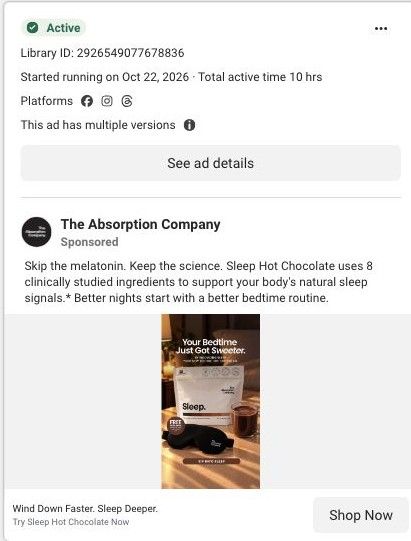
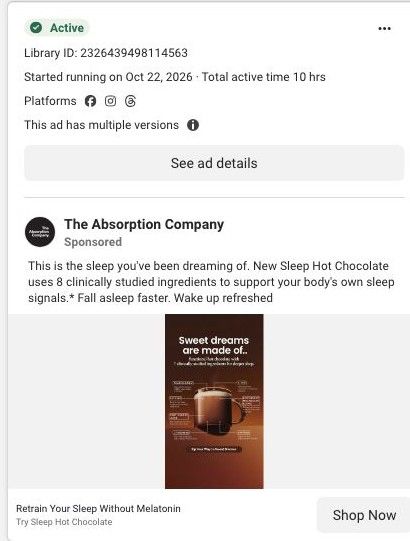
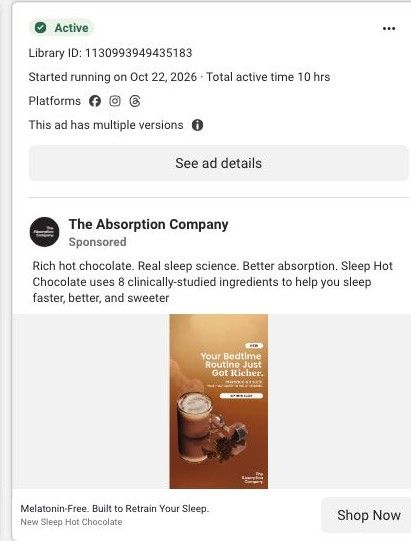
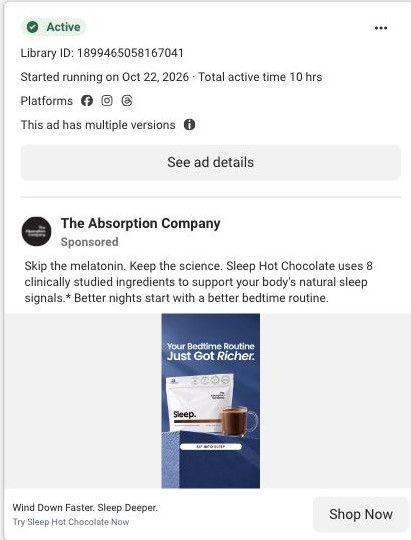
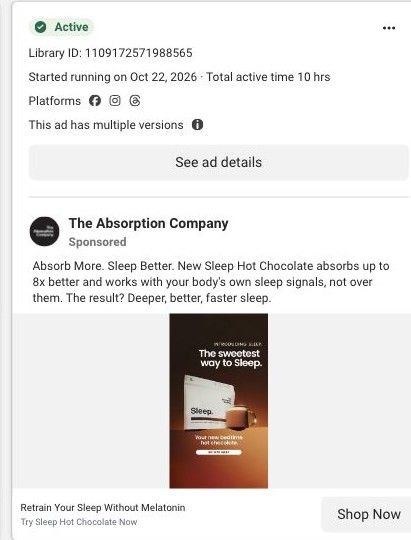
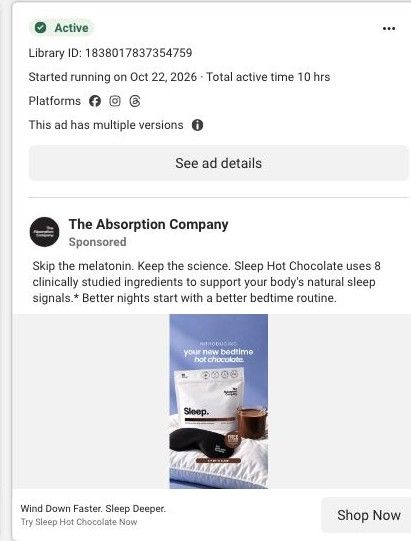
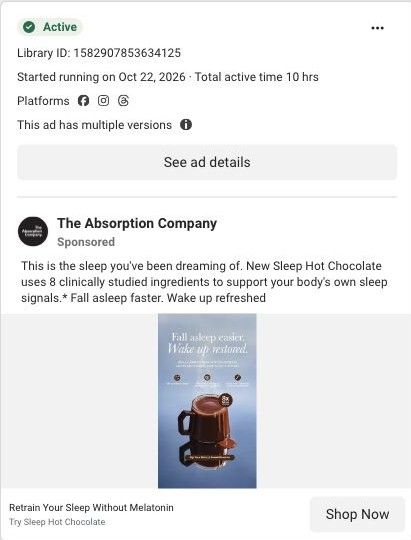
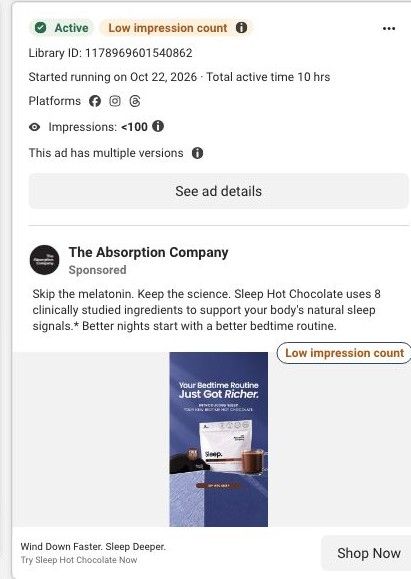
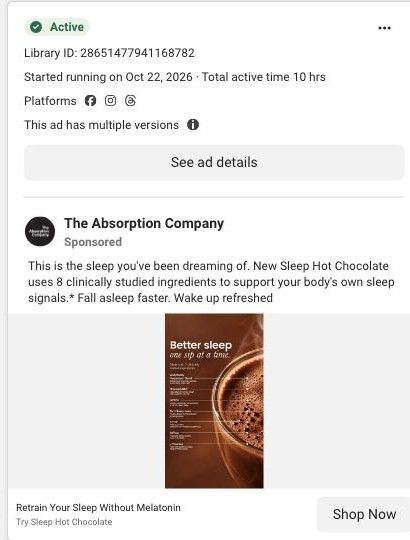
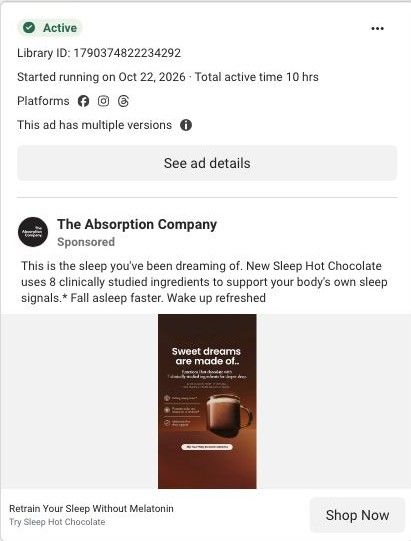
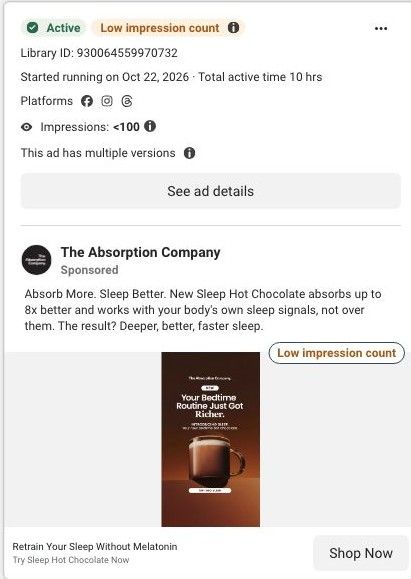
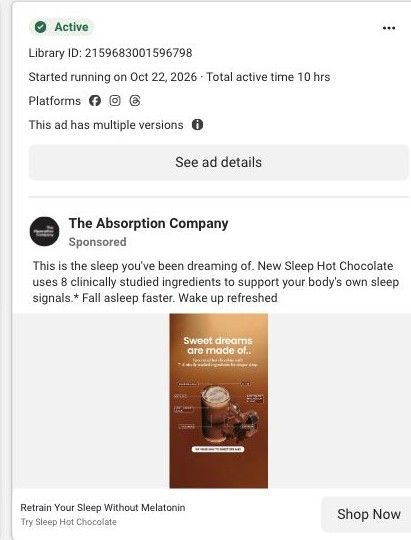
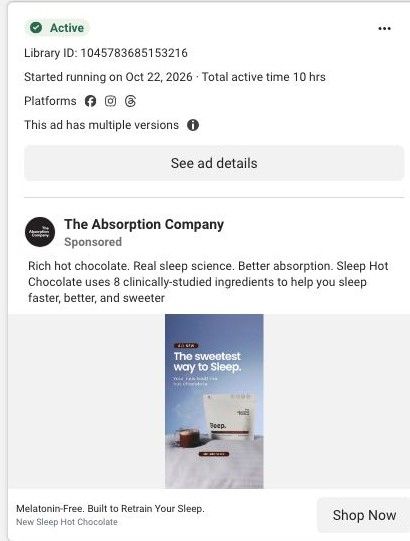
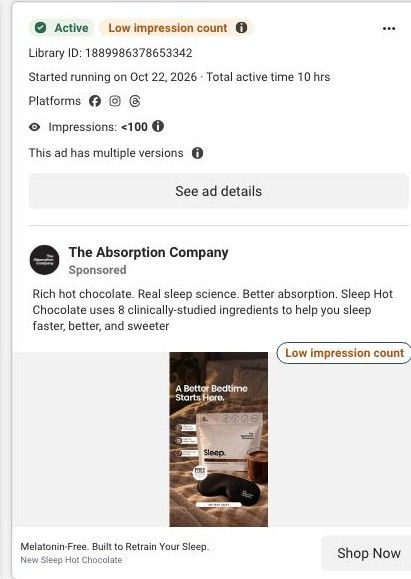
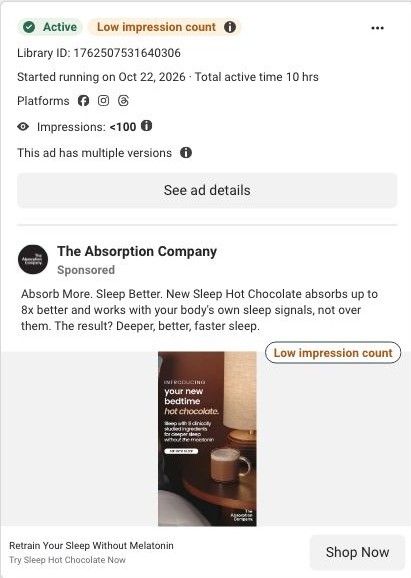
Active ad and exact outbound link observed in Meta Ad Library on October 22, 2026. This destination was captured with its public layout and styles on October 22. Offers and product selections may change. Selection reflects creative and page structure; performance is not available.

Wind Down Faster. Sleep Deeper.
Your Bedtime Just Got Sweeter · launch gift bundle. A product gallery introduces Sleep alongside flavor and plan choices, gift details, benefits, a three-pathway explanation and a routine timeline. Compare the creative with the destination and explore the other ads sharing this route.
- Brand
- The Absorption Company
- Observed offer
- Wind Down Faster. Sleep Deeper.
- Creative angle
- Product launch
- Page type
- Product page
- Ad format
- Image
- Listed start date
- Oct 22, 2026
- Captured
- Oct 22, 2026
- Library ID
- 2926549077678836
- Destination
- absorbmore.com
Selected for its design and offer structure. Ad performance isn’t available in this collection.
What this ad does well
The product is a hot chocolate, and the ad leans into it: a steaming mug and a warm, dim scene sell a bedtime ritual instead of a sleep supplement. The free sleep mask in the frame turns the launch into a gift offer without a single word of discount copy. The opening line, "Skip the melatonin. Keep the science.", speaks to someone who has already tried the obvious option, which is a sharper audience than 'anyone who sleeps badly'. Calling out the 8 clinically studied ingredients (the copy's claim) gives the cozy image a reason to believe.
What's missing
The ad tells you it's sweet and cozy, but not what bad night it fixes, so a viewer who isn't already shopping for sleep has no moment to recognize. The free mask is visible but never named in the copy or headline, so the offer is easy to miss. If you make one like this, open on the night the customer actually has (lying awake at 1am, waking groggy after melatonin), and spell out the gift in the copy with any terms. Because it's a new product, a few early customer lines about how it tastes or how they slept would give it proof it doesn't have yet.
Beat by beat
- ImageThe Sleep pouch, a mug of hot chocolate and a black sleep mask with a free badge on a table in warm light.
It sells the bedtime ritual and slips in the gift without needing copy.
- Headline'Your Bedtime Just Got Sweeter' at the top of the frame.
It frames the launch as an upgrade to a routine the viewer already has.
- CopySkip the melatonin, keep the science, then the copy's claim of 8 clinically studied ingredients for natural sleep signals.
It positions the product against the option most buyers have already tried.
The offer
A free sleep mask shown in the creative as part of the launch, with no discount stated in the copy.
Where it sends people
The ad goes to the Sleep product page, a standard product page rather than a focused landing page. It opens with a gallery, plan choices from a 3-month supply down to 2 weeks or a one-time purchase, a magnesium pairing, then a three-pathway explanation (quiet the nervous system, rebuild the sleep signal, access restorative sleep), a wellness-over-time timeline, absorption numbers and an experts section. The page note mentions gift details, so the mask likely carries through. The captured sections don't include a reviews block, which matters for a launch ad that also has no proof. It's one of 17 ads in the library that land here.
The page it sends people to: How The Absorption Company launched Sleep with a gift-led product page
The Absorption Company's product page for Sleep, a melatonin-free drink mix launched in a new hot chocolate flavor. It offers bag or stick formats, flavor choices, five plan options with free gifts, a three-pathway explanation, an over-time section and absorption claims. 17 Absorption Company ads in the Fluid library link here, mostly launch statics about retraining sleep without melatonin.
How the page is built
- 01Gallery and claims
Shows the new hot chocolate bag with a frother and mask beside the rating and claimed sleep benefits, answering what this is and why it's new.
- 02Flavor, format and plans
Offers bag or sticks, two flavors and plans from three months down to buy once, with free gifts, answering what it costs and what to choose.
- 03Magnesium cross-sell
Suggests adding magnesium, answering what else to pair and raising order size.
- 04Why Sleep works better
Explains the brand's ingredient claims, answering why this over another sleep product.
- 05Three sleep pathways
Breaks the formula into calming, rebuilding the sleep signal and deeper sleep, answering how it's supposed to work.
- 06Over-time section
Describes what the brand says changes over time, answering when to expect anything.
- 07Absorption claims
Shows 5x and 8x absorption figures, answering whether the ingredients reach the body.
- 08Expert proof and pairings
Shows expert backing and complementary products, answering who vouches for it and what to add.
The first fixes we would make
- The page shows a star rating at the top, but there's no customer review section in what we captured. Add reviews near the plan picker, ideally ones that mention the flavors and the first week, so the launch has proof from buyers.
- Two formats, two flavors, five plan lengths and a flavor choice for each bag add up to a lot of decisions before add to cart. Preselect the recommended format, plan and flavor so a visitor can buy in one tap and adjust only if they want to.
Read the full breakdown of this page
Three hooks you could test
- Call out the habit you're replacing. “Done with melatonin that leaves you foggy? Swap it for a mug.”
- Show a specific moment of use. “Lights low, phone down, one warm mug before bed.”
- Sell the outcome. “Wake up before your alarm and actually feel like getting up.”
What to borrow for your brand
- If your product has a ritual (a warm drink, a scent, a routine), build the image around the ritual so it sells the moment and not the ingredient list.
- Put a gift in the product shot with a small badge so the offer reads in a glance, then name it in the copy too.
- Write your first line against the option your buyer has already tried, so you're talking to people who are actively shopping.
One of 188 The Absorption Company ads in the Fluid Inspiration Library, captured from the Meta Ad Library on Oct 22, 2026. We record that an ad ran publicly, not how it performed.