How Ways2Well tells readers they don’t need to be peptide experts
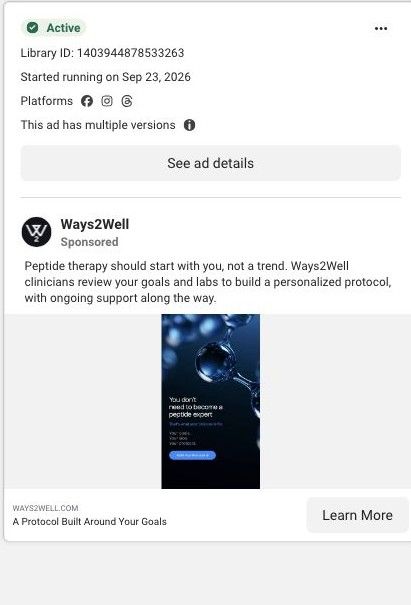
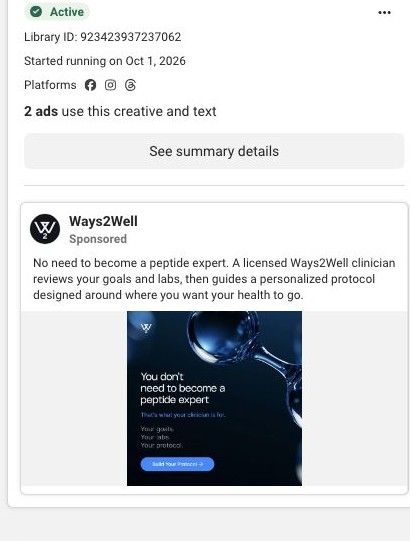
A vertical static ad from Ways2Well over a blue molecular illustration: “You don’t need to become a peptide expert. That’s what your clinician is for.” It lists “Your goals. Your labs. Your protocol.” above a Build Your Protocol button. The copy rejects trend-driven buying, and the ad links to the Ways2Well peptide consultation page.

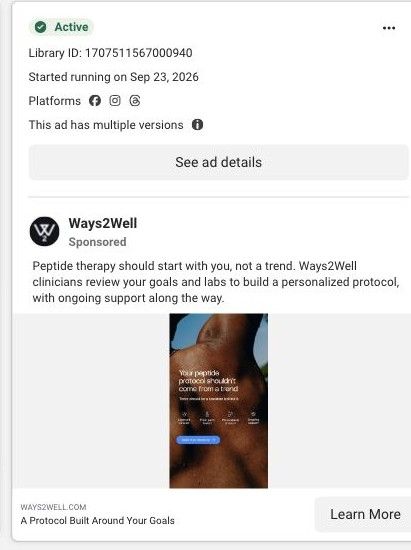
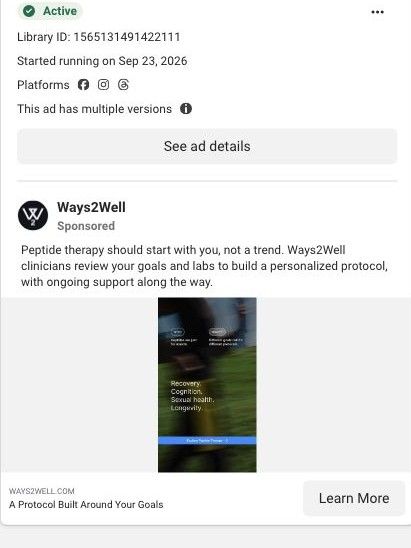
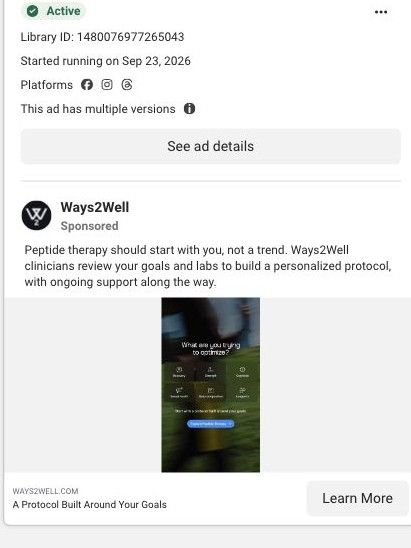
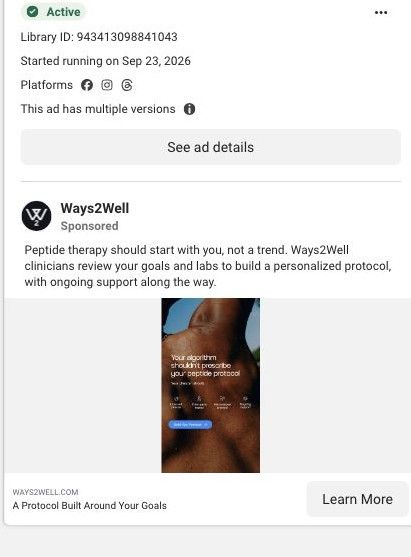
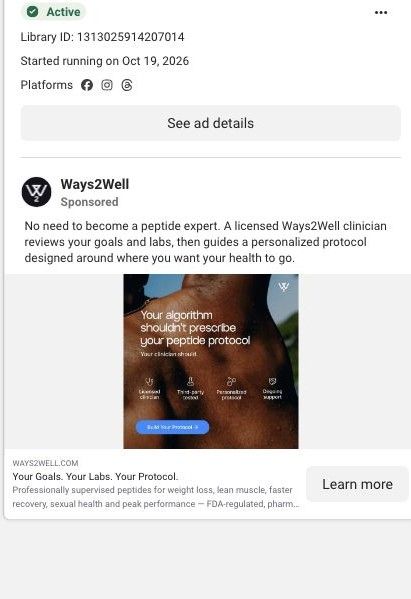
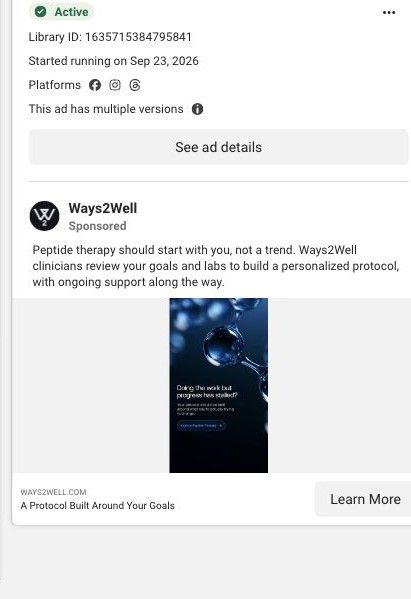
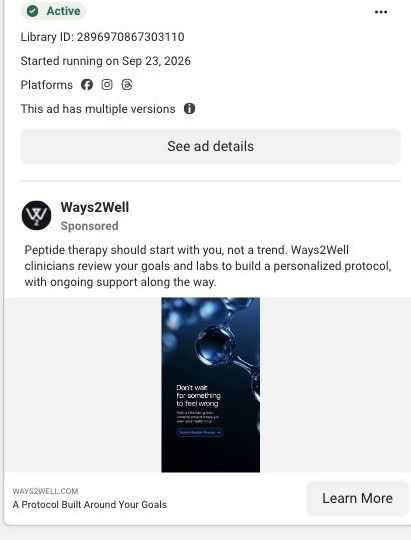
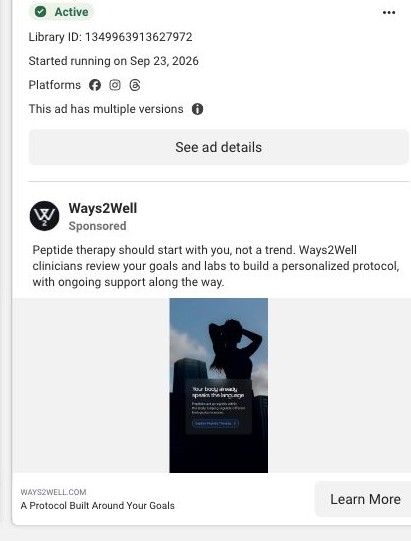
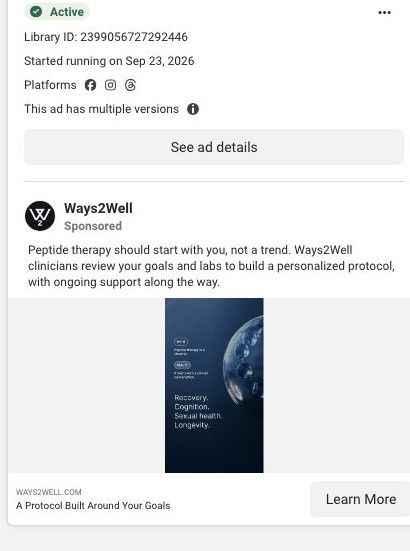
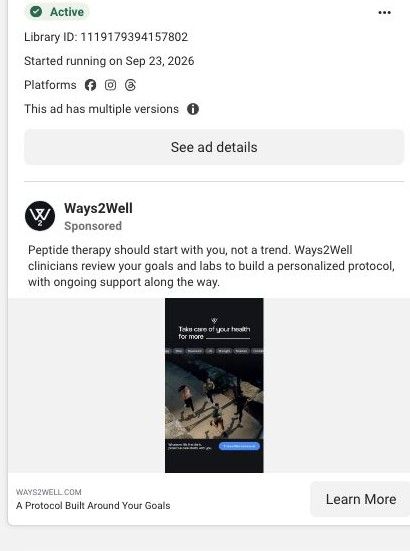
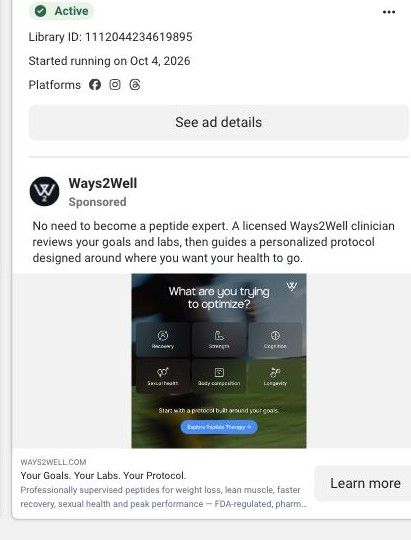
Active creative and exact outbound link observed in Meta Ad Library on October 22, 2026. The final destination was followed and its public rendered layout captured. Advertiser claims are retained as source material; creative activity does not establish performance. No personal, health or payment details were entered.

A Protocol Built Around Your Goals
A goal-led hero introduces a paid consultation, followed by trust cards, a peptide guide, the consultation process, pricing and FAQs. Compare the creative with the destination and explore the other ads sharing this route.
- Brand
- Ways2Well
- Observed offer
- A Protocol Built Around Your Goals
- Creative angle
- Objection handling
- Page type
- Consultation entry
- Ad format
- Image
- Listed start date
- Sep 23, 2026
- Captured
- Oct 22, 2026
- Library ID
- 1403944878533263
- Destination
- ways2well.com
Selected for its design and offer structure. Ad performance isn’t available in this collection.
What this ad does well
The headline names the real feeling behind a confusing category (there’s too much to learn) and takes that job off the reader’s plate in the next line. “Your goals. Your labs. Your protocol.” explains the process in three words each, so the reader knows what a clinician would look at. The copy adds a gentle jab at trend-driven buying, which positions Ways2Well as the careful option. The deep blue molecule art looks clinical and premium, and it matches the page’s dark design.
What's missing
The ad never tells the reader the first step costs $99, and “Build Your Protocol” suggests something free and instant. It also has no proof: no clinician face, no review, nothing that shows a real person behind the promise. If you make one like this, add a line like “Start with a $99 clinician consult” and a small photo or name of a clinician, so the click sets the right expectation and the clinician feels real.
Beat by beat
- ImageA glossy blue molecule fills the top of the frame above the headline “You don’t need to become a peptide expert.”
It names the overwhelm of a confusing category in the reader’s own terms.
- ImageBlue text answers “That’s what your clinician is for,” followed by “Your goals. Your labs. Your protocol.”
It hands the hard part to a clinician and shows the three inputs in one glance.
- ImageA Build Your Protocol button sits under the text.
It makes the next step feel active and personal.
- CopyThe caption says peptide therapy should start with you, not a trend, and mentions ongoing support.
It positions the brand against hype buying and promises care after the first visit.
Where it sends people
The ad links to the Ways2Well peptide consultation page, a focused landing page built around one service, which is a stronger rung than a homepage. The hero, “Peptide therapy, built around you.,” picks up the “your goals” promise directly, and a trust section with licensed clinician oversight backs up “That’s what your clinician is for.” The page also introduces the paid first step the ad never mentions: a 20-minute consult for $99, with any peptides that are prescribed billed separately. That price is explained clearly on the page, but someone who clicked “Build Your Protocol” may not expect to pay before anything is built.
The page it sends people to: How Ways2Well sells a $99 peptide consult before any product
The Ways2Well peptides page is a dark, goal-led landing page that sells a 20-minute, $99 clinician consult rather than a product. It moves from trust cards to goal tiles, state availability, a free peptide guide, a step-by-step process, the consult offer and FAQs. 13 ads in the Fluid library send people here, mostly statics on clinician-led reassurance and goal picking.
How the page is built
- 01Goal-led hero and consultation CTA
“Peptide therapy, built around you.” with a Book My Peptide Consult button and four trust labels answers “what is this and who is it for?”
- 02Clinical oversight and trust cards
Cards for licensed clinician oversight, FDA-regulated manufacturing, third-party testing and complete support answer “can I trust what I’d be taking?”
- 03Consult explanation
A section on the $99 consult says what it pays for and that peptides are billed separately, answering “what am I paying for?”
- 04Goal categories
Tiles from weight loss to sexual health answer “can this address my goal?”
- 05State availability
A grid of covered states with restrictions and an FDA disclaimer answers “can I get this where I live?”
- 06Educational guide
A free, clinician-written Ultimate Peptide Guide with a Request the Guide button answers “can I learn more before I commit?”
- 07Consultation process
Steps (sign up, meet with a clinician, receive your complete kit, ongoing support) answer “what happens after I book?”
- 08Entry offer and inclusions
A consult card restates the 20-minute, $99 visit and its inclusions, answering “what exactly do I get for $99?”
- 09FAQs
Questions on how peptides work, benefits, safety, which peptides and timing answer the remaining objections.
- 10Footer disclaimer
A medical and regulatory disclaimer sets expectations about outcomes and FDA approval.
The first fixes we would make
- There’s no social proof anywhere on the page: no reviews, no patient stories and no named clinicians. Add a short reviews section and the names and credentials of the clinicians right after the consult explanation, since the ads promise “your clinician” and the page never shows one.
- Peptide prices are never shown, so readers pay $99 without knowing what treatment might cost afterward. Add typical price ranges for common protocols near the consult card, so the decision to book feels safe.
Read the full breakdown of this page
Three hooks you could test
- Lead with the uncomfortable problem. “Overwhelmed by peptide advice online? You don’t need to sort it out alone.”
- Call out the habit you're replacing. “Stop piecing together a protocol from comment sections.”
- Sell the outcome. “Walk away from one consult with a plan built around your own labs.”
What to borrow for your brand
- Name the overwhelm in your category in the headline, then say who handles it for the customer in the next line.
- Summarize your process as a short repeated pattern (“Your goals. Your labs. Your protocol.”) so it’s readable at a glance.
- State the price of the first step in the ad when the next step is paid, so the click isn’t a surprise.
One of 13 Ways2Well ads in the Fluid Inspiration Library, captured from the Meta Ad Library on Oct 22, 2026. We record that an ad ran publicly, not how it performed.