How Smooche paired a serum unboxing with an accusation hook
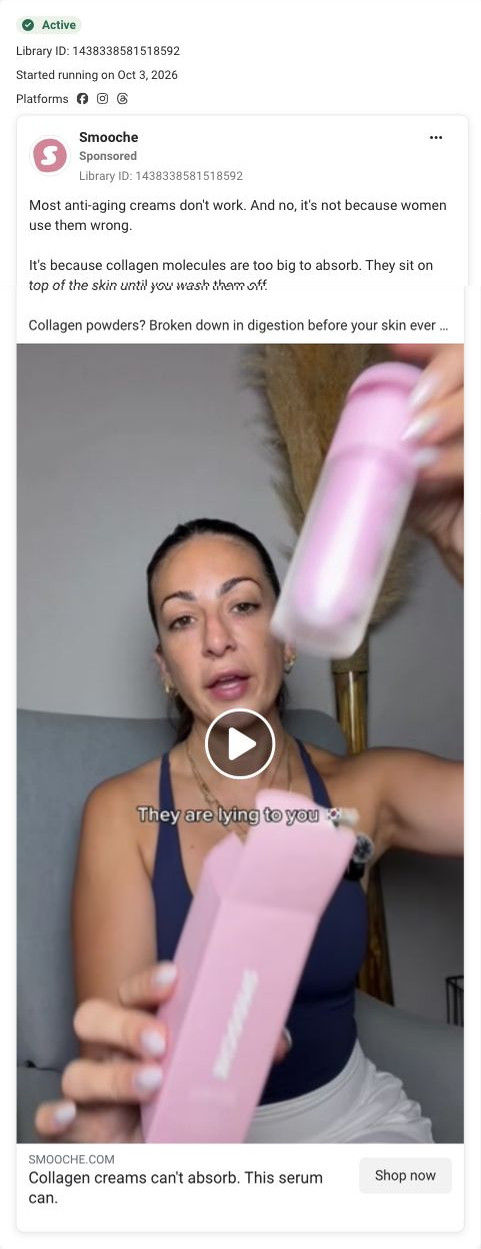
A creator video for Smooche's Reverse-Time Peptide Serum that opens as an unboxing: she pulls the pink serum toward the camera from its box under the caption “They are lying to you”. The copy claims collagen creams can't absorb and offers a 30-day risk-free trial, and Shop now opens the serum's product page.

The current destination was captured on October 20, 2026. Page offers may differ from the original ad.
Collagen creams can't absorb. This serum can.
A creator holds a pink serum bottle and box, pairing an unboxing view with an objection-led opening caption. Compare the creative with the destination and explore the other ads sharing this route.
- Brand
- Smooche
- Observed offer
- 30-day risk-free trial advertised
- Creative angle
- Creator stories
- Page type
- Product page
- Ad format
- Video
- Listed start date
- Oct 3, 2026
- Captured
- Oct 20, 2026
- Library ID
- 1438338581518592
- Destination
- smooche.com
Selected for its design and offer structure. Ad performance isn’t available in this collection.
What this ad does well
Unboxing puts the packaging right in front of the lens, and the accusation in the caption creates a villain before naming one. The copy then names it: collagen creams, which it claims have molecules too big to absorb. That's the persona's one-simple-enemy pattern, set up in the video and explained in the text, and it gives the viewer a reason to feel let down by her old products rather than by herself. It started running on Meta on Oct 3, 2026, one of 3 ads that land on the serum page.
What's missing
An accusation is a strong claim, and the ad doesn't say who they are on screen or show anything that backs the charge, so the hook can read as clickbait to a careful viewer. The copy's own claims (fresher-looking skin in days, firmer in weeks) need the same support. Name the enemy in the caption (collagen creams, as the copy does) and close the video with a piece of proof from the product page, such as an age-labeled review or a before-and-after, attributed to the customer.
Beat by beat
- 0-3sA creator pulls the pink serum bottle out of its pink box toward the camera under a they-are-lying caption.
The accusation creates curiosity and the unboxing shows the product up close.
- CopyThe text claims most anti-aging creams fail because collagen molecules are too big to absorb and powders are digested first.
It names the villain the caption hinted at.
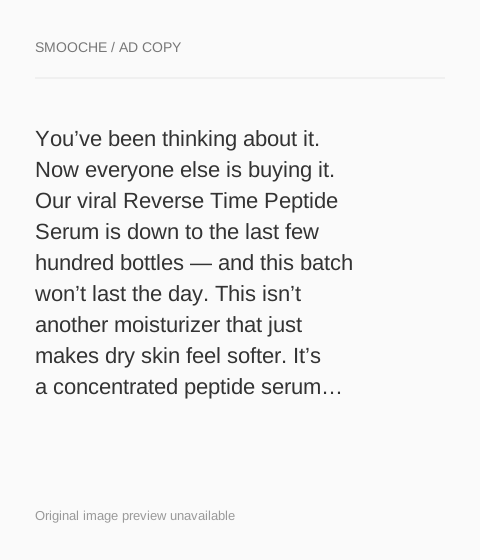
- CopyIt introduces a Korean-formulated peptide serum, lists three claims and ends with a 30-day risk-free trial.
It offers the alternative and removes the risk of trying it.
- HeadlineThe link line says collagen creams can't absorb but this serum can.
It restates the enemy and the answer at the tap.
The offer
A 30-day risk-free trial, stated at the end of the copy.
Where it sends people
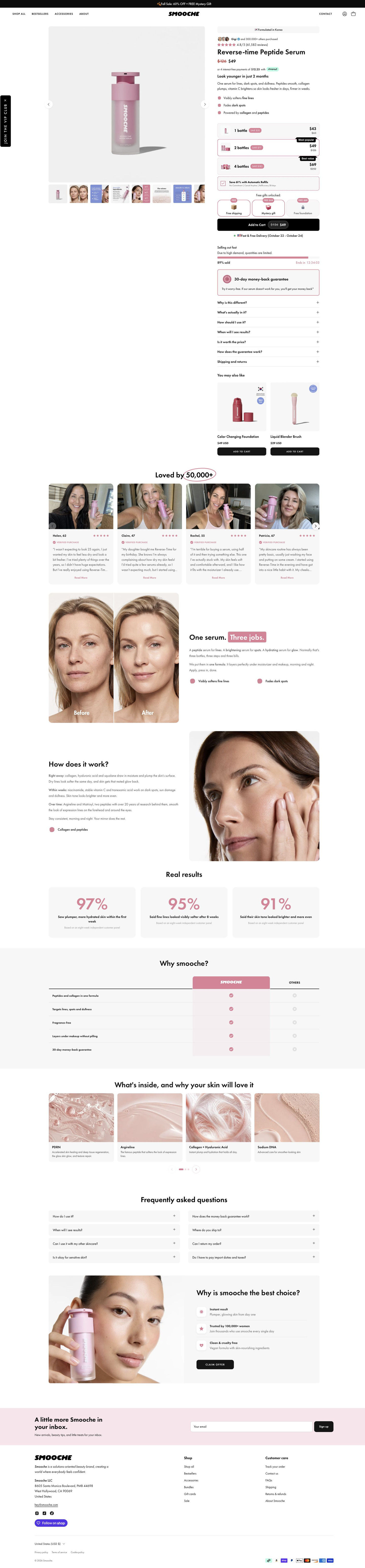
Shop now opens the serum's product page. The positioning section headed One serum. Three jobs. argues the serum replaces three products, which continues this ad's case against what the buyer uses now, and the comparison table pits the brand against Others across five rows. Age-labeled reviews with a photo of each customer holding the product provide the human proof the accusation needs. The buy box's quantity tiers and unlockable gifts then turn that case into a larger order.
The page it sends people to: How Smooche's serum page turns tiers and gifts into a bigger order
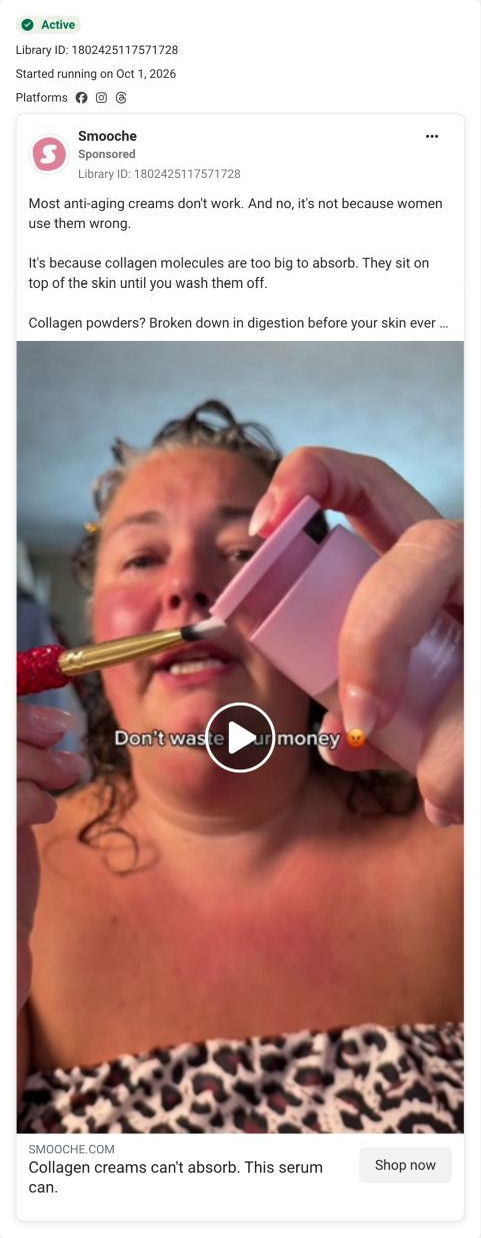
Smooche's Reverse-time Peptide Serum product page: the buy box stacks three quantity tiers, unlockable gifts, stock urgency and a guarantee, followed by age-labeled reviews, a before-and-after, a comparison table and a closing offer card. 3 ads in the Fluid library land here: a last-chance scarcity graphic, a creator demo and a creator unboxing.
How the page is built
- 01Announcement bar and header
A sale-plus-free-gift line and a header with a vertical VIP-club tab answer whether there's a deal and a loyalty program.
- 02Gallery
A large product shot with a thumbnail strip of model, before-and-after and infographic images answers what it looks like and what results the brand shows.
- 03Buy box top
An origin tag, purchase-count avatars, a star rating, a struck-through price, an installment line, a bold promise and three bullets answer what it is and who's bought it.
- 04Quantity and gifts
Three tier cards, an auto-refill checkbox, a free-gifts row with one locked tile and Add to Cart answer how much to buy and what bonus a bigger order unlocks.
- 05Urgency and objections
A stock bar with percent sold and countdown, a money-back card and seven question-style accordions answer why now, what if it doesn't suit me and is it worth it.
- 06Cross-sell
Two product cards under You may also like offer an add-on before the visitor scrolls on.
- 07Reviews carousel
Cards with a photo of each customer holding the product, first name and age, stars and a verified tag answer whether people like me use it.
- 08Before-and-after and positioning
A face pair beside the One serum. Three jobs. headline argues it replaces three products.
- 09How it works
Three time-phased paragraphs beside a close-up model photo explain what the brand says to expect and when.
- 10Results and comparison
Three customer-panel stat cards and a table against Others give the brand's proof and answer why this serum.
- 11Ingredients, FAQ and closing offer
Four ingredient cards, eight FAQ accordions and a closing card with three reasons and a Claim Offer button cover the last questions and give a final way to buy.
- 12Newsletter and footer
A pink email band and the store footer close the page.
The first fixes we would make
- Two of the three ads open on distrust of anti-aging products (a money warning and an accusation), yet the page's proof sits well below the buy box. Move one age-labeled review or the before-and-after pair into the gallery's first slots, so skeptical visitors see proof before the price.
- The ads' main argument is that collagen creams can't absorb, and the page's positioning focuses on replacing three products instead. Add a short line in the how-it-works section that picks up the absorption claim, attributed to the brand, so the ad's case continues.
Read the full breakdown of this page
Three hooks you could test
- Call out the habit you're replacing. “The collagen in your cream may never reach your skin.”
- Make the product the whole scene. “Opening the bottle that replaced my whole shelf.”
- Lead with the uncomfortable problem. “Paying for anti-aging cream that just washes off?”
What to borrow for your brand
- Give your ad one clear enemy (the product category your buyer used before) and name it in both the video and the copy.
- Pair an unboxing with a strong caption, so the packaging and the hook arrive in the same frame.
- Back any accusation with proof on screen before the video ends, so the hook earns trust instead of spending it.
One of 25 Smooche ads in the Fluid Inspiration Library, captured from the Meta Ad Library on Oct 20, 2026. We record that an ad ran publicly, not how it performed.