

PestieSponsored
Esc
How Pestie built a silent video around three on-screen claims
A 25-second Pestie video that ran on Meta from June 19, 2026, with no voiceover. On-screen text carries the message over moody product shots: Get rid of bugs, Smart Pest Plan, pro-grade treatments, 1/4 the cost and customized to location, climate and bug issues. It ends on "Visit pestie.com to get started" and links to the homepage.
Pestie
10 creatives lead here1 / 10




The Pestie homepage
Some embedded videos on the live homepage did not load during capture. The full page layout and copy are included.

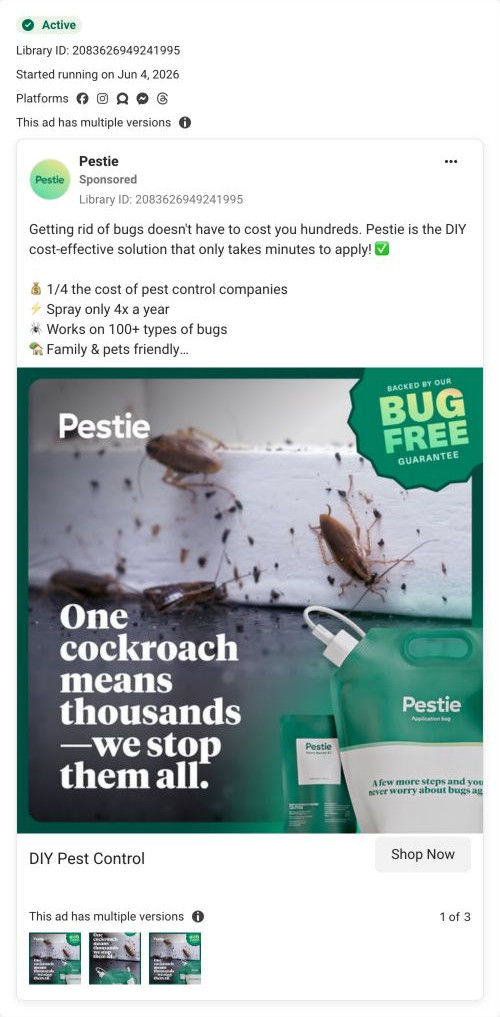
DIY Pest Control
The ad compares DIY pest control with service-company pricing and uses a short list of application and use-case benefits. Its CTA goes directly to Pestie’s homepage rather than a separate campaign landing page. Compare the creative with the destination and explore the other ads sharing this route.
- Brand
- Pestie
- Observed offer
- Advertised at 1/4 the cost of pest-control companies
- Creative angle
- Value-led
- Page type
- Homepage
- Ad format
- Video · 0:25
- Listed start date
- Jun 19, 2026
- Captured
- Oct 19, 2026
- Library ID
- 2911599485850163
- Destination
- pestie.com
Selected for its design and offer structure. Ad performance isn’t available in this collection.
What this ad does well
Built for sound-off viewing, the video lets the text do everything. It states the job (Get rid of bugs), names the product (Smart Pest Plan) and lands the three claims Pestie repeats across its ads: pro-grade treatments, a quarter of the cost, customized to location, climate and bug issues. The opening shot of a hand on a box sets up a delivery product rather than a spray can. It's a tidy template a brand could produce in many versions.
What's missing
With no person, no problem on screen and no proof, the video reads like a list of features. The viewer never sees a bug or a home, so there's nothing to recognize. If you make one like this, open on a shot of the pest or the moment you notice it, and add one review line before the end card. The text format can stay; it just needs a problem at the start and a reason to believe at the end.
Beat by beat
- 0-4sA hand reaches for a box under the text Get rid of bugs.
It states the job and hints that the product arrives at your door.
- 4-10sText reads Pestie, Smart Pest Plan and Pro-grade treatments.
It names the product and its main quality claim.
- 10-18sText reads 1/4 the cost, then Customized to: Location, Climate, Bug Issues.
It covers price and personalization for viewers without sound.
- 18-25sAn end card reads Visit pestie.com to get started.
It gives one clear next step.
The offer
On-screen text and copy frame Pestie as a quarter of the cost of pest-control companies.
Where it sends people
The ad sends people to the Pestie homepage, which sits on the weakest rung of the landing-page ladder because it has to serve every visitor at once. It does start strong for a value pitch: the hero reads "Do your own pest control like a pro. Save hundreds." with a Get Started button and a 4.7 average from 30,000+ reviews, followed by how-it-works cards, a safety card, a coverage cluster, a toggled comparison with pro services and store-bought sprays, reviews and a guarantee. The video's three claims (pro-grade, cheaper, customized) map onto the homepage's hero and how-it-works cards, so the visitor reads the same message again. That consistency is good, though neither the video nor the hero gives the viewer a problem to recognize.
The page it sends people to: How the Pestie homepage sells DIY pest control as the cheaper pro
The Pestie homepage sells a customized DIY pest-control subscription with a savings hero, how-it-works cards, safety and science cards, a toggled comparison, reviews, personalization, a guarantee and FAQs. Ten of the 11 Pestie ads in the Fluid library send people here, mostly value-led videos plus one humor teaser.
How the page is built
- 01Announcement bar and header
A Fall Sale line offering up to 35% off and a Shop Now button answer is there a deal right now.
- 02Hero
A photo of someone treating the outside of a home, the save-hundreds headline, Get Started and the review rating answer what is this and do people like it.
- 03How it works
Three photo cards for customized plans, easy application and year-round delivery answer how much effort it takes.
- 04Safety reassurance
An illustrated dog beside a card headed "Made for homes with kids, pets, and bugs" answers is it safe around my family, in the brand's words.
- 05Science card
Two paragraphs on the product technology answer how does it work.
- 06Coverage cluster
Illustrated pests and a See full bug list button answer will it handle my bug.
- 07What's included
A carousel of the sprayer, treatments, mixing bag and guide answers what arrives in the box.
- 08Comparison
A table with tabs for professional service and store-bought answers why this instead of what I'd normally do.
- 09Reviews
"Customers love us. Pests hate us." with a rating, text reviews and UGC videos answers does it work for people like me.
- 10Personalization carousel
Mock screens of a zip-code field and analysis steps answer how is it customized.
- 11Guarantee and expert support
A guarantee band and a Chat with our experts section answer what if it doesn't work.
- 12FAQ and closing CTA
About a dozen questions on safety, application, cancellation and cost, then a Start your plan band, close the remaining objections.
The first fixes we would make
- Pest-specific ads (the roach openers and the one-cockroach static) land on a page that talks about every bug at once. Send them to pest pages like the roach page, or add a pest picker near the hero so the visitor confirms their bug in one tap.
- The hero promises savings but shows no price. Add the starting per-application price from the roach page under the Get Started button so the save-hundreds claim has a number behind it.
Read the full breakdown of this page
Three hooks you could test
- Lead with the uncomfortable problem. “Spiders in the bathtub again?”
- Call out the habit you're replacing. “Same results as the exterminator, without the visit.”
- Sell the outcome. “A year of bug-free mornings, delivered in one box.”
What to borrow for your brand
- Build a silent template where each line of text is one claim, so you can swap claims and make many versions fast.
- Repeat the same short list of claims in your videos and your hero so the message stays consistent after the click.
- End on a plain end card with your web address and one verb.
Transcript
There's no speech in this video. The on-screen text and music carry the message.
Text on screen
- Get rid of bugs
- Pestie
- Smart Pest Plan
- Pro-grade
- treatments
- Pro grade
- 1/4 the cost
- Customized to:
- Location
- Climate
- Bug Issues
- Visit pestie.com to get started
- Visit pestie om to get started
One of 11 Pestie ads in the Fluid Inspiration Library, captured from the Meta Ad Library on Oct 19, 2026. We record that an ad ran publicly, not how it performed.