

Michelle Lee with Midi HealthSponsored
Esc
How Midi Health turned brain fog into a swipeable carousel
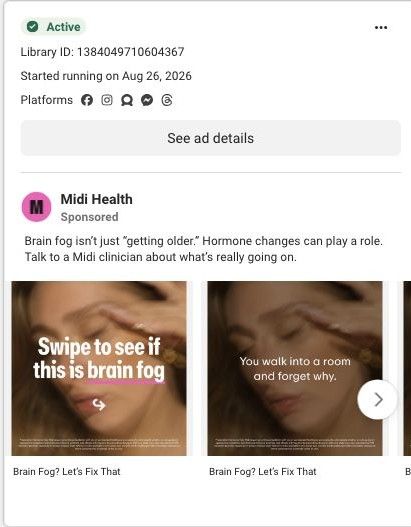
A carousel Midi Health ran on Meta from Aug 26, 2026. The first card shows a blurred portrait under Swipe to see if this is brain fog, and the next reads You walk into a room and forget why. Headlined Brain Fog? Let's Fix That, it's one of 3 Midi ads in the library sending people to the perimenopause solutions page.
Midi Health
3 creatives lead here1 / 3

Perimenopause solutions · care campaign
Native Meta creative and exact outbound link observed October 22, 2026. Redirects were followed to the captured public destination. Broader women’s HRT and longevity care; this record is not classified as peptide-specific. A carousel reference retains the captured visible frame; other original cards may be present. Advertiser claims are source material; activity does not establish performance. No personal, health or payment details were entered.

Brain Fog? Let’s Fix That
An audience-focused care page connects a clear opening with treatment context, the clinician-led process, supporting information and a visit entry. Compare the creative with the destination and explore the other ads sharing this route.
- Brand
- Midi Health
- Observed offer
- Brain Fog? Let’s Fix That
- Creative angle
- Problem / solution
- Page type
- Service landing
- Ad format
- Image
- Listed start date
- Aug 26, 2026
- Captured
- Oct 22, 2026
- Library ID
- 1384049710604367
- Destination
- joinmidi.com
Selected for its design and offer structure. Ad performance isn’t available in this collection.
What this ad does well
The blurred portrait shows brain fog instead of describing it, which is the benefit-as-a-picture idea applied to a problem. Swipe to see if this is brain fog is an invitation to self-check, and the arrow gives the thumb something to do. The next card is the strongest line in the ad: You walk into a room and forget why is a moment almost everyone has had, so it lands as recognition rather than diagnosis. The copy then reframes it (brain fog isn't just getting older; hormone changes can play a role) and points to a conversation with a clinician instead of a product, which suits a medical service.
What's missing
We captured the opening cards, and the carousel's payoff (what Midi does about it, what a visit costs) isn't visible in them; the link headline promises Let's Fix That, which is a bigger promise than the copy's talk to a clinician. If you make one like this, end the carousel on a card that says what happens next (a 30-minute virtual visit, covered by most insurance) and keep the headline to what the visit offers, so the fix promise doesn't run ahead of the service.
Beat by beat
- ImageA blurred portrait of a woman touching her temple under Swipe to see if this is brain fog, with an arrow and prescription disclaimer text.
The blur turns the symptom into a picture, and the swipe ask invites a self-check.
- ImageThe next card reads You walk into a room and forget why.
A universal moment makes the viewer recognize herself without any medical language.
- CopyBrain fog isn't just getting older; hormone changes can play a role, so talk to a Midi clinician about what's really going on.
It reframes the symptom and points to a conversation instead of a product.
- HeadlineBrain Fog? Let's Fix That under each card.
It restates the problem as a question next to the tap target.
Where it sends people
The ad lands on Midi's perimenopause solutions page, a focused service landing page. Brain fog is the first word of the hero intro and the first item in the seven-symptom accordion, so the visitor's problem is easy to find. The page then answers what comes next: a 95% symptom-improvement stat (footnoted as self-reported by patients), a four-step Book in minutes. Leave with a plan. section, and a price table showing first and returning visits covered by insurance or $250 and $150 self-pay. A patient quote about brain fog second-guessing decisions sits in the Real women. Real results. section.
The page it sends people to: How Midi Health's perimenopause page shows prices next to the plan
Midi's perimenopause solutions page is a focused service landing page: an insurance-covered hero, a footnoted 95% symptom-improvement stat, a symptom accordion, four steps, a price table, patient cards and FAQs. It's where 3 Midi ads in the library land, a brain fog carousel and creator videos from Michelle Lee and Big Time Adulting.
How the page is built
- 01Hero
Perimenopause care, covered by insurance with board-certified clinicians who listen first answers what this is and whether insurance pays.
- 02Stat photo
A 95% patient-reported symptom improvement figure over a photo, footnoted below, answers whether it works for people like me.
- 03Trust band and ticker
Trusted by 500k+ women, you don't need all the answers, and a ticker of booking in under 5 minutes and hormone and non-hormone treatments answer whether I'm ready.
- 04Symptom accordion
Seven symptoms, led by brain fog and forgetfulness, answer whether Midi treats what I have.
- 05Four steps
Book in minutes. Leave with a plan. lists booking, meeting your clinician, getting a Care Plan and tracking progress, answering what happens next.
- 06Price table
First and returning visits, covered or $250 and $150 self-pay, with coverage notes, answer what it costs.
- 07Not sure where to start?
A pink band repeats booking in under 5 minutes with an expert clinician, answering hesitation.
- 08Patient cards
Real women. Real results. shows photo cards with short quotes, disclosed as Midi Ambassadors, answering whether it worked for others.
- 09FAQs and sources
Ten questions from whether you need to know you're in perimenopause to cost, plus sources and citations, answer the last doubts.
- 10Closing CTA
Don't wait to start feeling like yourself again with a Book now link answers why now.
The first fixes we would make
- All three ads that land here are personal (a brain fog self-check and two creator stories), yet the page has no video. Add a short creator clip strip near the patient cards, so visitors from those ads see the same faces again.
- Michelle Lee's video shows Midi's intake questionnaire, which the page never mentions. Add the questionnaire as the first of the four steps, with a screenshot, so booking feels as easy as it looked.
Read the full breakdown of this page
Three hooks you could test
- Show a specific moment of use. “You walked into the kitchen and forgot why. Again.”
- Turn the benefit into a picture people get in a second. “This is what your afternoon feels like. Swipe to see why.”
- Lead with the uncomfortable problem. “Losing words mid-sentence isn't just getting older.”
What to borrow for your brand
- Show the problem visually (a blurred photo for brain fog) and ask people to swipe to check whether it's them.
- Put a universal everyday moment on the second card, so the carousel earns recognition before it explains.
- End a symptom carousel on a card that says exactly what happens when you book.
One of 15 Midi Health ads in the Fluid Inspiration Library, captured from the Meta Ad Library on Oct 22, 2026. We record that an ad ran publicly, not how it performed.