

Marek HealthSponsored
Esc
How Marek Health uses a carousel to sell single lab tests
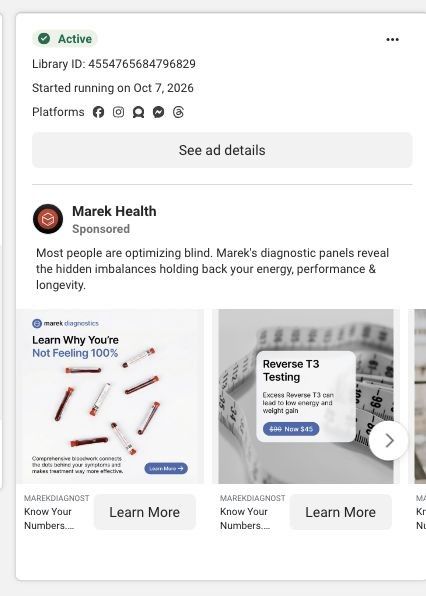
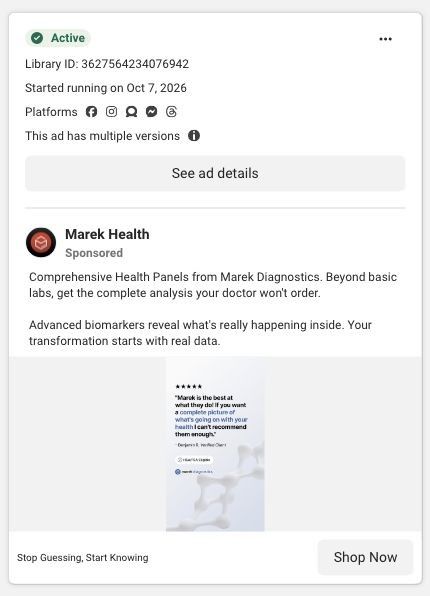
A carousel ad from Marek Diagnostics. The opening card says "Learn Why You're Not Feeling 100%" over scattered blood tubes, and the next promotes Reverse T3 Testing marked down from $90 to $45. The copy says most people are optimizing blind. Each card says Learn More, and the click lands on the total health panels collection page.
Marek Health
6 creatives lead here1 / 6
General health · diagnostic collection
Native Meta creative and exact outbound link observed October 22, 2026. Redirects were followed to the captured public destination. These ads promote diagnostic testing, consultation or hormone care; they are broader-care examples. A carousel reference retains the captured visible frame; other original cards may be present. Advertiser claims are source material; activity does not establish performance. No personal, health or payment details were entered.
Know Your Numbers. Optimize Everything.
A diagnostic collection organizes available lab panels into a browsable product grid with purchase-entry links. Compare the creative with the destination and explore the other ads sharing this route.
- Brand
- Marek Health
- Observed offer
- Know Your Numbers. Optimize Everything.
- Creative angle
- Product comparison
- Page type
- Collection page
- Ad format
- Image
- Listed start date
- Oct 7, 2026
- Captured
- Oct 22, 2026
- Library ID
- 4554765684796829
- Destination
- marekdiagnostics.com
Selected for its design and offer structure. Ad performance isn’t available in this collection.
What this ad does well
The carousel format fits a catalog of tests. The opening card sets up the problem in plain words (not feeling 100%) and explains that bloodwork connects the dots behind symptoms, then the next card gets specific with one named test, the symptom the ad links it to and a clear price cut. That progression from general to specific is a good use of swipes. The $90-to-$45 anchor gives the viewer a concrete reason to act, and a $45 test is an easy first purchase.
What's missing
The Reverse T3 card makes a specific offer, but the click lands on a collection of total health panels from $275 to $1,950, with no Reverse T3 test in the captured top of the page. A viewer who tapped for a $45 test now has to search for it or settle for a bigger panel. That break costs the ad its sharpest moment. If you run a carousel like this, link each card to its own product page, so the card that shows a $45 test opens on that test.
Beat by beat
- ImageThe opening card shows blood tubes scattered on white under "Learn Why You're Not Feeling 100%."
It names a vague but familiar feeling and shows the test that the ad says can explain it.
- ImageThe next card, over a tape measure, reads "Reverse T3 Testing" with a claim linking excess Reverse T3 to low energy and weight gain, priced $90 now $45.
It turns the general idea into one named test with a symptom and a discount.
- Copy"Most people are optimizing blind," followed by a claim that the panels reveal hidden imbalances.
It frames testing as the step people skip.
- CTAEach card ends with Learn More under a "Know Your Numbers" caption.
It keeps the action low-commitment while the viewer browses.
The offer
The Reverse T3 card shows a crossed-out $90 and a $45 price. The rest of the carousel uses Learn More without a price.
Where it sends people
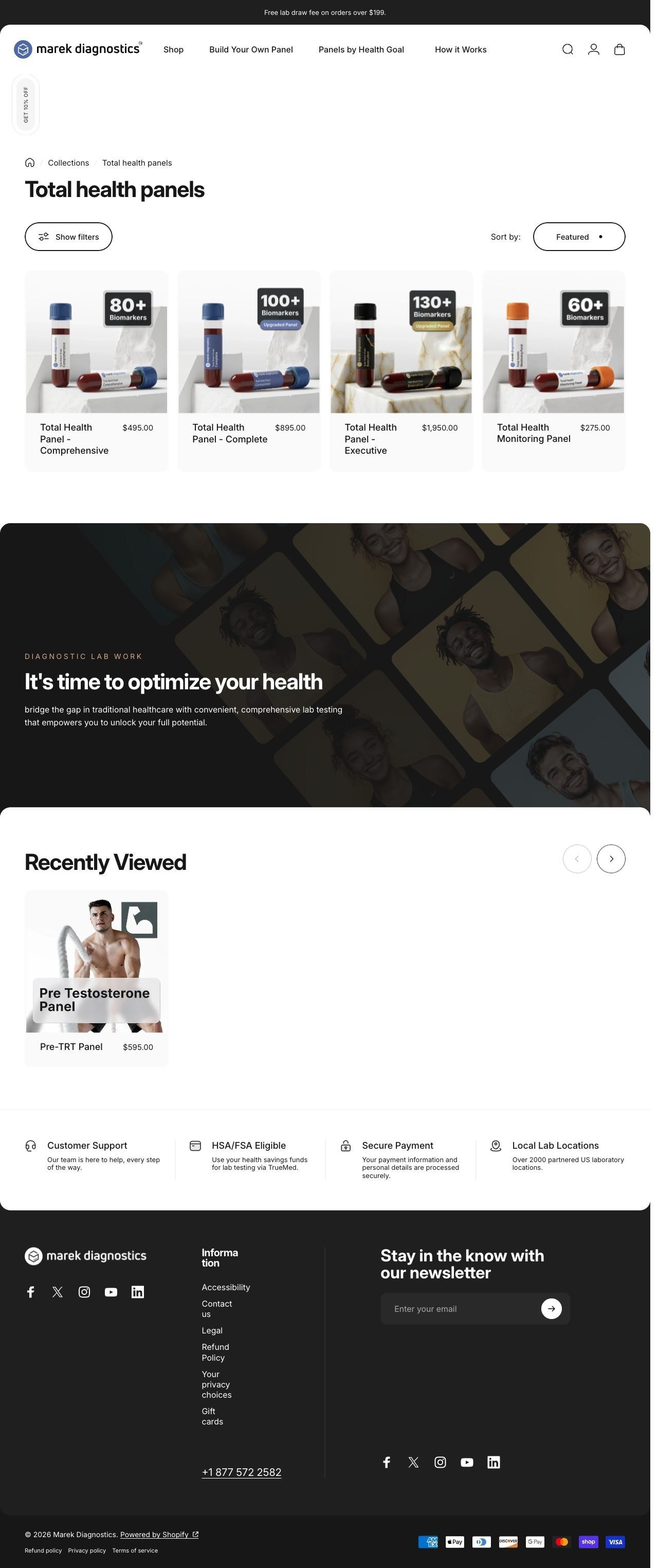
The ad sends people to the total health panels collection on Marek Diagnostics, the destination for 6 of the 16 Marek ads in the Fluid library. A collection page is near the bottom of the landing-page ladder. It shows the Total Health Panel tiers (Comprehensive, Complete, Executive and Monitoring) with biomarker counts on each tube image and prices from $275 to $1,950, plus filters and a sort menu. The top bar's free lab draw fee on orders over $199 is a useful nudge. For this carousel, though, the Reverse T3 offer doesn't carry through, so deep-linking that card to the Reverse T3 product page is the first fix.
The page it sends people to: How Marek Diagnostics lays out its total health panels
Marek Diagnostics' Total health panels collection shows its Total Health Panel tiers with biomarker badges and prices from $275 to $1,950, filters and a sort menu, then a dark "It's time to optimize your health" band. Six Marek ads in the Fluid library land here, mostly symptom-led statics plus a carousel, a review static and a gym testimonial.
How the page is built
- 01Collection heading and context
A free lab draw bar, the navigation, a Get 10% off side tab and the heading Total health panels tell the visitor what's here and that there's a first-order incentive.
- 02Category or filtering controls
Show filters and a Sort by Featured menu let the visitor narrow or reorder the panels.
- 03Diagnostic product grid
Cards for the Comprehensive, Complete, Executive and Monitoring panels show biomarker badges and prices from $275 to $1,950, answering 'what are my options and what do they cost?'
- 04Diagnostic lab work band
A dark band with a photo collage reads "It's time to optimize your health" and describes convenient, comprehensive lab testing, answering 'why test at all?'
- 05Testing and purchase information
The blueprint closes with testing and purchase information, which explains how ordering and the draw work.
The first fixes we would make
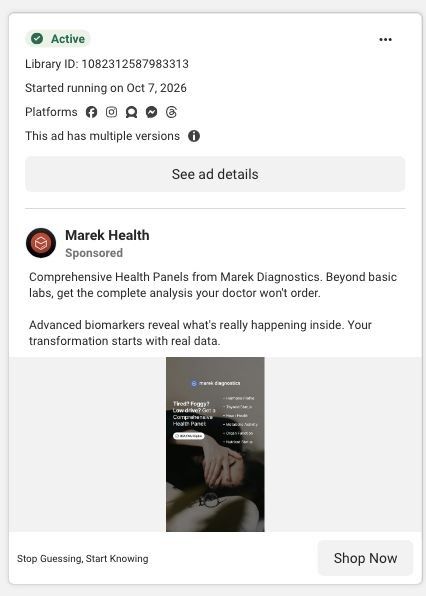
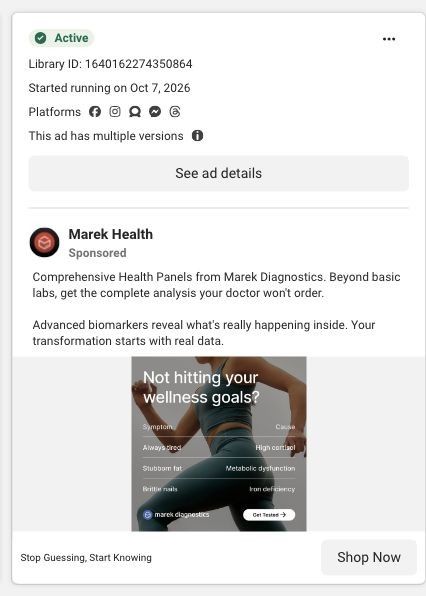
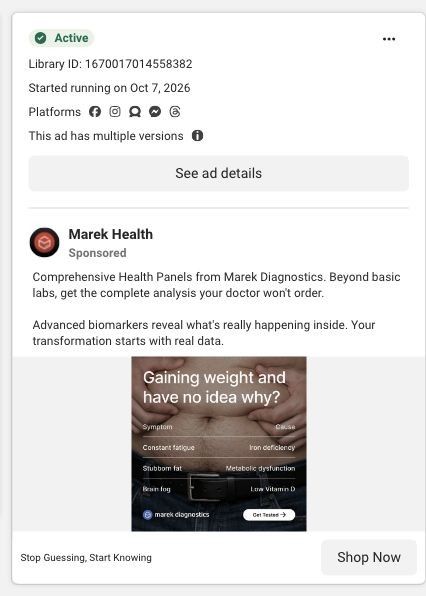
- Most of the ads landing here open on a symptom (tired, foggy, gaining weight, not hitting goals) and pair it with a possible cause, but the page never mentions symptoms. Add a short "what brought you here?" row above the grid that maps those symptoms to the tier that checks for them, so visitors from each ad find their answer.
- The tiers differ only by biomarker count and price on the cards. Add one line under each name saying what it adds, so the jump from $495 to $895 to $1,950 makes sense to a first-time buyer.
Read the full breakdown of this page
Three hooks you could test
- Lead with the uncomfortable problem. “Not sick, not great either? Here's the test most people skip.”
- Turn the benefit into a picture people get in a second. “One tube, one number, one answer to why you feel off.”
- Sell the outcome. “Know which number is off before you spend another month guessing.”
What to borrow for your brand
- Use the opening card of a carousel to name the feeling and the next cards to name one specific product with its price, so the swipe goes from general to concrete.
- Show a crossed-out price on a single entry-level product to give viewers a low-risk first purchase.
- Link each carousel card to its own product page so the offer on the card is the first thing the viewer sees after tapping.
One of 16 Marek Health ads in the Fluid Inspiration Library, captured from the Meta Ad Library on Oct 22, 2026. We record that an ad ran publicly, not how it performed.