

Lume DeodorantSponsored
Esc
How Lume answers a 'just shower' comment with a reply video
A 56-second Lume reply video. A creator in a red bodysuit sniffs her armpit beside an on-screen comment, "Dang.. How many people walk around with stink? Just take a shower daily," then explains why the ad says showering alone isn't enough, describes Lume's claims and mentions a free body wash. The headline offers over 30% off plus 2 free items.
Lume
60 creatives lead here1 / 60


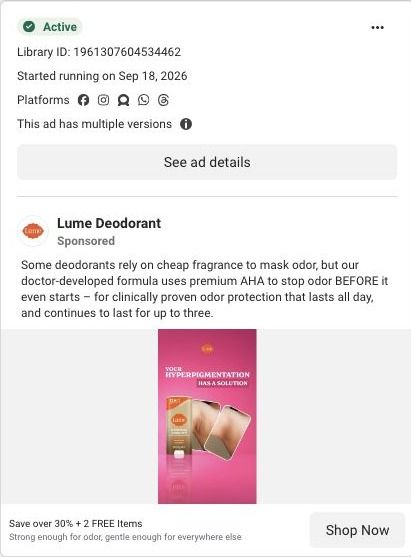
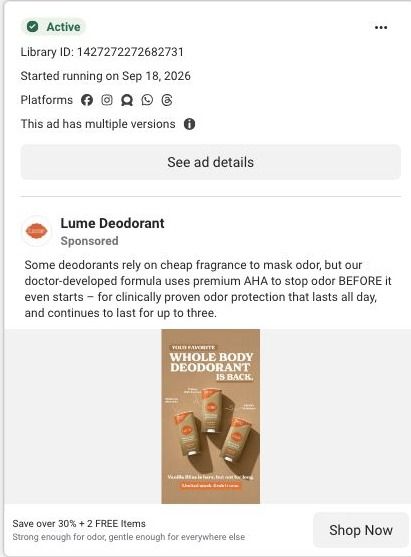
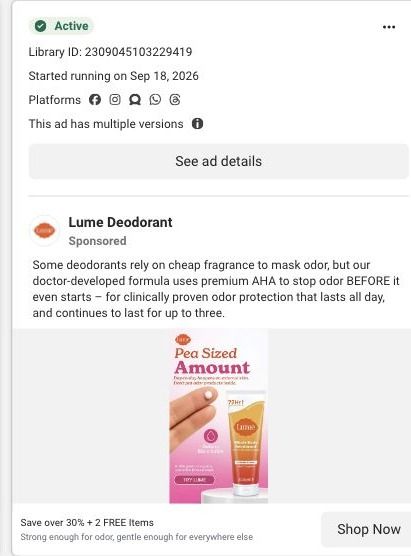


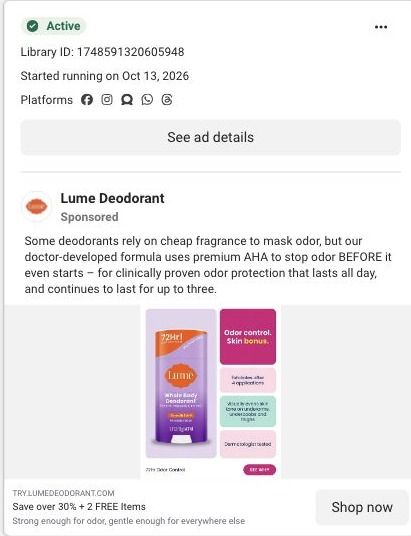
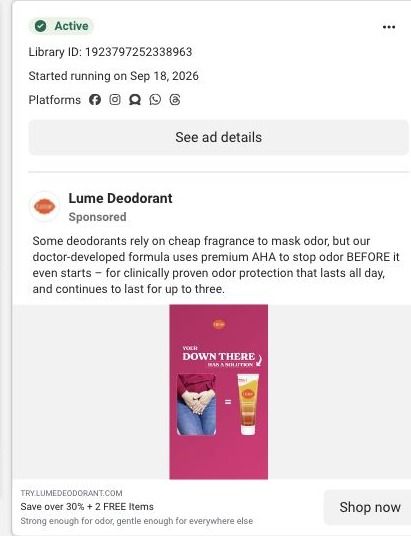

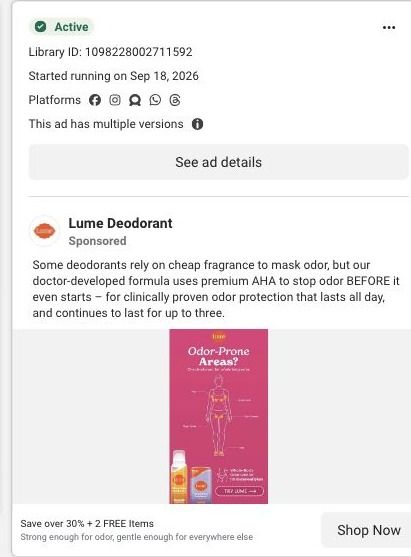

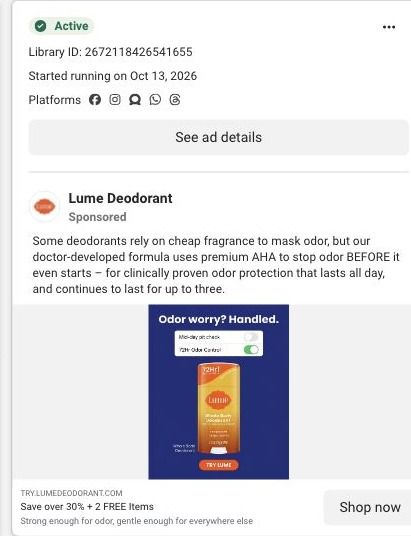


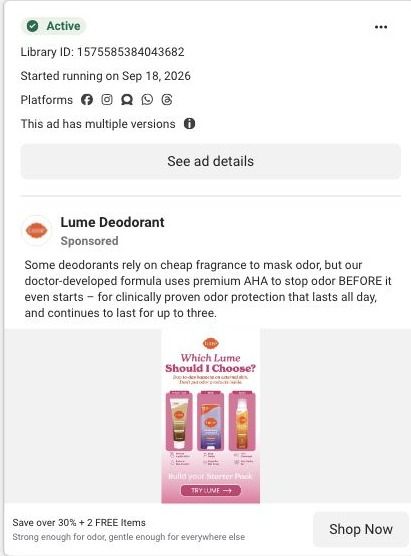

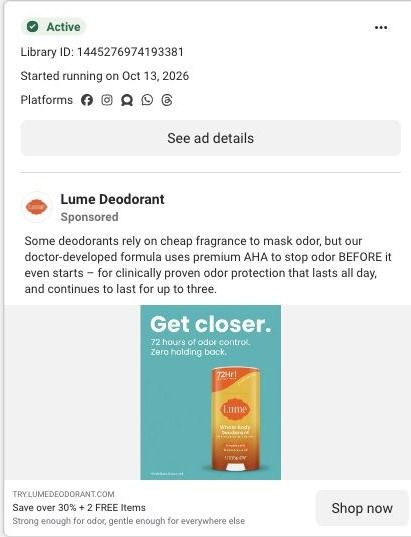
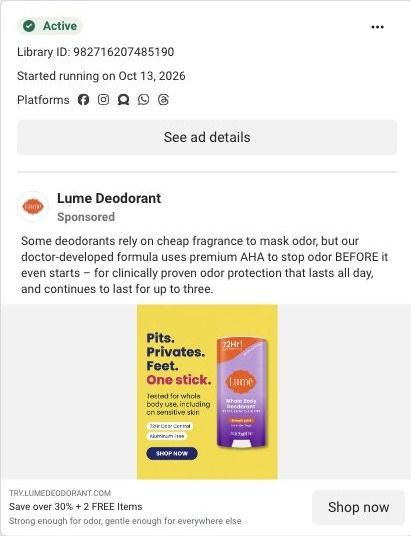
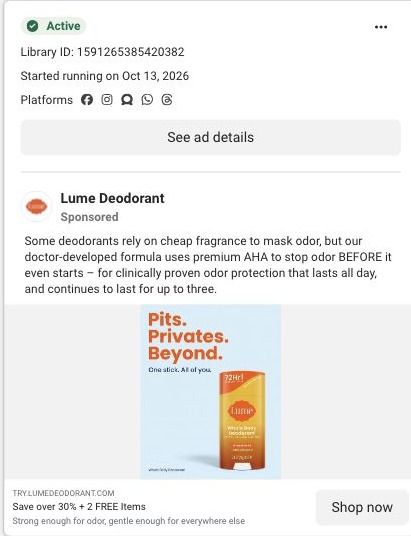
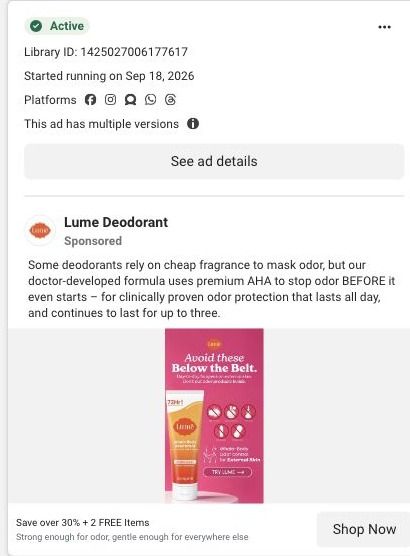
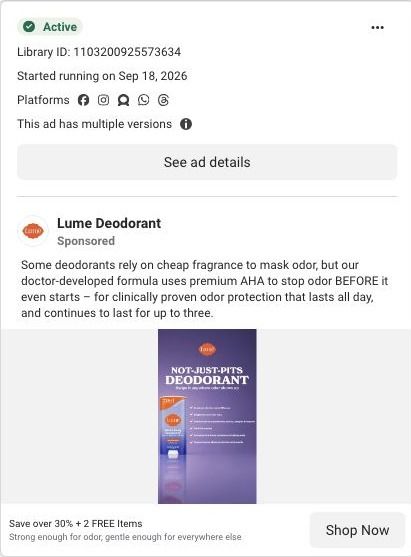

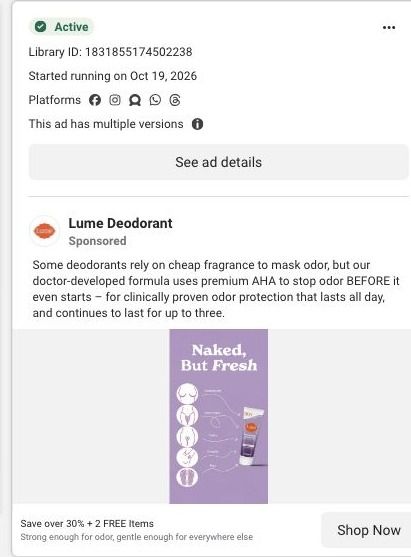
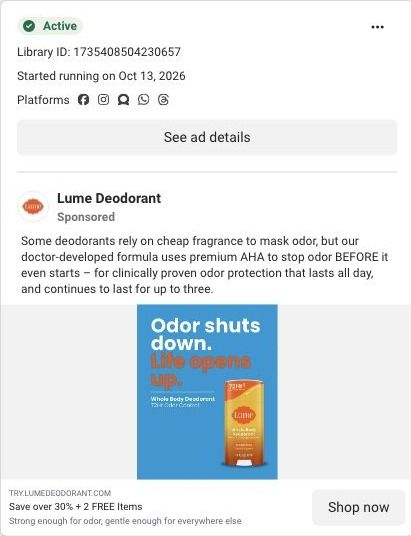
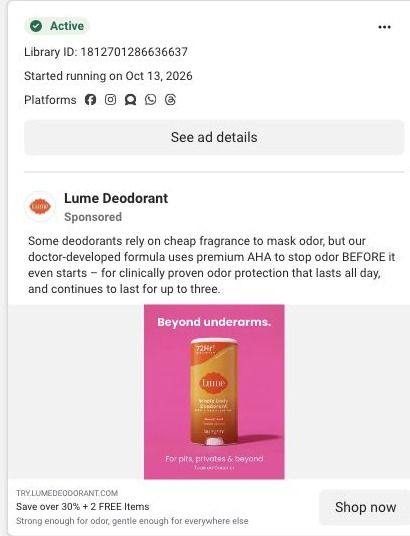
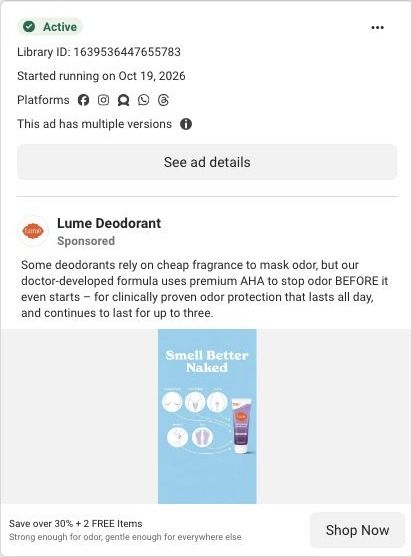

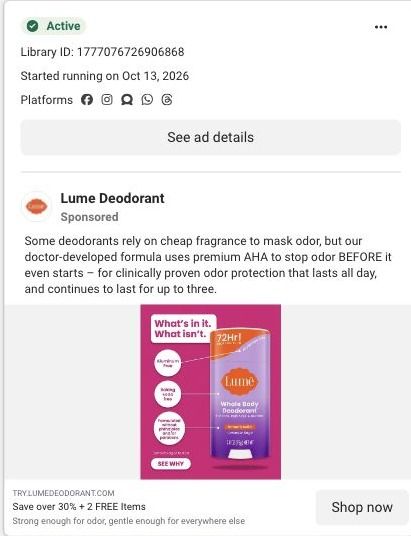
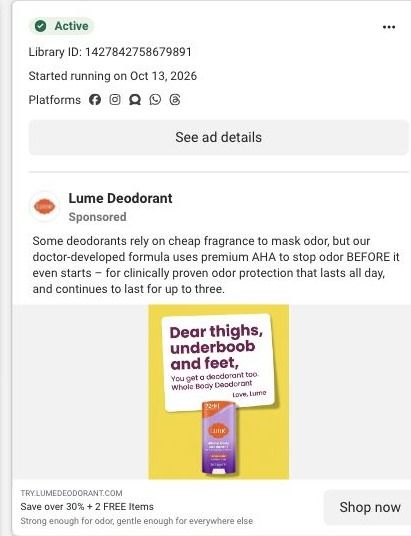
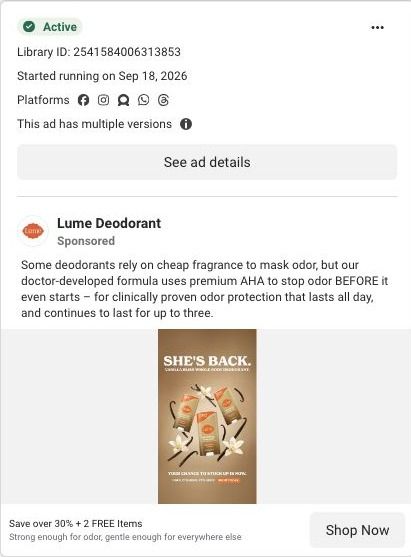
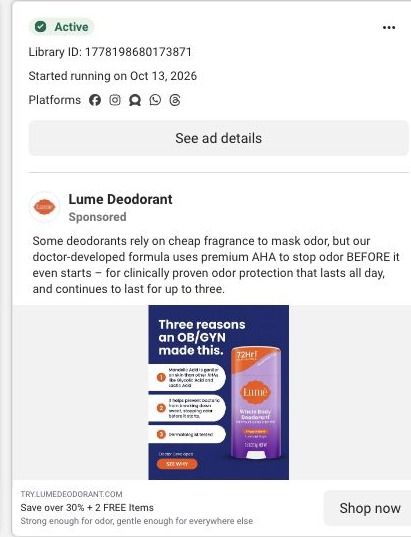
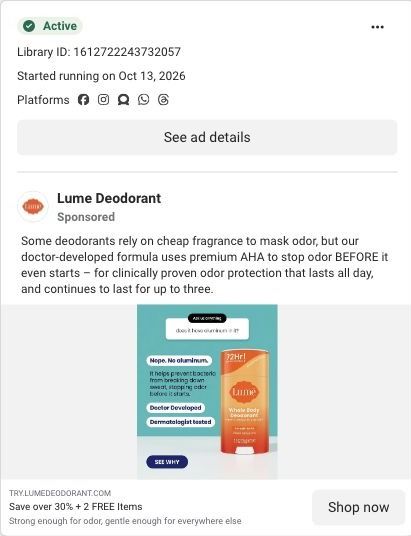


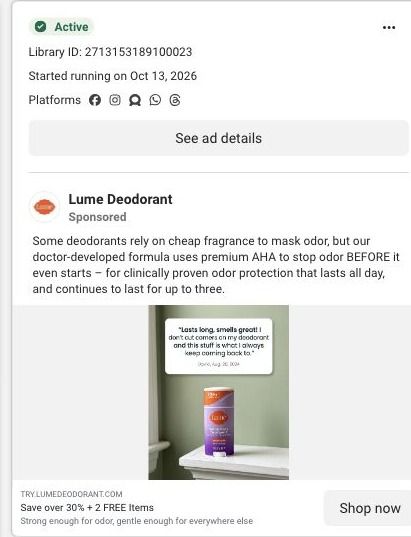

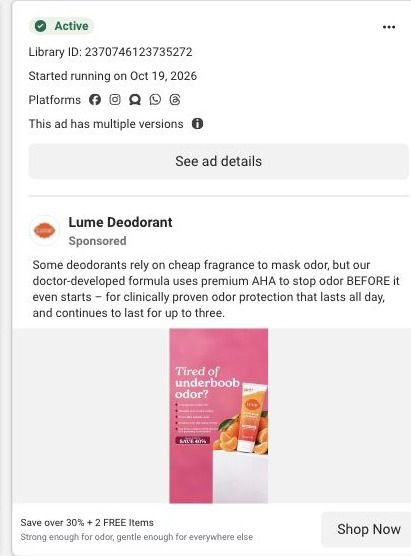


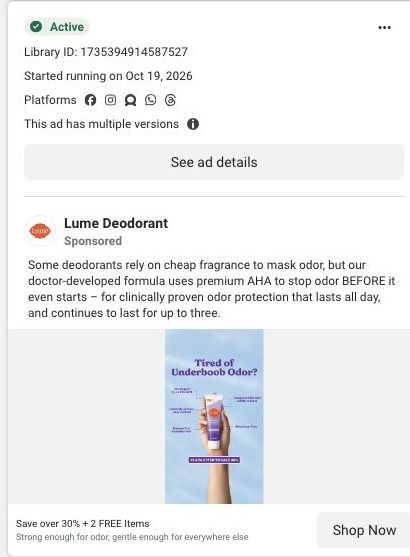


Lume · Smell Better Naked
Public page captured October 22, 2026. Promotional sheets, chat, extension overlays and sticky cart bars were removed from the static reference; page layout and copy were preserved. No account, personal, health or payment details were supplied. Quiz captures show the observed entry screen, not the complete consultation.
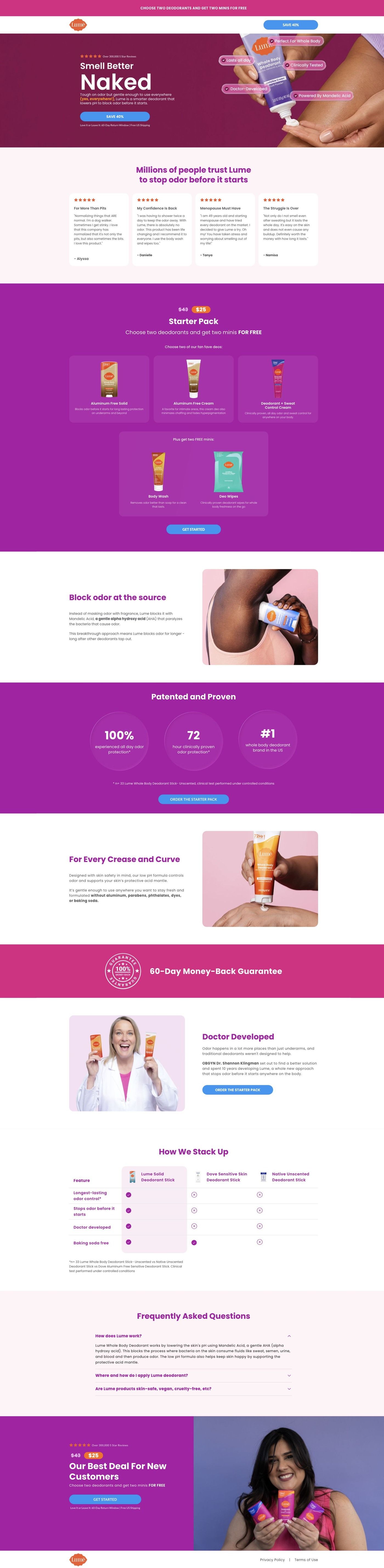
Save over 30% + 2 FREE Items
Visual reference: Just take a shower? · comment reply. Creator stories, price objections and product stills converge on a long-form $25 starter-pack offer. Reviews, product education, founder credibility and a comparison table lead to the kit builder. Compare the creative with the destination and explore the other ads sharing this route.
- Brand
- Lume
- Observed offer
- Starter-pack savings or product offer; original ad and destination terms apply
- Creative angle
- Creator stories
- Page type
- Starter-pack offer
- Ad format
- Video · 0:56
- Listed start date
- Oct 21, 2026
- Captured
- Oct 22, 2026
- Library ID
- 1802358294408619
- Destination
- try.lumedeodorant.com
Selected for its design and offer structure. Ad performance isn’t available in this collection.
What this ad does well
Answering a skeptical comment is a smart way to handle the biggest objection to the whole category, which is 'why would anyone need this?'. The first frame does a lot: the creator sniffing her own armpit next to a real-looking comment bubble ('Replying to drew09') makes you want to hear her answer. She doesn't argue with the commenter; she agrees ('we love showers') and then explains the ad's case, that showering washes away existing odor but doesn't prevent new odor during the day. That calm, agreeable tone makes the explanation easier to accept, and her close, telling viewers to keep showering, keeps it friendly.
What's missing
Some of the reasoning rests on claims the video doesn't support, like the line that traditional soap can make body odor worse, and nothing on screen backs it up. The offer also arrives late and differently from the headline: she mentions a free body wash, while the headline talks about over 30% off and 2 free items. If you make a reply video like this, show where the claim comes from (a line from the study or the doctor) and say the same offer the headline promises.
Beat by beat
- 0-4sThe creator sniffs her armpit beside a comment bubble reading 'Dang.. How many people walk around with stink? Just take a shower daily.'
A skeptical comment plus a funny visual creates instant tension the viewer wants resolved.
- 4-18sShe says 'we love showers' and explains the ad's claim that showering washes away existing odor but doesn't prevent new odor, and that soap can make it worse.
Agreeing first, then explaining, takes the fight out of the objection.
- 18-42sShe says Lume isn't a replacement for showering, then lists its claims: gynecologist-developed, a pH claim, clinically proven, safe for armpits, vulva, thighs, folds, creases and feet.
It repositions the product as something showers can't do, not a substitute for them.
- 42-56sShe says to keep showering and click the link to upgrade your hygiene routine and get a free body wash.
It closes on a friendly note and gives a concrete bonus for clicking.
The offer
The creator says clicking through gets you a free body wash, and the headline offers over 30% off plus 2 free items. The two framings point at the same starter-pack deal but don't match word for word.
Where it sends people
The ad goes to Lume's starter-pack landing page, a focused offer page rather than the homepage. The starter-pack offer section's free-gift tiles are where the body wash she mentions would show up, and the ingredient mechanism and proof sections give her 'prevents odor' argument some evidence. The FAQ accordion is a good place to answer the 'why not just shower?' question in writing too. The hero doesn't pick up the shower objection, so a variant that does would carry the reply's argument onto the page.
The page it sends people to: How Lume's Smell Better Naked page sells a $25 starter pack
Lume's Smell Better Naked page is a long-form sales page for a $25 starter pack. It moves from a benefit hero through reviews, the offer, ingredient education, study proof, founder story and a comparison table, then repeats the offer. It's where 60 Lume ads in the Fluid library point, mostly creator stories, savings offers and product benefits.
How the page is built
- 01Announcement and header
A simple logo header with a savings CTA keeps the discount visible and gives the visitor nowhere else to go.
- 02Split hero
A reviews eyebrow, a large benefit headline, body copy and a CTA sit beside a product-use image, answering "what is this and why would I want it?"
- 03Customer stories
Review cards with stars and short quotes answer "do people like me actually use this?" before any price appears.
- 04Starter-pack offer
Price treatment, product choices, free-gift tiles and a CTA answer "what do I get and what does it cost?"
- 05Ingredient mechanism
An image and an explanation of a highlighted ingredient answer "how is this supposed to work?" in Lume's own terms.
- 06Study proof
Prominent study metrics with a methodology footnote answer "is there evidence behind the claim?"
- 07Whole-body use
An application illustration and reassurance copy answer "is it okay to use this beyond my underarms?"
- 08Founder story
A portrait and origin explanation with a CTA answer "who's behind this and why should I trust them?"
- 09Comparison table
A highlighted Lume column against alternatives answers "why this instead of what I use now?"
- 10FAQ and repeated offer
An accordion handles the last objections, then the starter-pack offer repeats above the policy footer so the decision and the button sit together.
The first fixes we would make
- Many of the ads that land here lead with a specific use ("For Boobs That Run Hot"), but the hero speaks to the whole body and the matching reassurance sits much further down in the whole-body section. Send each ad headline to a hero that repeats it (Lume already runs a hero variant on another URL) so the visitor sees their problem in the first screen.
- The blueprint shows no guarantee anywhere on this page, while Lume's sweat-control page has one. Put the guarantee inside the starter-pack panel and again by the final offer, since that's exactly where a first-time buyer hesitates.
Read the full breakdown of this page
Three hooks you could test
- Call out the habit you're replacing. “Your shower cleans you. It wasn't built to keep you fresh until 5 p.m.”
- Lead with the uncomfortable problem. “Someone said 'just shower.' Here's why that doesn't cover it.”
- Sell the outcome. “Keep showering. Just stop wondering by lunchtime.”
What to borrow for your brand
- Turn the most common skeptical comment about your category into the opening frame of a reply video.
- Have the creator agree with the commenter first ('we love showers') before explaining, so the answer feels friendly instead of defensive.
- Make sure the bonus the creator mentions matches the offer in the headline, so viewers aren't sure which deal they're getting.
Transcript
Dang, how many people walk around with stink? Just take a shower daily. We love showers. But showering washes away existing odor. It doesn't prevent new odor from developing throughout the day, and traditional soap can actually make body odor worse. Lumi isn't a replacement for showering. Its whole body odor protection designed for the place's traditional deodorant ignores. Lumi is gynecologist developed, pH optimized, clinically proven to prevent odor, and safe for anywhere on your body. Armpits, obviously, but also vulva, thighs, folds, creases, feet and beyond. So please, keep showering. Just don't expect your shower to provide the odor protection. It wasn't designed to deliver. Click the link to upgrade your whole body hygiene routine and get a free body wash while you're at it.
Text on screen
- Dang.. How many
- people walk around
- with stink? Just take a
- shower daily.
- Replying to drew09
- we love showers
- washes away
- it doesn't prevent
- new odor
- throughout the day
- and traditional soap
- . can actually make
- body odor worse
- 72Hr!
- Lume
- a replacement
- tune
- whole Body
- for showering
- It's Whole body Odor
- Whate not
- design for the places
- Lume is gynecologist
- Whole Baay
- Deodorant
- Whole
- developed
- Doodorant
- pH optimized
- Smooth Soild
- clinically proven
- to Prevent Odor
- safe for anywhere
- sale i yoar Bwhere
- armpits obviously
- but also
- folds
- creases
- feet & beyond
- so please
One of 100 Lume ads in the Fluid Inspiration Library, captured from the Meta Ad Library on Oct 22, 2026. We record that an ad ran publicly, not how it performed.