How IM8 paired a soft product image with a skeptic's caption
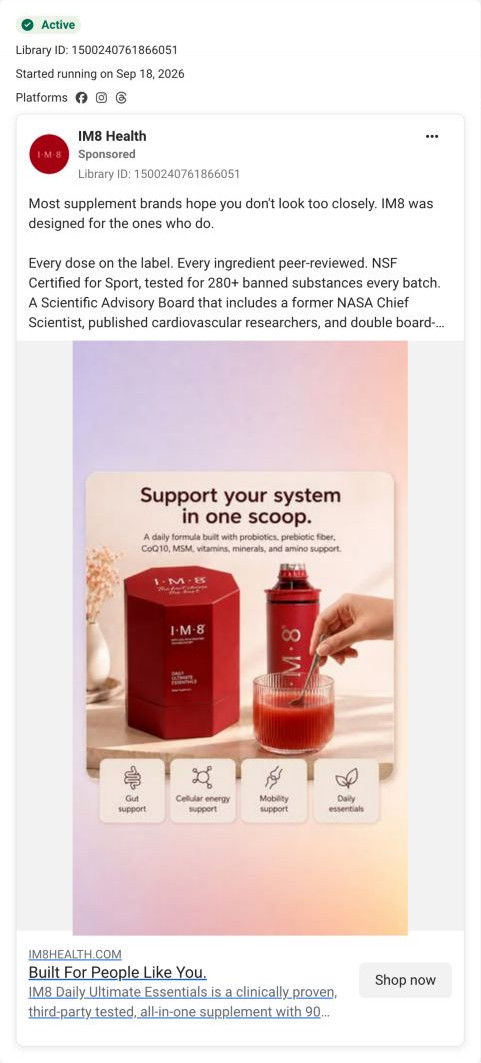
A static image ad from IM8 with a pastel gradient, the red box, bottle and a glass being stirred, and four benefit icons (gut, cellular energy, mobility, daily essentials) under a support your system in one scoop headline. The caption speaks to people who check labels. No price appears, and it links to IM8's Read the evidence page.

Captured October 20, 2026. Advertiser health claims are shown for design research. Video examples are still frames.

Support your system in one scoop
A soft gradient, product still life and four benefit icons organize the message. Compare the creative with the destination and explore the other ads sharing this route.
- Brand
- IM8
- Observed offer
- No price or discount stated in the captured ad text
- Creative angle
- Product benefits
- Page type
- Campaign landing
- Ad format
- Image
- Listed start date
- Sep 18, 2026
- Captured
- Oct 20, 2026
- Library ID
- 1500240761866051
- Destination
- im8health.com
Selected for its design and offer structure. Ad performance isn’t available in this collection.
What this ad does well
The caption is the strongest part: it opens by saying most supplement brands hope you don't look too closely, then lists specific things a skeptic can check (every dose on the label, NSF Certified for Sport, testing for 280+ banned substances every batch, an advisory board that includes a former NASA Chief Scientist). That's a clear audience and a clear reason to believe. The image keeps things calm and readable, with the product in use and four icons summarizing what it covers. The headline under the image (Built For People Like You) invites the viewer to see themselves as that careful buyer.
What's missing
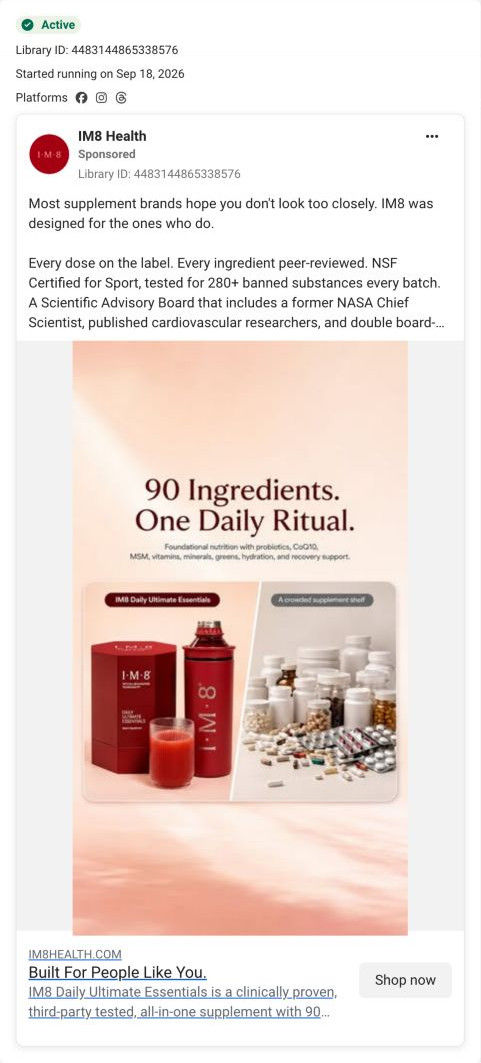
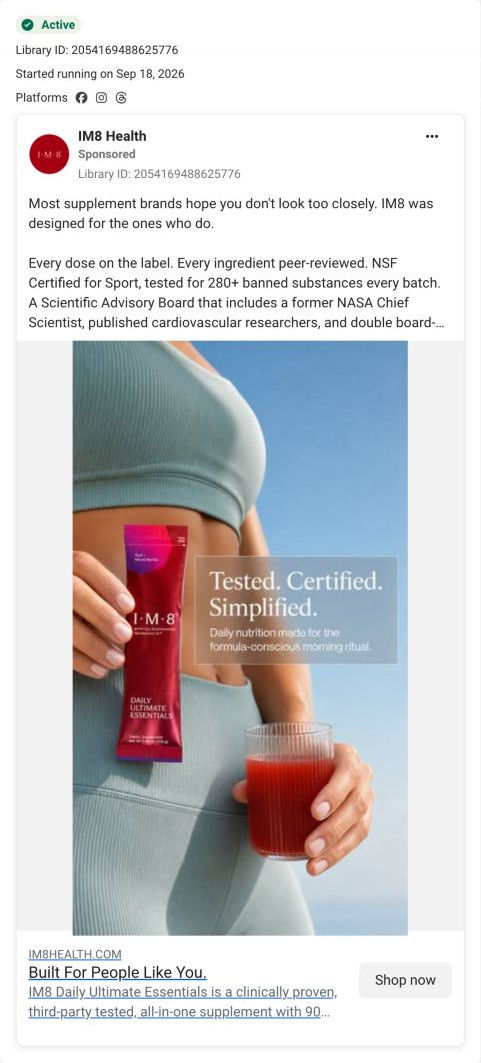
The image and the caption are speaking to different people: the copy is for someone who verifies everything, but the image is a soft lifestyle shot with general benefit icons, so the evidence never appears visually. IM8 ran the same caption on several images, which makes this a useful test, but this version gives the scroller nothing to check. If you make one like this, put one checkable proof point in the image itself (the certification mark, a dose from the label, the trial) so the visual and the copy make the same argument. A reason to act now is missing too, and the page's welcome offer could fill it.
Beat by beat
- ImageA pastel card with the red box, bottle and a hand stirring a glass, the support your system headline and icons for gut, cellular energy, mobility and daily essentials.
It shows the product in use and summarizes coverage in a glance.
- HeadlineBuilt For People Like You, with a description line about third-party testing and the all-in-one formula.
It asks the viewer to identify with the careful buyer the caption describes.
- CopyOpens on brands hoping you don't look too closely, lists label, certification, testing and advisory-board details, and ends on do your homework, then decide.
It turns skepticism into the audience and hands them specific things to check.
Where it sends people
The ad links to the Read the evidence campaign page, which picks up the caption almost line for line. Right after the hero, a section picks apart three claims buyers have stopped believing, then evidence tabs cover the trial, every dose, testing and the team, and a numbered checklist tells readers how to verify each claim themselves. That's an evidence-first page for an evidence-first caption. The one break is the image: the page's hero leads with the celebrity co-founder, not the pastel still life or the four benefits, so the look changes at the click even though the argument carries through.
The page it sends people to: How IM8's evidence page turns skepticism into a checklist
IM8's Read the evidence campaign page, an evidence-first landing page. It opens by naming claims buyers distrust, then covers the trial, testing, team, cost math and dose comparisons, plus a verification checklist, before an embedded buy box, guarantee and skeptic FAQ. 3 of the 23 IM8 ads in the library send people here, all built on the same skeptic caption.
How the page is built
- 01Announcement bar and hero
A welcome-offer line, then the co-founder photo, a headline contrasting reading the label with reading the evidence and an offer button, answer what is this and why should I believe it.
- 02Expert ticker
Scrolling chips of the people who developed or trust it answer who's behind the formula.
- 03Problem section
Three cards that pick apart common industry claims answer why this should be different.
- 04Evidence tabs
Tabs for the trial, every dose, testing and the team answer what exactly the proof is.
- 05Cost math and results
A table pricing six key ingredients bought separately and four trial stat tiles answer is it worth the money.
- 06Clinician reviews
Disclosure-framed clinician cards with benefit filters answer what do doctors say.
- 07Founder letter
A signed note from the co-founder answers why the brand exists.
- 08Verification checklist
Numbered rows, each a step to verify a claim, answer how can I check this myself.
- 09Positioning and athlete proof
A band about building for people who check research and three athlete cards answer who uses it.
- 10Supply chain and advisory board
Partner step cards from formulation to delivery and an advisor grid answer where it's made and who checks it.
- 11Embedded buy box
Subscription cards with the longer plan pre-selected, perks, the free kit and certification labels answer how much and which plan.
- 12Proof, guarantee and skeptic FAQ
Creator videos, a dose table against a leading greens powder, third-party reviews, a guarantee card and Questions a Skeptic Would Ask close out the page.
The first fixes we would make
- The hero leads with the celebrity co-founder, which sits oddly on a page for people who don't take brands at their word. Test a hero built around the label or the certification instead, so the first screen makes the evidence argument the ads promised.
- The buy box arrives late, after the checklist, supply chain and advisory board. Add a compact plan selector or offer reminder right after the evidence tabs for visitors who are convinced early.
Read the full breakdown of this page
Three hooks you could test
- Call out the habit you're replacing. “Still reading five labels every morning? Read one.”
- Sell the outcome. “One scoop that covers what your shelf of bottles was trying to.”
- Lead with the uncomfortable problem. “Most brands hope you won't check the label. Check ours.”
What to borrow for your brand
- Write to the skeptic directly, then list specific things they can verify (dose, certification, testing, team).
- Run the same caption across several images so you can see which visual earns the click for that message.
- End the caption with a line that invites scrutiny, like do your homework, then decide, to signal confidence.
One of 23 IM8 ads in the Fluid Inspiration Library, captured from the Meta Ad Library on Oct 20, 2026. We record that an ad ran publicly, not how it performed.