What this ad does well
Comparing the price with a coffee is the most useful idea here, because nearly everyone knows what their morning coffee costs, so £1.79 a meal suddenly has a reference point. The creator's opener (“You know what's wild?”) is conversational and gets the comparison out in the first few seconds. He names the alternatives people actually spend on, meal deals and protein smoothies, and says this does the same job. The captions confirm the numbers (40g protein, up to 10g fibre, £1.79 per meal, with a subscription asterisk). The copy adds a second angle, keeping your extra half hour of sleep, and footnotes the feel-full claim to a perception study.
What's missing
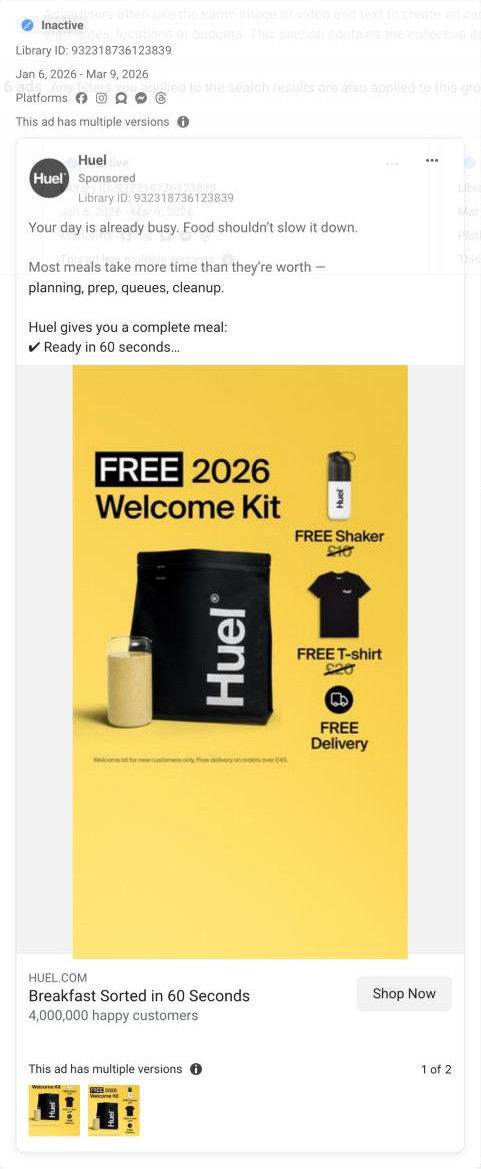
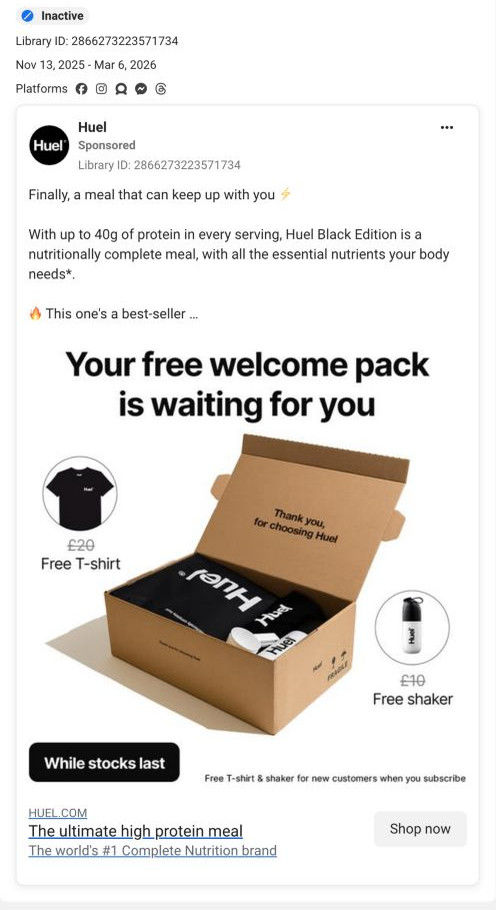
The video and the copy tell two different stories: the video is about price, and the copy is about sleep and skipping breakfast. Either one is a good ad, but together the viewer gets a mixed message. If you make one like this, pick one angle per ad and give each its own version (the coffee price in one, the extra half hour in another), then see which one people respond to. The video also ends quickly after the price, with no first-order offer, though the product page has a free T-shirt and shaker for new customers.
Beat by beat
- 0-3s
The creator, holding a Huel bottle in a kitchen, says “You know what's wild?” and that his breakfast cost less than your coffee.A price comparison everyone recognises lands in the first seconds.
- 3-8s
He says people spend a fortune on meal deals and protein smoothies, and that this does the same job.It names the specific things the viewer spends on now.
- 8-13s
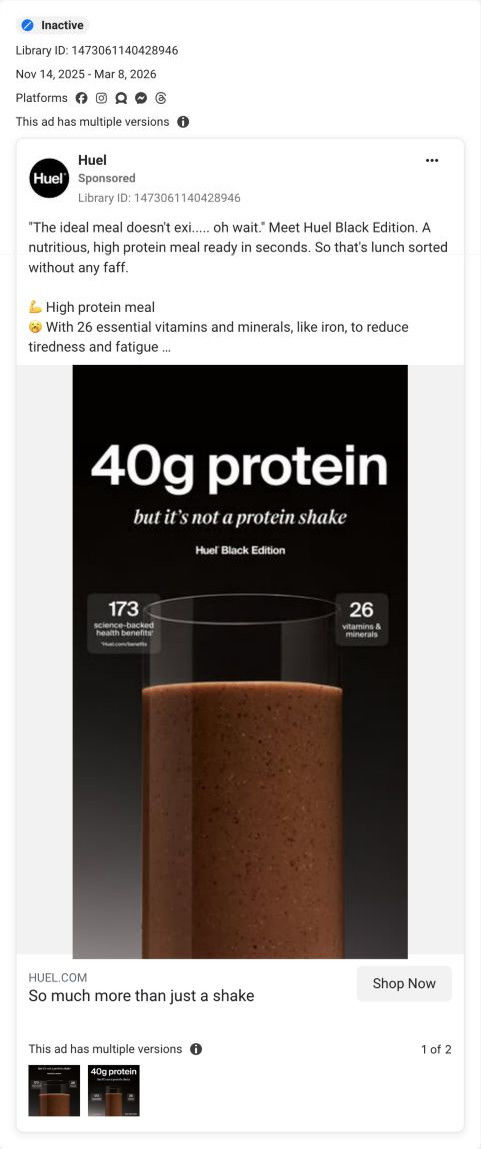
Captions list 40g protein, vitamins and minerals, up to 10g fibre and £1.79 per meal when you subscribe.On-screen numbers back up the verbal claim.
- 13-16s
He repeats that it's less than the price of a coffee, ending on Try now and huel.com.Repeating the comparison makes it the line viewers remember.
The offer
Captions show £1.79 per meal when you subscribe, framed as less than the price of a coffee. No first-order gift is mentioned.
Where it sends people
The ad links to the Black Edition product page, which is a product page rather than a page built around the coffee comparison. The price carries through clearly: “From £1.79 per meal” sits under the product name, the Flexible Plan shows £1.79 per meal for 17 meals, and the stat band repeats £1.79. The free T-shirt and shaker for new customers give the visitor a reason to order that the ad didn't mention. The coffee comparison itself doesn't appear, and a small line by the price would let it land again.
The page it sends people to: How Huel's Black Edition product page handles ad traffic
Huel's UK Black Edition product page is where 12 ads in the Fluid library send people. It opens on a buy box with £1.79 per meal, flavours, a subscription plan and a free T-shirt and shaker, then adds cross-sells, a stat band, ingredients, press, creators, reviews and FAQs. The ads cover study claims, price anchors, starter offers and creator reviews.
How the page is built
- 01
Gallery and buy boxPrice per meal, flavours, subscription and one-time plans, gifts and free delivery over £45 answer “what does it cost and what do I get?”
- 02
We know you'll love these tooCross-sell cards for the ready-to-drink, Daily Greens, a bar and Black Edition Ramen raise order size for people already buying.
- 03
Find your Huel chatAn AI question box with suggested prompts answers “is this the right product for me?”
- 04
Meal stat band“This is a meal. Not another protein shake.” with 40g protein, 26 vitamins and minerals and £1.79 per meal answers “how is this different from a protein shake?”
- 05
Superfoods carouselIngredient photos with short notes answer “what's actually in it?”
- 06
Benefits of Black EditionBenefit tiles, including Save Time and Taste Guaranteed, answer “why this, and what if I don't like it?”
- 07
Health benefitsAn “Over 170 health benefits” panel lists nutrient-linked benefits, attributed to the vitamins and minerals.
- 08
Press quotesQuotes from GQ, Men's Health and WIRED answer “has anyone credible written about this?”
- 09
Creator and expert cardsVideo cards from Gary Neville, Kristen Holmes, Spencer Matthews and others answer “who uses this?”
- 10
Customer reviewsVerified-customer review cards answer “do regular people like it?”
- 11
FAQQuestions on meal replacement, protein, carbs and vegan suitability handle the last practical doubts.
- 12
Email signup£10 off a first order over £60 captures visitors who aren't ready to buy.
The first fixes we would make
- Several ads lead with a six-week perception study (73% said they felt healthier), but the page capture doesn't show that study anywhere. Add a short study panel near the reviews, with the same self-reported scope as the ads, so visitors who tapped for the proof find it.
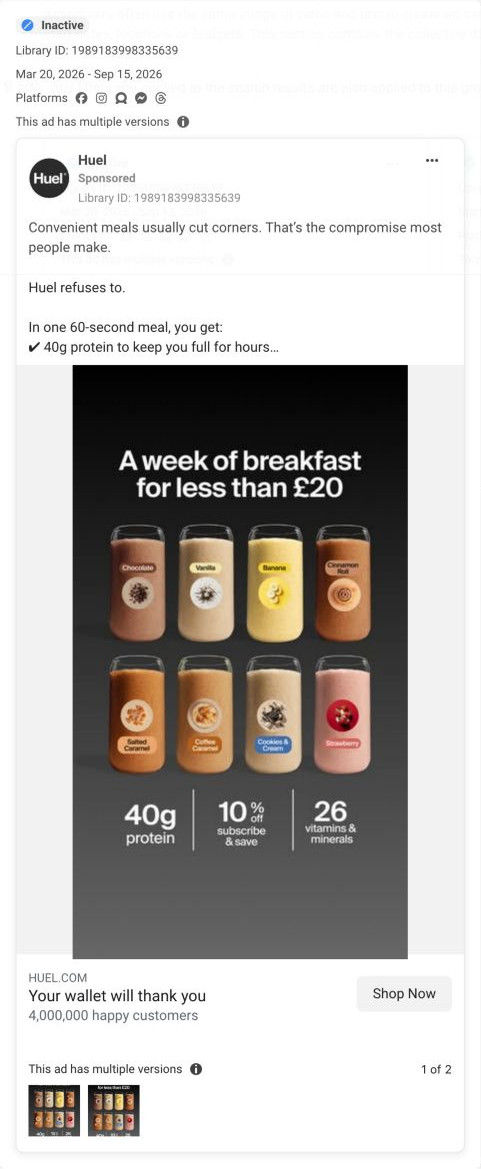
- The ads lean on price comparisons (a week of breakfast, less than a coffee, less than a meal deal), and the page only states a per-meal price. Put one comparison line beside the plan cards, so the saving the ads promised is spelled out where people decide.
Read the full breakdown of this page
Three hooks you could test
- Turn the benefit into a picture people get in a second. “My whole breakfast cost less than your flat white.”
- Call out the habit you're replacing. “Stop paying £4 for a smoothie that isn't even breakfast.”
- Show a specific moment of use. “Thirty more minutes in bed, and breakfast still happened.”
What to borrow for your brand
- Compare your per-use price with something the viewer buys daily, like a coffee, so the number has an instant reference point.
- Name the exact alternatives your customer spends on now (meal deals, smoothies) instead of a vague “expensive options”.
- Keep one angle per ad, and split a second idea (like the extra half hour of sleep) into its own version.
Transcript
It was wild. My breakfast cost less than your coffee. People spend a fortune on meal deals and protein smoothies. This has the same job. It's got your protein, carbs, fiber, and all the vitamins and minerals you need, less than the price of a coffee. Phew.
Text on screen
- You know what's wild?
- My breakfast
- cost less
- People spend a fortune on
- meal deals
- Huel
- and protein smoothies.
- This does the same job
- Huel®
- It's got your
- Fibre
- Vitamins
- & Minerals
- you need
- / 40g protein
- / 26g vitamins & minterals
- / Up to 10g fiber
- / £1.79 per meal*
- ally complete food
- luel
- for less than the price of a
- coffee.
- *When you subscribe
- Huel.com
- Try now
- Discover more at huel.com
One of 20 Huel ads in the Fluid Inspiration Library, captured from the Meta Ad Library on Oct 20, 2026. We record that an ad ran publicly, not how it performed.