
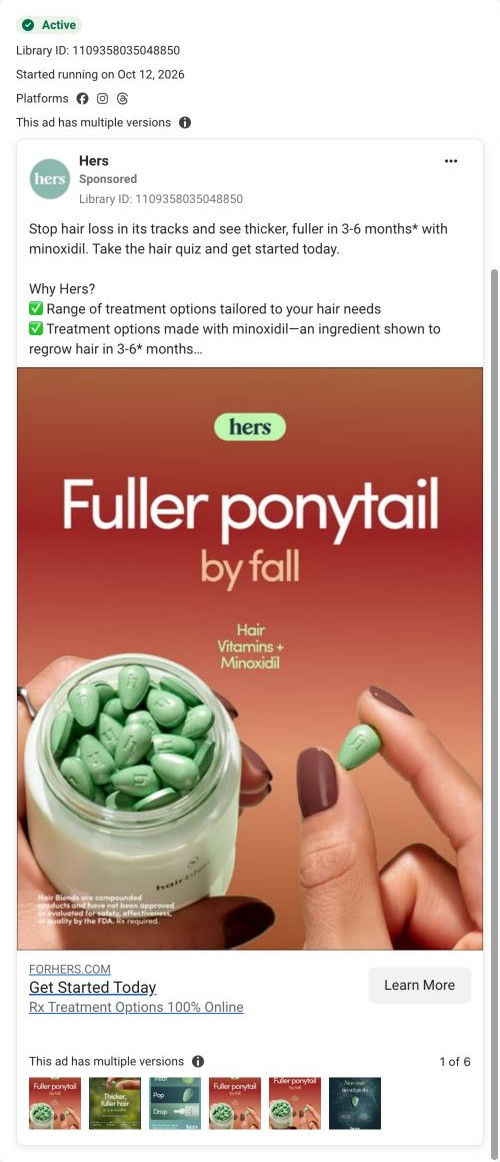
Stop hair loss in its tracks and see thicker, fuller in 3-6 months* with minoxidil. Take the hair quiz and get started today. Why Hers? ✅ Range of treatment options tailored to your hair needs ✅ Treatment options made with minoxidil—an ingredient shown to regrow hair in 3-6* months ✅ Personalized treatment plans starting at $35/month with a 5 month plan, paid upfront in full** Hair Blends are compounded products and have not been approved or evaluated for safety, effectiveness, or quality by the FDA. Prescription products require an online consultation with a healthcare provider who will determine if a prescription is appropriate. See website for full details, restrictions, and important safety information. *Based on studies of oral minoxidil up to 2.5 mg per day at various doses. **The actual price to the customer will depend on the product and subscription plan purchased.
How Hers sells hair-loss treatment with a fuller ponytail by fall
A static image ad from Hers with the headline "Fuller ponytail by fall" over a hand holding an open jar of green chews labeled Hair Vitamins + Minoxidil. The copy claims fuller hair in 3-6 months, invites a hair quiz and cites plans from $35 a month on a 5-month plan paid upfront. It sends people to Hers's hair-loss consultation.
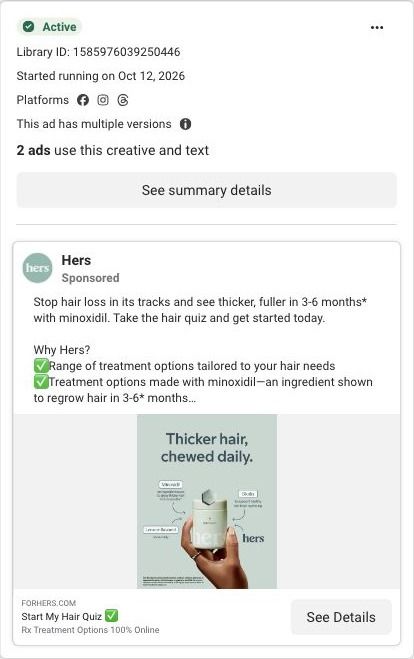
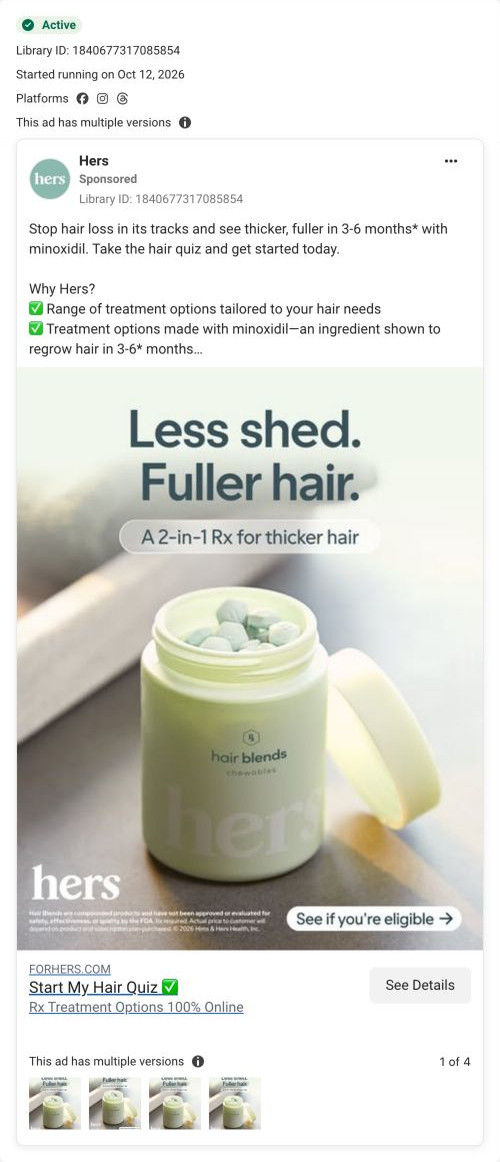

Captured while scrolling the public page. Opening prompts are shown without answering health questions. A browser shopping-extension badge may appear in the right margin.
Take the hair quiz
A hair-loss problem and regrowth-timing claim introduce a quiz invitation and an upfront-paid treatment-plan offer. The recorded CTA points to the hair-loss entry URL. Compare the creative with the destination and explore the other ads sharing this route.
- Brand
- Hers
- Observed offer
- Hair plans from $35/mo on a 5-month plan paid upfront; price varies by product and plan
- Creative angle
- Price-led
- Page type
- Consultation entry
- Ad format
- Image
- Listed start date
- Oct 12, 2026
- Captured
- Oct 20, 2026
- Library ID
- 1109358035048850
- Destination
- forhers.com
Selected for its design and offer structure. Ad performance isn’t available in this collection.
What this ad does well
"Fuller ponytail by fall" is a strong outcome line: it's specific, it's a picture people get in a second, and it puts a season on it, which gives the ad a natural timeline. The product shot is tactile (an open jar, one chew held between fingers) and the warm red background makes it pop in a feed. The copy names minoxidil and cites a 3-6 month timeframe with a footnote on the studies it's based on, which keeps the claim attributed. The Library shows Hers ran this in several versions, including other headlines, from Oct 12, 2026.
What's missing
The $35 a month price only applies to a 5-month plan paid upfront, and that detail sits in the copy, so the real commitment is easy to miss. There's also no proof in the ad, like a before-and-after, even though the landing page has them. If you make one like this, state the plan length next to the price ("$35/mo on a 5-month plan") and put one before-and-after pair in the image, attributed and dated, so the outcome promise has something behind it.
Beat by beat
- ImageA hand holds an open jar of green chews under "Fuller ponytail by fall," labeled Hair Vitamins + Minoxidil, with a compounding disclaimer.
It pairs a specific, seasonal outcome with a tactile product shot.
- Headline"Get Started Today" with "Rx Treatment Options 100% Online."
It tells the viewer this is prescription care they can start online.
- CopyClaims thicker, fuller hair in 3-6 months with minoxidil, invites the hair quiz and lists plans from $35 a month on a 5-month upfront plan.
It backs the outcome with a timeframe and gives the price cue with its condition.
The offer
Personalized plans from $35 a month on a 5-month plan paid upfront, with the actual price depending on product and plan.
Where it sends people
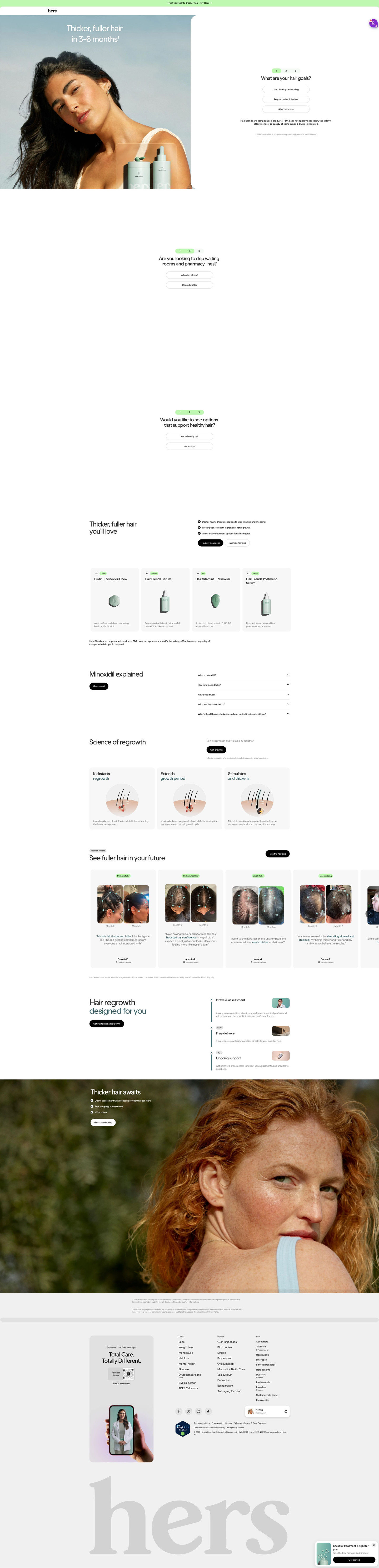
It lands on Hers's hair-loss consultation entry, which 37 ads in the Fluid library send people to. It's near the quiz end of the ladder: the hero pairs an outcome headline over a portrait with a step indicator and the first question, "What are your hair goals?", with one-tap answers. Below come a treatment lineup, ingredient and mechanism explainers, a before-and-after carousel and a process timeline. The quiz picks up the ad's invitation directly, but no price is visible on the page, so the $35 figure that drew a price-minded visitor isn't confirmed until after the intake.
The page it sends people to: How Hers turns its hair-loss page hero into a three-question intake
Hers's hair-loss consultation page starts the intake in the hero with a hair-goals question and two more one-tap prompts, then covers the treatment lineup, ingredient FAQs, before-and-after reviews and a three-step care timeline. 37 ads in the Fluid library send people here, including creator stories, problem-led videos and price-led ads.
How the page is built
- 01Announcement bar and header
One short invitation line with an arrow sits above a logo-only header, pointing straight at the consultation.
- 02Hero with first question
An outcome headline over a full-height portrait sits beside a step indicator and the hair-goals question with three pill answers, answering "what do I do first?" with a single tap.
- 03Intake steps 2 and 3
A convenience question about skipping waiting rooms and an interest question, each with two pill answers, keep the visitor moving before any health detail comes up.
- 04Value summary
Three check bullets (provider-made plans, ingredients, once-a-day options) and two buttons, Find my treatment and Take free quiz, answer "why do this online?"
- 05Treatment lineup
Four product cards with Rx and format tags (chew, serum, pill) and a one-line formula description answer "what would I actually take?"
- 06Ingredient explainer
Five FAQ accordions cover what the ingredient is, timing, how it works, side effects and oral versus topical, catching the questions a careful buyer asks before starting.
- 07Mechanism explainer
Three cards with illustrated cross-sections and a footnoted timeframe line show how the page says treatment works on the scalp.
- 08Before-and-after carousel
A Featured review tag, month-labeled photo pairs, quotes with bolded phrases, names and verified tags answer "has this worked for someone like me?" in customers' own words, with disclaimers.
- 09Process timeline
A vertical three-step timeline (intake and assessment, delivery, ongoing support) with small photos explains how remote care works from start to finish.
- 10Closing band
A full-bleed portrait with three check bullets (online assessment, free shipping if prescribed, fully online) and a Get started today button restates the easy path one last time.
- 11Footer
Legal footnotes, an app-download card, condition and treatment link columns, a certification badge and a floating quiz-prompt card close the page.
The first fixes we would make
- Price-led ads land here, yet the page shows no price; the ads' monthly figure is tied to a five-month plan paid upfront. Show the price with those plan terms in the value summary, so the visitor who clicked for the price knows what the commitment looks like before the intake rather than after it.
- The before-and-after carousel is the page's strongest match for the creator-story ads, and it sits well below the treatment lineup and two explainers. Move a single before-and-after card or a short review strip up to sit right after the intake prompts, so people who came for a real person's result see one early.
Read the full breakdown of this page
Three hooks you could test
- Sell the outcome. “Fuller by the next season, on a plan built for you.”
- Turn the benefit into a picture people get in a second. “Show the ponytail, not the bottle.”
- Lead with the uncomfortable problem. “Noticing more hair in the brush lately?”
What to borrow for your brand
- Write the outcome as something people can picture plus a season or date, so the promise comes with a timeline.
- Put the plan length right next to a monthly price, so the commitment is clear before the click.
- Test several headlines on the same product shot, so you learn which outcome line your buyers respond to.
One of 125 Hers ads in the Fluid Inspiration Library, captured from the Meta Ad Library on Oct 20, 2026. We record that an ad ran publicly, not how it performed.