How Cymbiotika pitches skin support to people losing weight
A static from Cymbiotika showing three liposomal packets (Vitamin C, Beauty Peptide Complex and NAD+) under the line "Three Formulas, Zero Overlap." The copy talks about skin during a major body transformation and gives each product one job. There's no price in the ad, and Learn More opens an advertorial about how losing weight changes your skin.

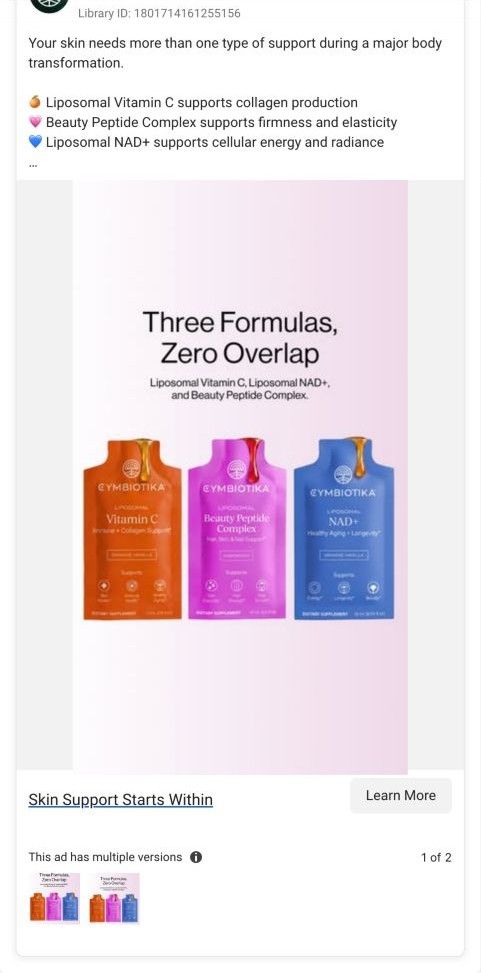
Creative, ad copy, and CTA link captured directly from Meta Ad Library on October 21, 2026. The linked destination was visited.

Skin Support Starts Within
Compare the education-led story with the purchase offer, ingredient explanations, and evidence presented on the page. Statements shown belong to the advertiser. Compare the creative with the destination and explore the other ads sharing this route.
- Brand
- Cymbiotika
- Observed offer
- Skin Support Starts Within
- Creative angle
- Education & problem awareness
- Page type
- Advertorial
- Ad format
- Image
- Listed start date
- Sep 17, 2026
- Captured
- Oct 21, 2026
- Library ID
- 1801714161255156
- Destination
- cymbiotika.com
Selected for its design and offer structure. Ad performance isn’t available in this collection.
What this ad does well
The ad makes a three-product bundle feel simple. The image puts three brightly colored packets side by side, and the copy gives each one a single line and a single job (collagen, firmness, cellular energy), so you understand why there are three before anyone asks. "Zero Overlap" answers the obvious objection to buying a stack, which is paying twice for the same thing. And the Learn More button is honest about what comes next: a page to read, not a checkout.
What's missing
The ad is shy about who it's for. The copy says "a major body transformation", while the landing page says weight loss and GLP-1 medications in its first lines, so the person this was made for may not realize it's speaking to them. The image also leads with the product idea rather than the worry that would stop a scroll. If you make one like this, put the reader's situation on the image itself (the page's own headline, about weight loss changing your skin, would do it) and keep the three packets underneath as the answer.
Beat by beat
- ImageThree packets in orange, pink and blue sit under the headline "Three Formulas, Zero Overlap."
It shows the whole protocol at once and pre-empts the worry that a three-product stack is redundant.
- HeadlineThe link headline reads "Skin Support Starts Within" with a Learn More button.
It frames the products as something you take rather than apply, which is the idea the advertorial goes on to explain.
- CopyThe copy names a major body transformation, then gives each formula one line with a colored emoji to match its packet.
Matching each emoji to a packet color lets the reader connect product to claim without studying the image.
Where it sends people
This one lands on a focused advertorial, a better rung than a product page because the whole page is built around one problem. It opens with the headline about losing weight changing your skin, names GLP-1 medications, then walks through eight numbered reasons before it reaches a buy box. It picks up the ad's three products, but the section introducing the buy box calls it a two-step protocol while the ad and the FAQ ("Why three products?") talk about three, and that's worth cleaning up. The page closes with a week-by-week timeline, a risk-free block with a 60-day money-back guarantee, and a list of cited studies.
The page it sends people to: How Cymbiotika's weight-loss skin advertorial is built
An advertorial from Cymbiotika titled around how losing weight changes your skin. It names GLP-1 medications up front, works through eight numbered reasons, adds experts and a comparison table, then sells a skin protocol with a week-by-week timeline, a guarantee and citations. One ad in the Fluid library sends people here, a static about three formulas for skin.
How the page is built
- 01Hero
A headline about weight loss changing your skin, a GLP-1 mention and a Start the Protocol button answer who this page is for.
- 02Trust bar
Four short claims (clinically studied ingredients, no artificial additives, liposomal delivery, made in the USA) answer whether the brand is careful.
- 03The Problem
A short block on rapid weight loss putting collagen and elasticity under pressure answers why the reader's skin is changing, in the brand's words.
- 04Eight numbered reasons
Alternating photo-and-text rows, each linking a claim to an ingredient, answer what the brand says each product does.
- 05Backed by Experts
Three portrait cards for named experts answer who stands behind the formulas.
- 06Why Cymbiotika Is Different
A comparison table against conventional supplements answers why this over a cheaper option.
- 07Protocol buy box
A section titled Now You Know What's Happening with a Beauty Peptide Complex buy box and two more products answers how to buy the protocol.
- 08Week by week
A four-stage timeline from weeks 1-2 to weeks 8-12+ answers what to expect and when.
- 09FAQ
Questions on why three products, collagen powder, when to start and GLP-1 users answer the last objections.
- 10Risk-free block
A Start the Protocol Risk-Free panel with a 60-day money-back guarantee and third-party testing answers what happens if it doesn't suit you.
- 11Cited research
Cards listing five studies by topic answer where the claims come from.
The first fixes we would make
- The buy section calls it a two-step protocol while the ad, the product carousel and the FAQ all talk about three products. Make the count match everywhere, because a reader deciding on three purchases notices the inconsistency.
- The section headed "Don't Just Take Our Word for It" is empty in our capture. Put customer reviews from people in this exact situation there, since this page has expert and study proof but no customer voice.
Read the full breakdown of this page
Three hooks you could test
- Lead with the uncomfortable problem. “The scale moved. Now your skin looks tired. Here's why.”
- Turn the benefit into a picture people get in a second. “Three packets, three jobs, nothing doubled up.”
- Call out the habit you're replacing. “Another serum won't reach where this problem starts.”
What to borrow for your brand
- When you sell a stack, give each product one line and one job in the copy so the reader sees why they need all of them.
- Answer the redundancy objection on the creative itself with a short promise like "zero overlap" before anyone has to ask.
- Match emoji or icons in the copy to the packaging colors so readers link each claim to the right product without effort.
One of 12 Cymbiotika ads in the Fluid Inspiration Library, captured from the Meta Ad Library on Oct 21, 2026. We record that an ad ran publicly, not how it performed.