

Bio.meSponsored
Esc
How Bio.me answered what's different about its fiber
A 39-second comment-reply video for Bio.me. A creator holds the Daily Prebiotic Fiber pouch and answers a viewer asking what's different about this fiber, saying it's a prebiotic, then covering 7g per scoop, a spinach comparison and how she takes it. No price. It ran on Meta from Sep 18, 2026 and links to the product page.
Bio.me
18 creatives lead here1 / 18
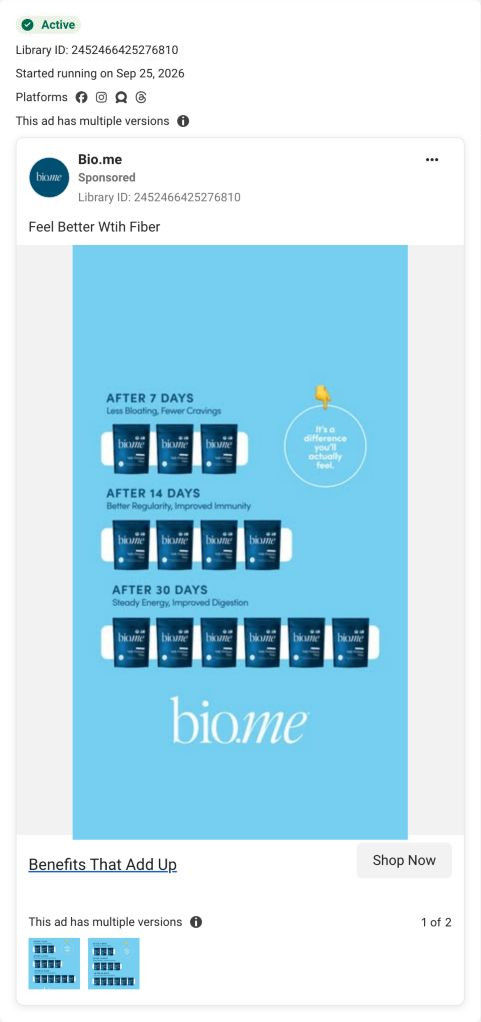
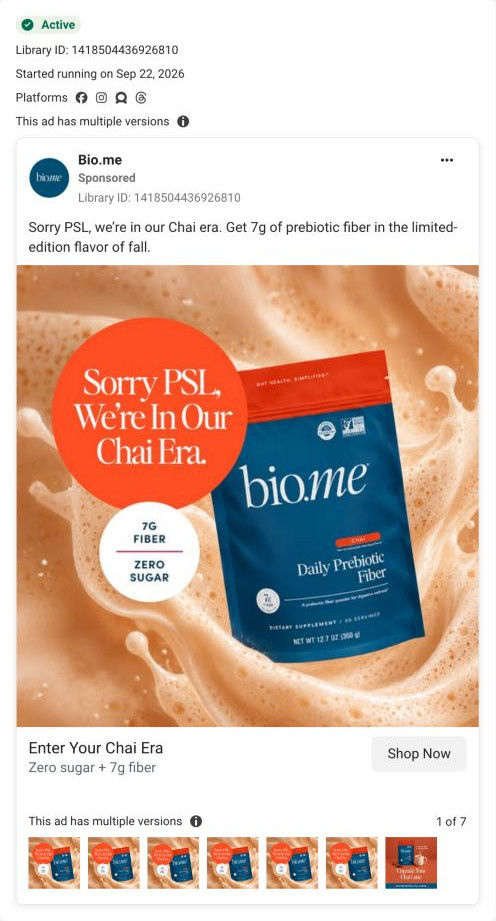
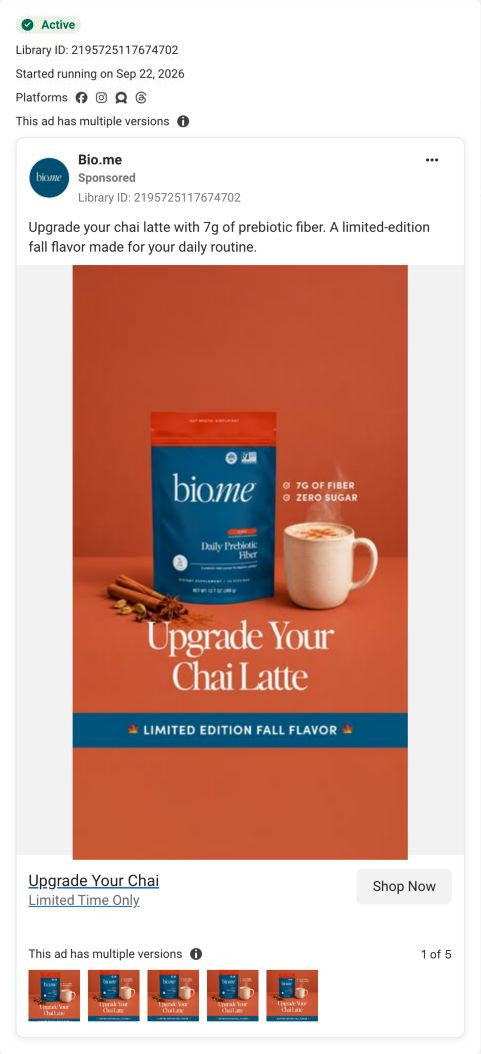
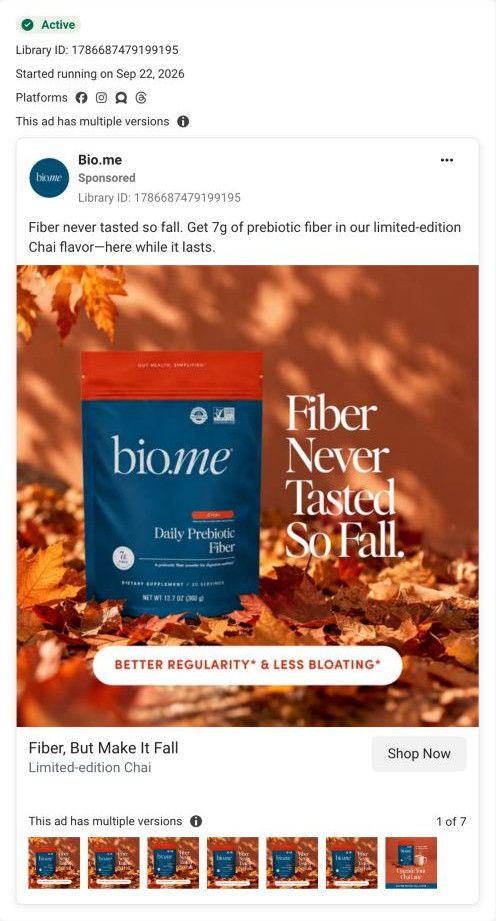
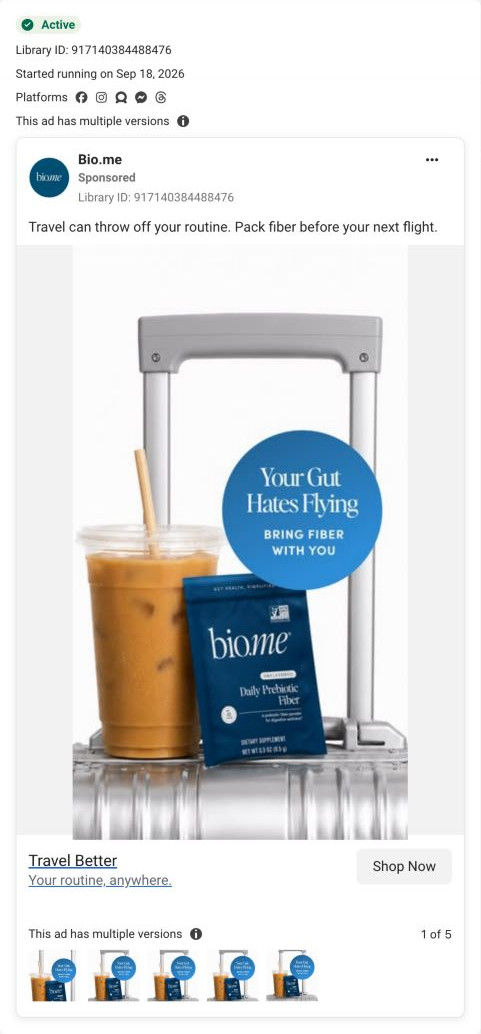
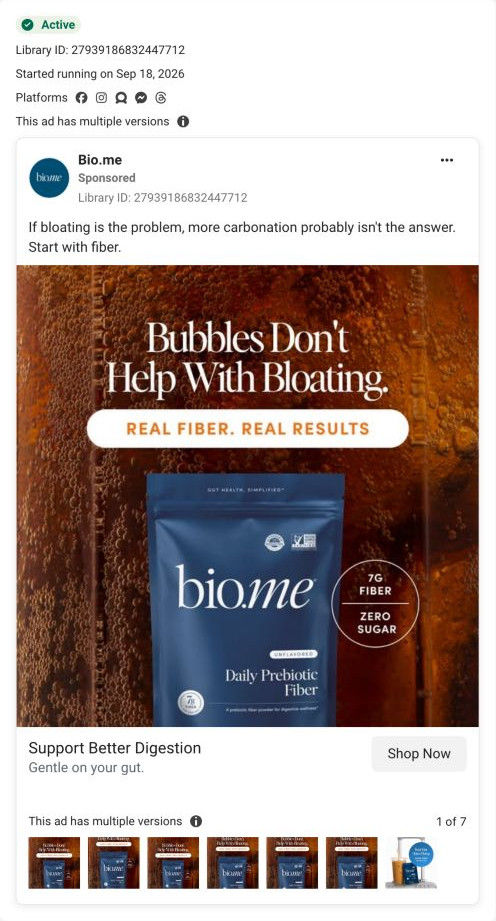
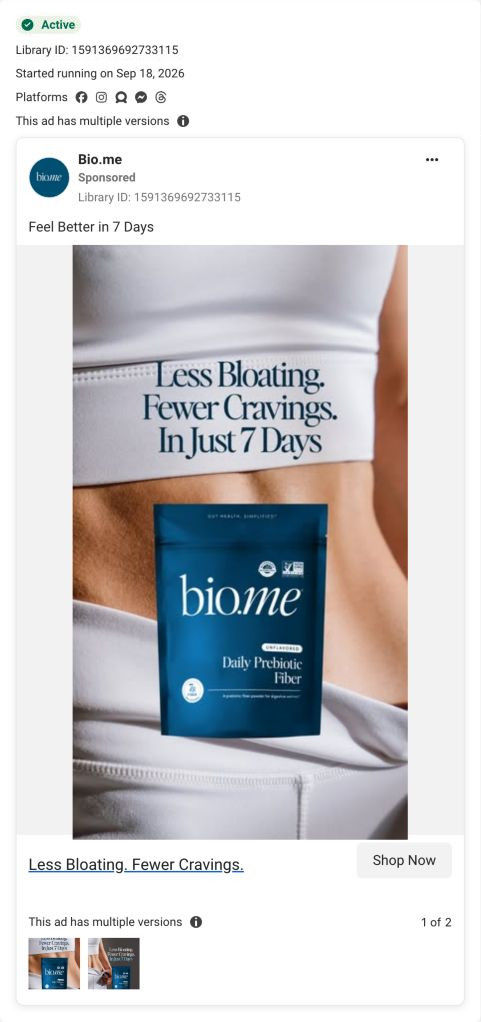
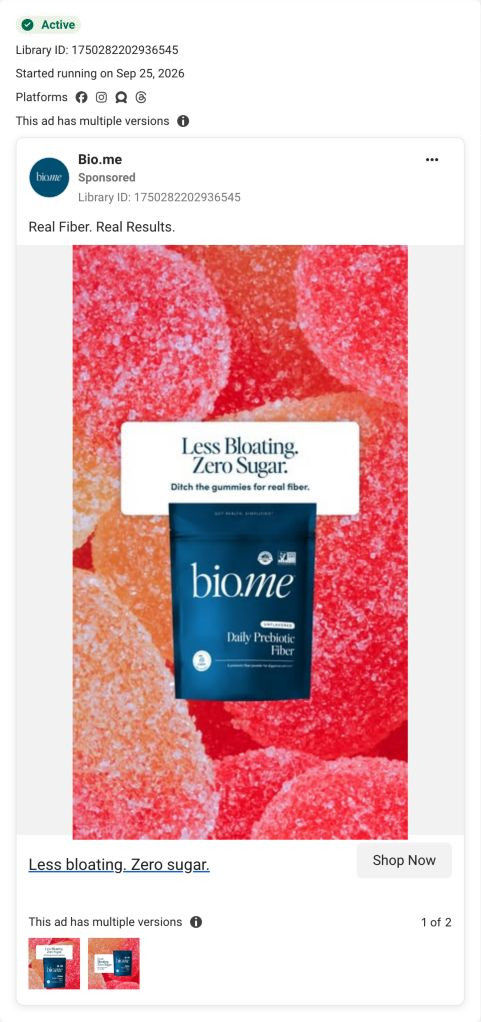


Bio.me · Daily Prebiotic Fiber
Advertiser benefit claims are shown as advertising examples. The landing page was captured on October 20, 2026 and may show a different offer from the ad.
Bio.me Daily Prebiotic Fiber
A creator replies to a viewer question about what makes this fiber different while holding the pouch. Compare the creative with the destination and explore the other ads sharing this route.
- Brand
- Bio.me
- Observed offer
- Fiber comparison explainer; no price or discount stated
- Creative angle
- Product education
- Page type
- Product page
- Ad format
- Video · 0:39
- Listed start date
- Sep 18, 2026
- Captured
- Oct 20, 2026
- Library ID
- 4720779754874616
- Destination
- bio.me
Selected for its design and offer structure. Ad performance isn’t available in this collection.
What this ad does well
The question on screen, what's different about THIS fiber, is one a shopper comparing powders really asks, and the comment overlay makes the ad feel like a reply rather than a pitch. She answers right away with the word prebiotic and explains it plainly (it feeds the good gut bacteria, in her words). The rest of the body carries the same concrete details as her other Bio.me ads in the library: 7g per scoop, a 10-cups-of-spinach comparison, and coffee, water or a smoothie once a day.
What's missing
The answer doesn't fully match the question. She explains what a prebiotic is and lists claims about gut health, skin and sleep (all attributed to her), but never compares Bio.me to another fiber, so a shopper still doesn't know what's different. If you make one like this, answer the comparison directly: put your ingredient count, grams per scoop and texture next to the typical alternative on screen. Then the closing line has earned its call to action.
Beat by beat
- 0-3sA comment overlay asks what's different about this fiber while she holds the pouch.
It voices a shopper's comparison question so the ad opens as an answer.
- 3-10sShe says it's a prebiotic fiber that feeds good gut bacteria and supports gut health, skin and sleep.
It defines the category in plain words, attributed to her.
- 10-22sShe covers two ingredients, 7g per scoop and a 10-cups-of-spinach comparison.
The comparison makes the gram count tangible.
- 22-32sShe says there are no fillers and she mixes it into coffee, water or a smoothie once a day.
It shows the habit is simple.
- 32-39sShe closes with this is your sign to start.
It's a soft call to action for people who've been putting fiber off.
Where it sends people
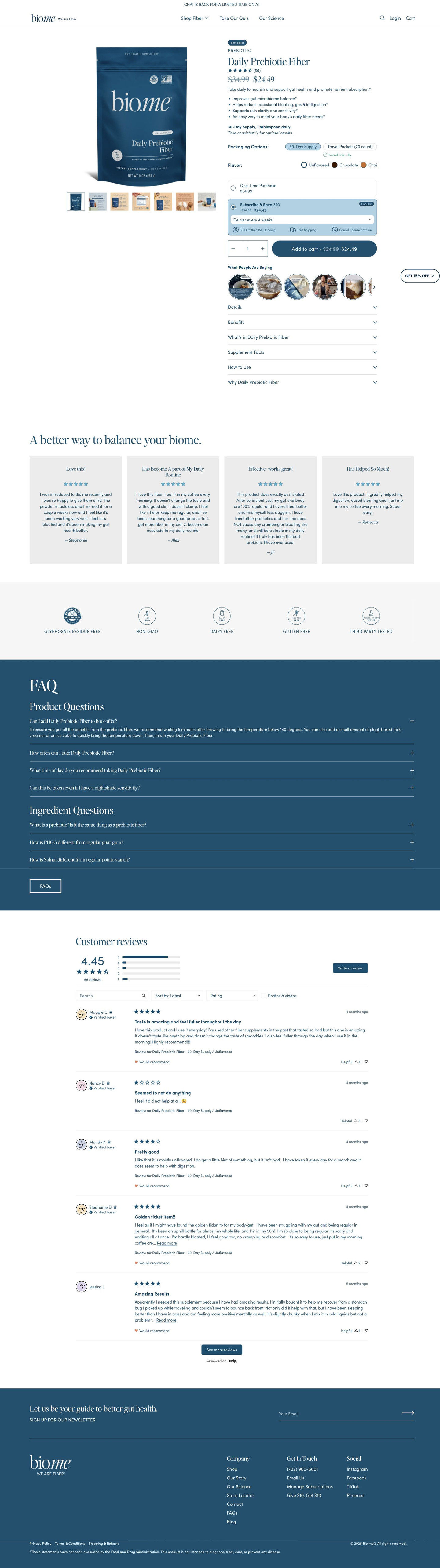
It sends people to the Daily Prebiotic Fiber product page, which sits on the weakest rung of the landing-page ladder (a standard product page rather than a page built around one problem, or the quiz Bio.me already links in its header). The buy box category label says Prebiotic, and the accordions include a why-this-product panel, which is the right place to answer her question. But the blueprint shows no comparison table, so the page leaves the same gap as the ad. A simple table near the trust strip (Bio.me versus a typical fiber powder) would make the answer visible.
The page it sends people to: How Bio.me's Daily Prebiotic Fiber page sells a subscription
Bio.me's Daily Prebiotic Fiber product page is short and subscription-first: the buy box carries the price, flavors, a pre-selected Subscribe & Save card and customer videos, with reviews, trust icons and an FAQ below. 18 ads in the Fluid library send people here, from Chai launch statics and habit-switch images to creator stories and comment replies.
How the page is built
- 01Announcement bar
A single limited-time line about the seasonal Chai flavor answers whether there's anything new worth buying now.
- 02Buy box
A pack shot with a gallery of infographic, lifestyle and supplement-facts images sits beside the badge, rating, price, a one-line promise, benefit bullets, a dosage line and the packaging and flavor selectors, answering what it is, what it costs and which version to pick.
- 03Purchase options
A one-time card and a pre-selected Subscribe & Save card with a delivery dropdown and perk icons answer how to save and whether a subscription locks you in.
- 04Customer videos
A row of round UGC thumbnails titled What people are saying sits directly under Add to cart and answers whether real people use it.
- 05Buy-column accordions
Details, benefits, ingredients, supplement facts, how to use and why this product answer the label reader's questions without making the page longer.
- 06Review highlight
A headline and quote cards with titles, stars and first names answer whether it works for people like the buyer, in customers' words.
- 07Trust strip
Line icons for residue free, non-GMO, dairy free, gluten free and third-party tested answer whether it's clean and safe to try.
- 08FAQ
Product and ingredient questions on a brand-color band handle the remaining objections before checkout.
- 09Full reviews
An average rating, distribution bars, search, sort and filters let a careful buyer dig into the reviews.
- 10Newsletter and footer
A newsletter band and the footer with the supplement disclaimer catch visitors who aren't ready to buy.
The first fixes we would make
- Many of the ads sell a specific flavor or format (Chai, Chocolate, travel packets), but the observed page opens on the Unflavored 30-day pouch. Link each ad to its matching variant so the selector and main image already show what the click promised.
- Several ads lead with bloating, while the page's opening promise is broad gut health. Build a bloating landing page, or route those ads into the quiz Bio.me already links in its header, so the page starts on the problem the ad named.
Read the full breakdown of this page
Three hooks you could test
- Lead with the uncomfortable problem. “You asked what makes this one different. Here it is, side by side.”
- Turn the benefit into a picture people get in a second. “Two ingredients versus the long list on the bag you have now.”
- Make the product the whole scene. “Everything in this pouch fits on one line of the label.”
What to borrow for your brand
- Answer the comparison question shoppers actually type in the comments, with your product in hand from the first frame.
- Define your product category in one plain sentence before you list any benefits.
- Reuse a strong body script under a new comment-reply opener, the way Bio.me runs this creator's script under several questions.
Transcript
This is a plebiotic fiber, so it feeds your good gut bacteria, but also supports your overall gut health, skin, and even your sleep. On top of that, bio needs daily fiber, fiber is made with 2 clinically proven ingredients with 7 grams of fiber in every single scoop. That's like 10 cups of spinach. There's no fillers, no weird additives, just gentle fiber that actually works. It won't leave you feeling bloated. I mix it into my coffee, my water, even a smoothie once a day, and that's it. If you've ignored your fiber until now, this is your sign to start. Your gut? Well, thank you.
Text on screen
- Reply to Natalle.Sor12's comment
- Okay, but what's different
- about THIS fiber?
- This is a prebiotic fiber,
- Dally Prehitk
- so it feeds your good gut bacteria
- Diame
- Daily Prebitic
- Reply to Natalle Sor12's comment
- but also supports your
- biome
- Daily Prebiotic
- File
- overall gut health.
- skin, and even your sleep.
- On top of that, Bio.me's Daily
- Daily Pretir
- Daily Probic
- is made with two clinically proven ingredients
- Daily Probie
- with 7 grams of fiber in every single scoop.
- Daily Prebioti
- That's like 10 cups of spinach.
- Daily Prebick
- There's no fillers, no weird additives.
- There's no fillers, no weird additives,
- just gentle fiber that actually works.
- It won't leave you feeling bloated.
- I mix it into my coffee, my water.
- even a smoothie
- Once a day and that's it.
- If you've ignored your fiber until now.
- this is your sign to start.
- Your gut will thank you.
One of 20 Bio.me ads in the Fluid Inspiration Library, captured from the Meta Ad Library on Oct 20, 2026. We record that an ad ran publicly, not how it performed.